Why Do Rockets Use Multiple Stages?

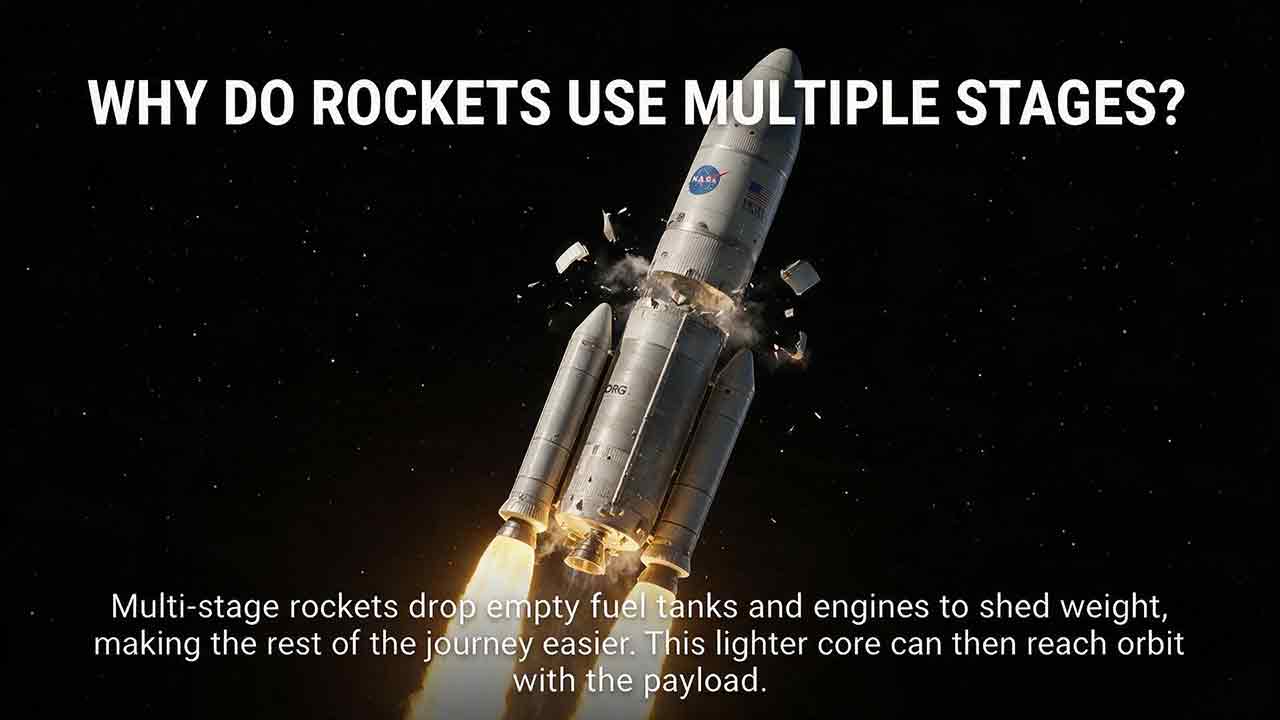
Why Do Rockets Use Multiple Stages?
Rockets use multiple stages because dropping tanks, engines, and structure that have finished their job makes the remaining vehicle much lighter. Each upper stage can therefore accelerate the payload without carrying the empty hardware below it. Staging also allows different engines to be optimized for liftoff, atmospheric flight, vacuum operation, precise orbital insertion, or deep-space departure.
Key Takeaways
- A rocket stage is a powered section that can separate after completing its part of the mission.
- Discarding an exhausted stage improves performance by removing dry mass that later engines would otherwise have to accelerate.
- Lower stages usually prioritize high thrust, while upper stages often prioritize efficiency, low mass, precise control, and restart capability.
- More stages can increase performance, but they also add structure, separation systems, cost, testing requirements, and failure points.
- The best staging arrangement depends on the payload, destination, propulsion technology, recovery plan, and acceptable complexity.
This guide explains the physics behind rocket staging, follows a typical launch sequence, compares common architectures, and uses an original simplified calculation to show why a two-stage rocket can outperform a similar single-stage design.
What Is a Rocket Stage?
A rocket stage is a major section of a launch vehicle containing propellant tanks, one or more engines, structure, plumbing, controls, and supporting equipment. After the stage has used most of its useful propellant, it may shut down and separate from the rest of the vehicle.
The stage that operates first is usually called the first stage, lower stage, or booster stage. A stage that continues the flight after separation is called an upper stage.
These related terms describe different parts of the system:
| Term | Meaning |
|---|---|
| Propellant | The fuel and oxidizer consumed by a rocket engine |
| Dry mass | Tanks, engines, structure, equipment, and other hardware without usable propellant |
| Payload | The satellite, spacecraft, cargo, or crewed vehicle being transported |
| Booster | A propulsion unit that adds thrust, often beside the main vehicle |
| Stage separation | The controlled release of one powered section from another |
| Delta-v | A measure of how much a vehicle can change its velocity |
| Specific impulse | A standard measure of how effectively a rocket engine uses propellant |
| Mass ratio | The vehicle’s mass before a burn divided by its mass after the burn |
Stage-count conventions are not always identical. Some descriptions count strap-on boosters as a separate stage, while others count only the serially stacked powered sections and list the boosters separately. For that reason, the physical configuration is often more informative than the number assigned to it.
Stage separation therefore requires dedicated hardware, timing logic, structural interfaces, and sequencing that can release the spent stage without damaging or destabilizing the remaining vehicle.
Why Does Dropping an Empty Stage Improve Performance?
Dropping an exhausted stage improves performance because the remaining engines no longer have to accelerate that stage’s tanks, engines, plumbing, insulation, recovery equipment, and structural supports.
A stage that has completed its burn is not literally empty or weightless. It may still contain residual propellant, pressurization equipment, avionics, engine hardware, landing systems, and a large supporting structure. Once the stage can no longer provide useful propulsion, carrying it farther reduces the velocity available to the payload.
At liftoff, the first stage must accelerate:
- Its own engines and tanks
- Its own propellant
- Every upper stage
- All upper-stage propellant
- The payload
- The payload fairing and adapters
The rocket becomes lighter as it consumes propellant. Stage separation creates an additional and more sudden reduction in mass by removing hardware that has finished its job.
NASA Glenn describes staging as the process of discarding part of a launch vehicle so that a lighter upper stage can continue accelerating toward orbital velocity. Reaching orbit requires not only altitude but also enough horizontal speed to keep falling around Earth rather than returning directly to the surface.
Reaching orbit therefore requires both altitude and enough horizontal velocity for continuous free fall around Earth.
How Does a Multistage Rocket Work Step by Step?
The exact sequence varies among launch vehicles, but a typical two-stage orbital launch follows seven major steps.
1. The First Stage Lifts the Entire Rocket
At liftoff, the first-stage engines must produce more thrust than the rocket’s weight. The first stage carries the complete upper vehicle, so it normally produces far more thrust than any later stage.
The rocket initially climbs steeply to clear the launch area and move through the densest part of the atmosphere. As propellant is consumed, the vehicle’s mass decreases and its acceleration can increase.
2. The Rocket Turns Toward the Horizon
A rocket does not enter orbit by traveling straight upward. It must develop enough horizontal velocity to follow a curved path around Earth.
Soon after liftoff, the guidance system gradually pitches the vehicle away from vertical. The rocket continues climbing, but an increasing share of its thrust is used to build horizontal speed.
Altitude determines whether a spacecraft is above most of the atmosphere. Horizontal velocity determines whether it remains in orbit.
3. The First-Stage Engines Shut Down
When the first stage has nearly completed its planned propellant burn, its engines shut down. Launch providers may describe this event as main engine cutoff, booster engine cutoff, first-stage engine cutoff, or a vehicle-specific abbreviation.
A planned engine cutoff is not a failure. It means the stage has reached the end of its scheduled powered flight.
4. The Stages Separate
Mechanical connections between the stages are released. Springs, pneumatic pushers, separation motors, or other systems create distance between the completed lower stage and the remaining vehicle.
The event must be carefully controlled. A stage that separates too slowly could strike the upper stage, while an unexpected rotation could place the vehicle outside acceptable guidance limits.
5. The Upper Stage Ignites
After adequate clearance has been established, the upper-stage engine begins its burn. The upper stage now carries only its own hardware, its remaining propellant, and the payload.
Even if the upper-stage engine produces much less thrust than the first stage, it can still add a large amount of velocity because it is accelerating a far lighter vehicle.
6. The Upper Stage Shapes the Trajectory
An upper stage may burn continuously until orbital insertion, or it may shut down and restart after a coast period.
Multiple burns can be used to:
- Circularize an orbit
- Raise or lower an orbital altitude
- Change the timing of payload deployment
- Release payloads into different orbits
- Begin a lunar or planetary transfer
- Move the upper stage onto a disposal trajectory
7. The Payload Separates
After the target trajectory has been established, the payload separates from the upper stage. The payload may then deploy antennas, solar arrays, instruments, or its own propulsion system.
The upper stage may be passivated, deorbited, transferred into a disposal orbit, or left on another planned trajectory.
The protective payload fairing is usually discarded earlier, once atmospheric heating and aerodynamic loads have fallen sufficiently. Fairing separation removes the aerodynamic shell around the payload, whereas stage separation discards a propulsion section that has completed its primary job.
How Does the Rocket Equation Explain Staging?
The ideal rocket equation, commonly called the Tsiolkovsky rocket equation, relates a rocket’s velocity capability to its engine efficiency and mass ratio:
Δv = Isp × g₀ × ln(m₀ / mf)
Where:
Δvis the ideal change in velocityIspis specific impulse in secondsg₀is standard gravitational accelerationm₀is the mass before the burnmfis the mass after the burnlnis the natural logarithm
NASA Glenn’s educational derivation expresses the same relationship through effective exhaust velocity and mass ratio. It also explains the relationship between effective exhaust velocity and specific impulse.
The critical term for staging is m₀ / mf.
A rocket gains more ideal delta-v when it carries a large amount of propellant relative to the mass that remains after the burn. Empty tanks, engines, and structure increase that remaining mass without providing additional propellant.
Stage separation reduces the mass that begins the next burn. The discarded lower-stage hardware is no longer included in the upper stage’s mass ratio.
Mission designers use delta-v budgets to allocate the required velocity changes among launch, staging, orbital insertion, maneuvers, and reserves while accounting for real losses and margins.
What Does the Ideal Equation Leave Out?
The equation is valuable for comparison, but it does not represent a complete launch simulation.
A real rocket must also overcome:
- Gravity losses while the engines support the vehicle against Earth’s gravity
- Atmospheric drag
- Steering and trajectory losses
- Propellant reserves
- Residual propellant that cannot be consumed
- Engine throttling and shutdown margins
- Changing engine performance with altitude
- Structural and thermal constraints
- Guidance corrections
- Recovery maneuvers, when a stage is reusable
For this reason, ideal delta-v should not be treated as a guarantee that a vehicle can reach a particular orbit.
How Much Difference Can Staging Make?
The following original educational comparison uses two hypothetical rockets with the same starting mass, payload, and engine efficiency.
It is designed to isolate the effect of dropping hardware. It is not a proposed launch vehicle or a prediction of real flight performance.
Shared Assumptions
Both configurations:
- Begin with 100 mass units
- Carry a payload of 2 mass units
- Use a constant specific impulse of 350 seconds
- Use standard gravity of approximately 9.80665 meters per second squared
- Are evaluated with the ideal rocket equation
- Ignore drag, gravity losses, steering losses, reserves, and changing engine performance
A mass unit could represent any consistent unit. It does not specifically mean kilograms, tonnes, or pounds.
Single-Stage Configuration
| Component | Mass units |
|---|---|
| Propellant | 88 |
| Tanks, engine, and structure | 10 |
| Payload | 2 |
| Initial mass | 100 |
| Mass after the burn | 12 |
The ideal delta-v is:
Δv = 350 × 9.80665 × ln(100 / 12)
Result: approximately 7.28 kilometers per second.
The single-stage vehicle must accelerate all 10 units of tanks, engine hardware, and structure throughout the entire burn.
Two-Stage Configuration
The same 100-unit starting mass is divided as follows:
| Component | Propellant | Dry hardware | Payload |
|---|---|---|---|
| First stage | 70 | 8 | — |
| Second stage | 17 | 3 | 2 |
| Total | 87 | 11 | 2 |
The staged configuration contains one unit less propellant and one unit more dry hardware than the single-stage configuration. This prevents the comparison from giving the staged rocket an artificial structural advantage.
First-Stage Burn
The complete vehicle begins at 100 mass units. After consuming 70 units of first-stage propellant, it has a mass of 30 units.
Δv₁ = 350 × 9.80665 × ln(100 / 30)
First-stage ideal delta-v: approximately 4.13 kilometers per second.
The eight-unit first-stage structure is then discarded. The upper-stage vehicle begins its own burn with a mass of 22 units.
Second-Stage Burn
The second stage begins at 22 mass units. After consuming its 17 units of propellant, 5 units remain:
- 3 units of upper-stage hardware
- 2 units of payload
Δv₂ = 350 × 9.80665 × ln(22 / 5)
Second-stage ideal delta-v: approximately 5.09 kilometers per second.
Combined Comparison
| Configuration | Ideal delta-v |
|---|---|
| Single stage | 7.28 km/s |
| Two stages | 9.22 km/s |
| Difference | 1.94 km/s |
The two-stage configuration provides approximately 1.94 kilometers per second more ideal delta-v in this simplified comparison.
The gain does not come from using a better engine or carrying more propellant. It comes from removing eight mass units of first-stage hardware before the upper-stage burn.
Original Mass-Flow Map
Single-stage path:
100 units at ignition → 12 units after the burn
Remaining mass: 10 units of hardware + 2 units of payload
Ideal result: 7.28 km/sTwo-stage path:
100 units at first-stage ignition → 30 units after the first burn
30 units → 22 units after first-stage separation
22 units → 5 units after the second burn
Remaining mass: 3 units of hardware + 2 units of payload
Combined ideal result: 9.22 km/s
Figure 1. Original mass-flow comparison showing where stage separation removes eight units of completed hardware before the second burn.
Recommended image alt text: “Comparison of a 100-unit single-stage rocket and two-stage rocket showing first-stage separation reducing mass from 30 to 22 units and increasing ideal delta-v from 7.28 to 9.22 kilometers per second.”
Calculation Check
The comparison should be interpreted with five boundaries in mind:
- The mass values are hypothetical units, not measured vehicle specifications.
- Both vehicles use the same assumed specific impulse of 350 seconds.
- The two-stage result is the sum of two separate ideal burns.
- The calculation excludes gravity, drag, steering, reserves, and changing engine performance.
- A result of 9.22 km/s does not prove that the hypothetical vehicle could place its payload into orbit.
The example demonstrates the mass-ratio benefit of staging, not the complete feasibility of a rocket design.
Why Do Lower and Upper Stages Use Different Engines?
Lower and upper stages use different engines because they operate with different vehicle masses, atmospheric pressures, burn durations, and mission requirements.
Why Do First Stages Need High Thrust?
The first stage must lift the entire launch vehicle from the pad. It must also accelerate the rocket through the lower atmosphere while maintaining control under aerodynamic loads.
Common first-stage priorities include:
- High total thrust
- Strong thrust-to-weight performance
- Reliable ignition on or near the ground
- Structural durability
- Stable operation at sea-level pressure
- Effective steering during atmospheric flight
- Throttling to manage acceleration and aerodynamic loads
- Recovery capability when reuse is planned
A highly efficient engine is not sufficient at liftoff if the complete vehicle cannot produce enough thrust to rise safely.
Why Do Upper Stages Prioritize Efficiency?
An upper stage begins operating after much of the original rocket has been discarded. It does not need to lift the entire launch vehicle, so it can use a smaller engine and accelerate more gradually.
Upper-stage priorities often include:
- High specific impulse
- Low dry mass
- A nozzle optimized for low pressure or vacuum
- Accurate guidance
- Long-duration coasting
- Reliable restart capability
- Precise shutdown timing
- Controlled disposal after payload deployment
A vacuum engine often uses a larger expansion nozzle than a sea-level engine. The larger nozzle allows exhaust gases to expand more effectively in low external pressure, but the same design may be unsuitable in the dense lower atmosphere.
Upper-stage engines are therefore optimized for low-pressure or vacuum operation, often using larger expansion ratios because they do not need to fit the same sea-level operating constraints as first-stage engines.
Specific impulse is useful, but it is not the only measure of engine quality. Engineers must also consider thrust, engine mass, reliability, cost, restart capability, propellant storage, manufacturing limits, and mission duration.
What Types of Rocket Staging Are Used?
Launch vehicles can discard propulsion hardware in several ways.
What Is Serial Staging?
Serial staging places powered stages one above another. The lower stage operates first, separates, and is followed by the next stage.
This arrangement creates a clear mass reduction between major burns and is common in orbital launch vehicles.
What Is Parallel Staging?
Parallel staging uses boosters mounted beside a central stage. The boosters and core may operate at the same time during the early ascent.
When the boosters complete their burns, they separate while the central stage continues operating. This arrangement adds liftoff thrust without necessarily requiring a larger core-stage engine.
What Is Combined Staging?
Many launch vehicles combine parallel and serial staging.
A typical sequence may include:
- Strap-on boosters and the core stage operating together
- Booster separation
- Continued core-stage operation
- Core-stage separation
- Upper-stage ignition
- One or more upper-stage burns
This architecture can provide strong liftoff performance while preserving the mass benefits of an upper stage.
What Are Drop Tanks?
A drop-tank design discards empty propellant tanks while retaining one or more engines.
Keeping the engine can reduce engine duplication, but it also requires that the retained propulsion system work across a wider range of flight conditions. The attachment, plumbing, and separation systems can also become complex.
Drop tanks are less common than conventional staging on large operational orbital launch vehicles.
Which Is Better: One Stage, Two Stages, or Three Stages?
No stage count is universally best. The preferred architecture is the one that meets the mission requirement with an acceptable balance of payload performance, reliability, complexity, cost, and operational risk.
| Architecture | Main advantage | Main limitation | Commonly suited to |
|---|---|---|---|
| Single stage | Fewer major propulsion sections and separation events | Carries all hardware throughout powered flight | Some suborbital vehicles and lower-delta-v missions |
| Two stages | Strong performance without excessive stage duplication | Requires a major separation and upper-stage ignition | Many orbital launch missions |
| Three or more stages | Can divide the velocity requirement among specialized sections | More engines, interfaces, and separation events | High-energy missions or lower-performance propulsion systems |
| Core plus boosters | Adds early thrust and supports modular configurations | Adds attachment and booster-separation hardware | Heavy payloads and adaptable launch families |
| Reusable first stage plus upper stage | Recovers valuable lower-stage hardware | Recovery consumes mass, propellant, and operational effort | Programs prioritizing repeated use |
Stage count alone does not determine payload capability. Vehicle size, engine efficiency, structural mass, propellant choice, launch site, trajectory, recovery strategy, and destination can be equally important.
When Is Another Stage Worth Adding?
A useful decision framework begins with five questions.
1. How Much Delta-v Does the Mission Require?
A suborbital research rocket does not require the same performance as a vehicle placing a satellite into orbit or sending a spacecraft toward another planet.
The higher the required delta-v, the more costly it becomes to carry exhausted hardware through later parts of the mission.
2. Is the Main Problem Thrust or Velocity?
Liftoff thrust and total velocity capability are different design problems.
- If the rocket cannot produce enough thrust at liftoff, additional boosters may help.
- If it needs more velocity after leaving the lower atmosphere, a more capable upper stage may be more useful.
- If both are insufficient, the entire vehicle architecture may need to change.
3. Can the Existing Design Meet the Requirement With Margin?
A vehicle must support not only the nominal trajectory but also reserves, guidance corrections, performance variation, structural margins, and operational constraints.
If the required single-stage mass ratio becomes structurally unrealistic, adding a stage may be more practical than continuing to enlarge the tanks.
4. Does the Mission Require Coasting or Restarting?
A restartable upper stage can perform several burns separated by coast periods.
That capability may allow the same stage to:
- Establish a parking orbit
- Restart for a transfer burn
- Deploy payloads at different times
- Refine the final orbit
- Conduct a disposal burn
In some cases, adding restart capability provides more mission value than adding another complete stage.
5. Does the Performance Gain Justify the Complexity?
Each new stage introduces engines, tanks, structural interfaces, control systems, connectors, software events, and test requirements.
An attractive ideal delta-v gain may not justify an additional stage if it creates too much dry mass, cost, operational burden, or reliability risk.
Why Do Rockets Not Use an Unlimited Number of Stages?
More stages are not automatically better because every stage carries equipment that does not directly become payload.
A functional stage may require:
- At least one engine
- Propellant tanks
- Tank walls and supports
- Valves and feed lines
- Avionics
- Electrical connections
- Thermal protection
- An interstage
- Separation hardware
- Guidance and control equipment
- Testing and integration work
These components cannot be made arbitrarily small or massless.
Dividing a vehicle into many short-burning stages can also create operational problems:
- More ignition events
- More opportunities for failed separation
- Shorter and harder-to-control burns
- Greater hardware duplication
- More complex ground integration
- Larger testing programs
- More debris or recovery zones
- Poorer manufacturing economics
Rocket designers therefore search for an optimum stage count rather than the maximum possible number.
What Are the Main Benefits and Costs of Staging?
The central engineering trade-off can be summarized in one table.
| Benefit | Corresponding cost or limitation |
|---|---|
| Removes completed dry mass | Requires separation hardware |
| Improves later-stage mass ratio | Adds structural interfaces |
| Allows specialized engines | May duplicate engines and avionics |
| Increases payload or velocity capability | Increases design and testing complexity |
| Supports coast-and-restart missions | Requires reliable ignition after coasting |
| Enables booster or upper-stage modularity | Creates more vehicle configurations to qualify |
| Can support lower-stage reuse | Recovery reduces ascent performance |
| Allows controlled disposal strategies | Disposal maneuvers require propellant and planning |
The correct design is not the one with the highest theoretical performance in isolation. It is the one that completes the intended mission within acceptable technical, financial, and operational constraints.
Can a Rocket Reach Orbit Without Staging?
A single-stage-to-orbit vehicle is physically possible in principle, but an Earth-launched chemical rocket faces extremely demanding mass requirements.
An SSTO vehicle cannot improve its late-flight mass ratio by dropping a completed propulsion section. It must carry its engines, tanks, structure, control systems, thermal protection, and any recovery hardware all the way to orbital velocity.
Small changes in the following factors can determine whether an SSTO design closes:
- Structural mass
- Engine efficiency
- Payload mass
- Propellant reserves
- Thermal protection
- Landing or recovery hardware
- Required orbit
- Launch-site conditions
- Operational safety margins
This does not mean staging is always mandatory under every possible condition. A vehicle launched from a smaller celestial body, using a different propulsion system, or serving a lower-velocity mission would face different constraints.
This discussion specifically concerns Earth-launched chemical vehicles. It should not be applied without qualification to lunar launches, air-launched concepts, electromagnetic launch systems, or future nonchemical propulsion.
How Do Real Rockets Use Staging Differently?
Four launch vehicles illustrate how staging can be adapted to different mission priorities.
How Did Saturn V Use Three Stages?
The Saturn V used three powered stages for Apollo lunar missions.
The first stage provided enormous thrust during the opening portion of ascent. The second stage continued accelerating the vehicle after the first stage separated. The third stage completed orbital insertion and could later restart for a simulated or actual translunar injection maneuver.
During Apollo 4 on November 9, 1967, the S-IVB third stage first placed the spacecraft into a parking orbit and then reignited after two orbits for a simulated translunar injection burn. NASA identifies Apollo 4 as the first all-up flight test of the three-stage Saturn V.
This architecture assigned distinct tasks to three propulsion sections rather than asking one stage to satisfy the entire lunar mission velocity requirement.
How Does Falcon 9 Combine Staging and Reuse?
Falcon 9 is a two-stage launch vehicle with a reusable first stage and an expendable upper stage.
According to SpaceX’s official vehicle description:
- The first stage uses nine Merlin engines.
- The interstage contains pneumatic pushers for separation.
- The second stage uses one Merlin Vacuum engine.
- The second-stage engine can restart multiple times.
- The first stage carries hardware for controlled reentry and landing.
Falcon 9 shows that reuse does not eliminate the value of staging. The first stage still separates so the upper stage does not have to accelerate the full booster to orbital velocity.
The trade-off is that landing legs, grid fins, thermal protection, reserve propellant, and recovery maneuvers reduce the performance available for payload delivery.
How Does Ariane 6 Use Modular Boosters?
Ariane 6 combines a cryogenic core stage, a restartable upper stage, and either two or four solid boosters.
The Vinci upper-stage engine can shut down and restart multiple times. That capability allows the upper stage to support complex deployments and conduct a later maneuver intended to reduce long-lived orbital debris.
On February 12, 2026, the first Ariane 64 launched with four P120C boosters and placed 32 Amazon Leo satellites into low Earth orbit. Arianespace reported that the mission lasted 1 hour and 54 minutes from liftoff through deployment of all satellites.
The two-booster Ariane 62 and four-booster Ariane 64 demonstrate how one launch family can adapt its early thrust and payload capability without replacing the complete core and upper-stage architecture.
How Does Space Launch System Divide the Work?
NASA’s Space Launch System Block 1 combines:
- Two five-segment solid rocket boosters
- A liquid-hydrogen and liquid-oxygen core stage
- Four RS-25 core-stage engines
- An Interim Cryogenic Propulsion Stage
- The Orion spacecraft and its adapters
The boosters provide a large share of the initial thrust. The core stage supports the vehicle and continues the ascent, while the ICPS provides in-space propulsion after the boosters and core stage have been discarded.
This is a combined parallel-and-serial architecture: the boosters operate beside the core, and a separate upper stage performs the later in-space maneuver.
Mistake 1: Treating Reaching Space as Reaching Orbit
A vehicle can cross the conventional boundary of space and still return to Earth on a suborbital path.
Orbit requires enough horizontal velocity for the vehicle’s falling path to curve around Earth.
Mistake 2: Calling Every Jettisoned Object a Stage
A payload fairing, launch escape tower, protective cover, or adapter may be discarded, but that does not automatically make it a powered stage.
A stage normally contains or supports a propulsion system that contributes to the mission.
Mistake 3: Assuming the First Stage Provides Most of the Delta-v
The first stage generally produces the most total thrust because it must lift the heaviest version of the rocket.
An upper stage may nevertheless contribute a large share of the ideal delta-v because it begins its burn with a much more favorable mass ratio. The actual division depends on the vehicle and mission.
Mistake 4: Assuming More Stages Always Mean More Payload
An additional stage helps only when its propellant and performance benefits exceed the penalties from its tanks, engine, structure, avionics, and separation equipment.
A poorly optimized extra stage can make a vehicle heavier and more complicated without delivering enough useful performance.
Mistake 5: Comparing Rockets Only by Stage Count
Two rockets with the same stage count can have very different capabilities.
Meaningful comparisons also require information about:
- Liftoff mass
- Propellant
- Engine efficiency
- Structural mass
- Booster arrangement
- Payload fairing
- Launch site
- Target orbit
- Recovery requirements
Mistake 6: Treating Engine Cutoff as a Malfunction
Launch timelines contain many planned engine shutdowns.
Terms such as MECO, SECO, and BECO usually identify scheduled cutoff events associated with a particular engine group or stage.
Mistake 7: Assuming “Empty Stage” Means Zero Propellant
A stage may retain residual propellant because tanks, feed systems, and engines cannot always consume every remaining drop.
Some propellant may also be reserved for settling, disposal, reentry, landing, or safety requirements.
How Can You Read a Rocket Launch Timeline?
Use this checklist when following a launch broadcast or mission profile.
- Liftoff: The vehicle has left the launch platform.
- Pitch or roll maneuver: The guidance system begins aligning the vehicle with its planned trajectory.
- Max Q: The rocket passes through the period of greatest aerodynamic pressure.
- Booster cutoff: Strap-on or side-mounted boosters complete their planned burns.
- Booster separation: Completed boosters detach from the core vehicle.
- Main engine cutoff: A major propulsion section reaches its scheduled shutdown point.
- Stage separation: A completed lower stage disconnects from the remaining vehicle.
- Upper-stage ignition: The next propulsion section begins its burn.
- Fairing separation: The payload’s protective cover is discarded.
- Orbital insertion: The vehicle reaches the planned initial orbit.
- Coast phase: The vehicle follows its trajectory without main-engine thrust.
- Upper-stage restart: The engine begins another burn.
- Payload deployment: The satellite or spacecraft separates.
- Passivation: Stored energy is reduced by venting propellants or discharging batteries.
- Disposal burn: The upper stage changes its trajectory to reduce future hazards.
The exact order depends on the vehicle. Some rockets discard their boosters while the core continues firing. Others have no strap-on boosters. Some upper stages perform several restarts, while others complete one continuous burn.
How Can You Understand Any Rocket’s Staging Plan?
When examining an unfamiliar launch vehicle, ask these questions in order:
- Which engines or boosters produce thrust at liftoff?
- Which components are operating at the same time?
- Which powered component separates first?
- Does the core continue firing after booster separation?
- How many serially stacked powered stages remain?
- Which engines are designed for sea-level operation?
- Which engines are optimized for vacuum?
- Can the upper-stage engine restart?
- Does the mission include a parking orbit or coast period?
- Is any stage intended to be recovered?
- When is the payload fairing discarded?
- What orbit or departure trajectory must the payload reach?
- What happens to the upper stage after deployment?
This framework is more reliable than counting visible cylinders in a photograph. It separates three different questions: what produces thrust, what separates, and what remains with the payload.
What Is the Practical Answer?
Rockets use multiple stages because carrying completed hardware reduces the velocity available to the payload. Once a lower stage has consumed its useful propellant, separating it allows the remaining rocket to accelerate without its tanks, engines, and supporting structure.
Staging also gives engineers the freedom to design each part of the vehicle for a different task. A first stage can provide high thrust in the atmosphere, while an upper stage can emphasize vacuum efficiency, accurate guidance, long coast periods, and engine restarts.
The advantage is not free. Every additional stage adds dry mass, interfaces, software events, testing, and separation risk. Engineers therefore choose the smallest number of stages that can meet the mission with sufficient performance and acceptable complexity.
For a student, the most useful next step is to compare stage mass ratios with the ideal rocket equation. For a launch viewer, track cutoff, separation, ignition, coast, and restart events. For a reader comparing vehicles, examine the physical architecture and mission rather than relying only on the advertised stage count.
Why do rockets drop their first stage so early?
The first stage is built to lift the complete rocket and usually burns propellant quickly to produce high thrust. After its planned burn, its large tanks and engines become unnecessary mass. Dropping the stage allows a much lighter upper stage to continue accelerating the payload.
Does stage separation happen inside the atmosphere?
It can. Booster or first-stage separation may occur while the vehicle is still passing through a thin part of the atmosphere. Later stage events and payload deployment usually happen at higher altitudes. The exact timing depends on the rocket and mission.
Are rocket boosters the same as stages?
A booster is a propulsion unit used mainly to increase early thrust. It may be treated as part of the vehicle’s staging system, but naming conventions vary. Some sources count boosters when describing the number of stages, while others list them separately from the serially stacked stages.
Why are upper-stage engines usually smaller?
An upper stage accelerates much less mass than the first stage, so it does not require the same total thrust. Its engine can instead prioritize low dry mass, vacuum efficiency, accurate shutdown, long-duration operation, and restart capability.
Can a reusable rocket still benefit from staging?
Yes. A reusable first stage separates so the upper stage does not have to carry the booster to orbital velocity. The separated stage then uses reserve propellant and recovery hardware to return safely rather than being abandoned.
Sources
NASA Glenn Research Center. “Ideal Rocket Equation.” Accessed July 30, 2026.
NASA Glenn Research Center. “Flight to Orbit.” Accessed July 30, 2026.
NASA Glenn Research Center. “Specific Impulse.” Accessed July 30, 2026.
NASA. “Apollo 4.” Accessed July 30, 2026.
NASA. “55 Years Ago: Apollo 4, the First Flight of the Saturn V.” Published November 9, 2022. Accessed July 30, 2026.
SpaceX. “Falcon 9.” Accessed July 30, 2026.
European Space Agency. “Ariane 6 Takes Next Step to First Flight With Upper Stage Hot Fire Tests.” Published October 6, 2022. Accessed July 30, 2026.
European Space Agency. “More Boosters, More Power: Ariane 6 Lifts Off With Four Boosters for the First Time.” Published February 12, 2026. Accessed July 30, 2026.
Arianespace. “Arianespace Successfully Launches 32 Amazon Leo Satellites With the First Ariane 64.” Published February 12, 2026. Accessed July 30, 2026.
NASA. “SLS Fact Sheets.” Accessed July 30, 2026.
NASA. “SLS Core Stage.” Updated July 15, 2024. Accessed July 30, 2026.
NASA. “SLS Interim Cryogenic Propulsion Stage.” Updated November 29, 2024. Accessed July 30, 2026.
Review note: Reviewed by the editorial team for source accuracy, mathematical consistency, clarity, and alignment with the cited official documentation.
This guide is based on published specifications, authoritative documentation, and an original educational comparison rather than hands-on rocket testing. The simplified calculation explains a physical principle and is not a complete launch-vehicle performance analysis or construction guide.
For information about sourcing, corrections, and review practices, see the site’s Editorial Standards and Corrections Policy.
More from Rockets & Launch Systems
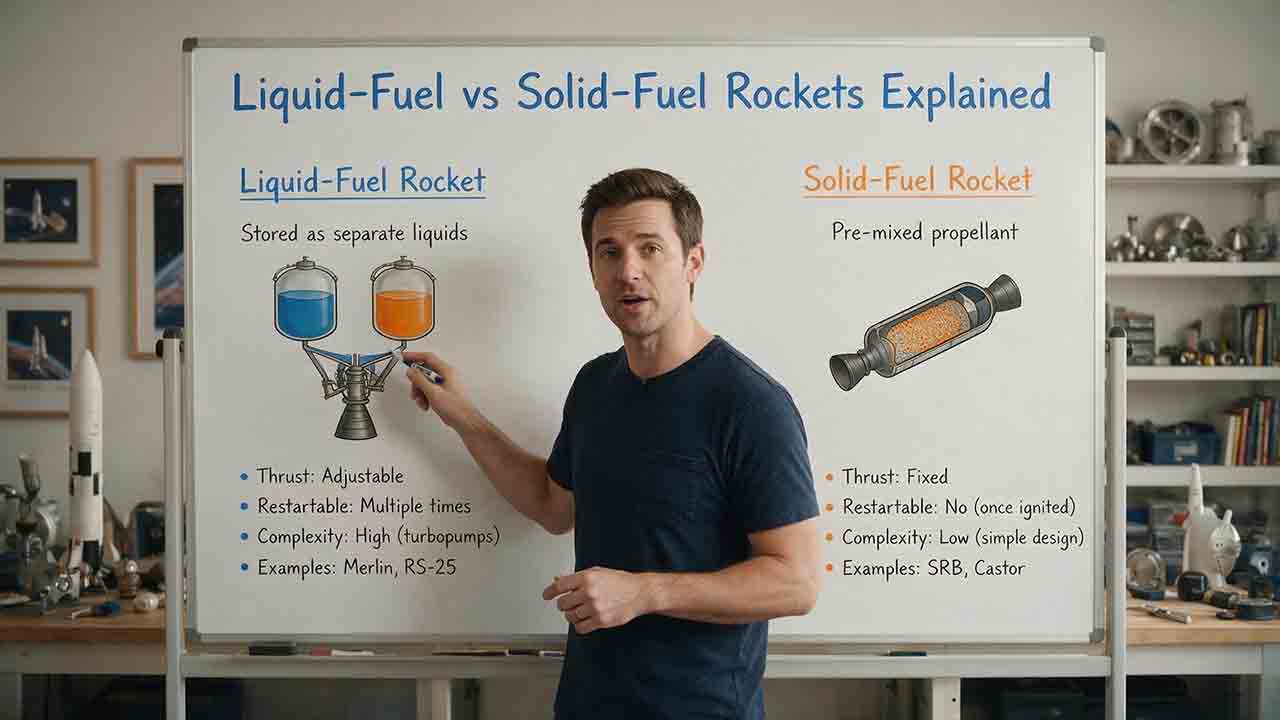
Liquid-Fuel vs Solid-Fuel Rockets Explained
Liquid-fuel and solid-fuel rockets solve different engineering problems. Liquid rocket engines store fuel and oxidizer separately, allowing many systems to regulate thrust, shut down, or restart during flight. Solid rocket motors contain prepared solid propellant and can deliver compact, powerful thrust with fewer active feed-system components, although conventional motors offer limited control after ignition. This article compares both propulsion types across thrust, specific impulse, storage, mechanical complexity, reliability, cost, reusability, and environmental considerations. It also explains why solid motors often serve as launch boosters while liquid engines are widely used for core stages, upper stages, and powered recovery. An original calculation demonstrates how specific impulse affects ideal velocity change, while a five-part mission framework helps readers evaluate propulsion choices based on control, performance, packaging, operations, and lifecycle requirements. Real launch systems, including SLS, Ariane 6, Falcon 9, and Vulcan Centaur, show why no single propulsion type is best for every mission.
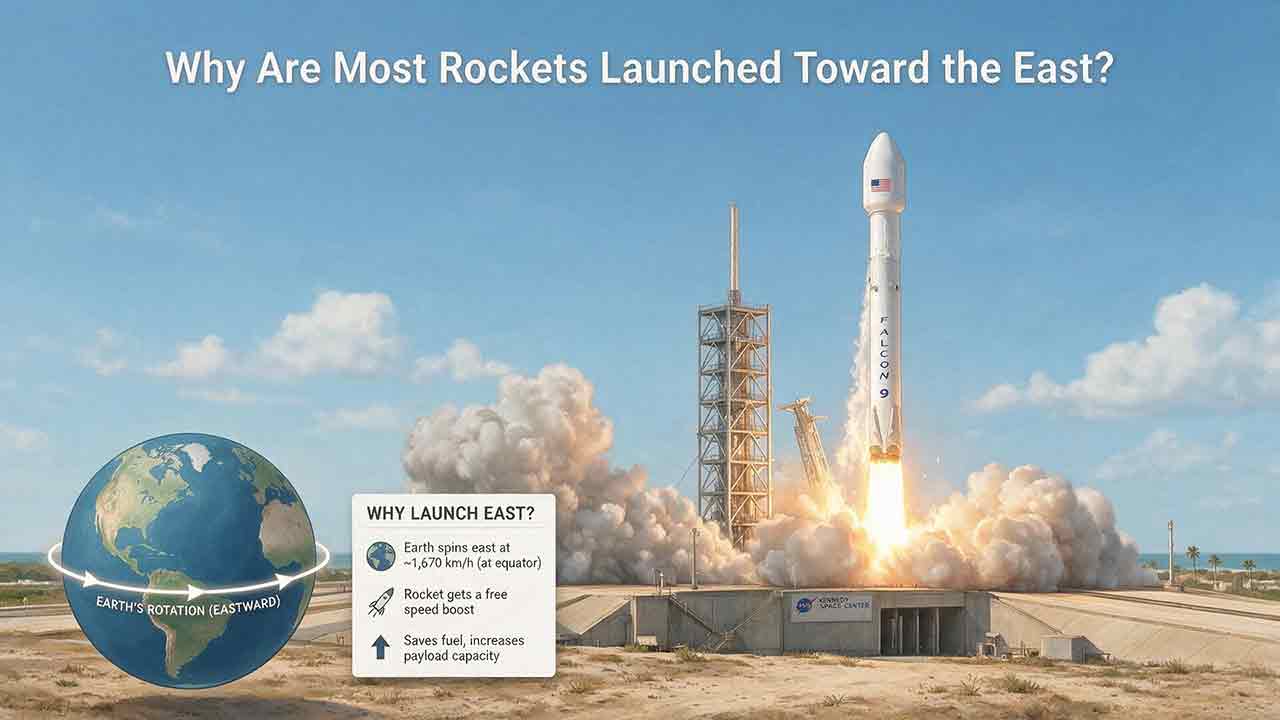
Why Are Most Rockets Launched Toward the East?
Most orbital rockets launch generally toward the east because Earth rotates from west to east, giving launch vehicles useful initial velocity before liftoff. This advantage is strongest near the equator and can reduce the additional speed a rocket must produce for compatible prograde orbits. However, launch direction is not determined by efficiency alone. Target orbital inclination, launch-site latitude, populated areas, stage-impact zones, range-safety rules, and mission objectives may require a rocket to travel northeast, southeast, south, or along a retrograde trajectory. This article explains how Earth’s rotation contributes to launch performance, compares Kourou with Cape Canaveral through a transparent calculation, and shows how latitude and launch azimuth affect the usable speed component. It also introduces the reader-friendly EAST framework for evaluating real missions and explains why polar, Sun-synchronous, and range-constrained launches often do not fly directly east.
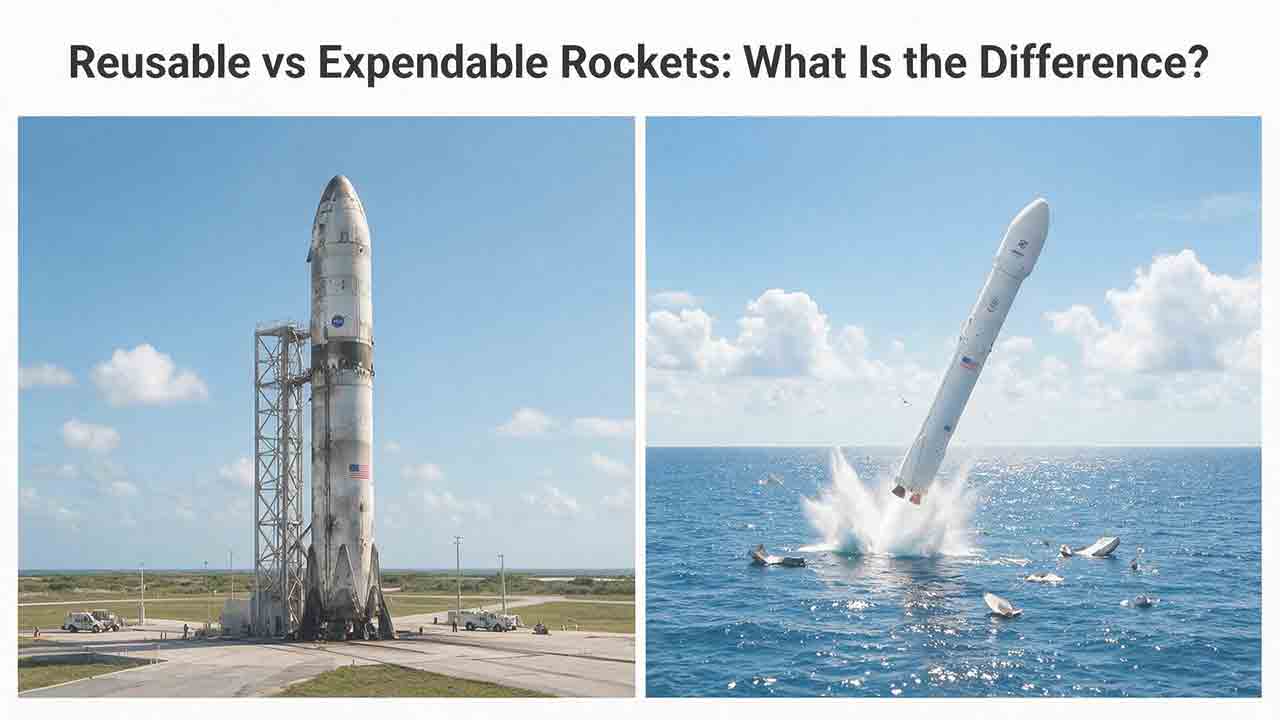
Reusable vs Expendable Rockets: What Is the Difference?
Reusable and expendable rockets follow two different approaches to launch vehicle design. Reusable systems recover and fly again one or more major components, while expendable rockets use each propulsive stage only once. This guide compares the two architectures across payload performance, recovery requirements, launch cadence, reliability, refurbishment, and mission cost. It explains why reusable rockets may reduce average hardware costs when stages fly frequently, while expendable configurations can preserve more performance for demanding payloads or high-energy destinations. The article also distinguishes partial reuse from full reuse, examines Falcon 9, NASA’s Space Launch System, and ESA’s Themis demonstrator, and introduces the original RAMP framework for early mission screening. A fictional cost-sensitivity example, decision tree, troubleshooting table, and practical checklist help readers evaluate launch options without relying on unsupported commercial cost claims or treating either architecture as universally superior.
Explore More Topics
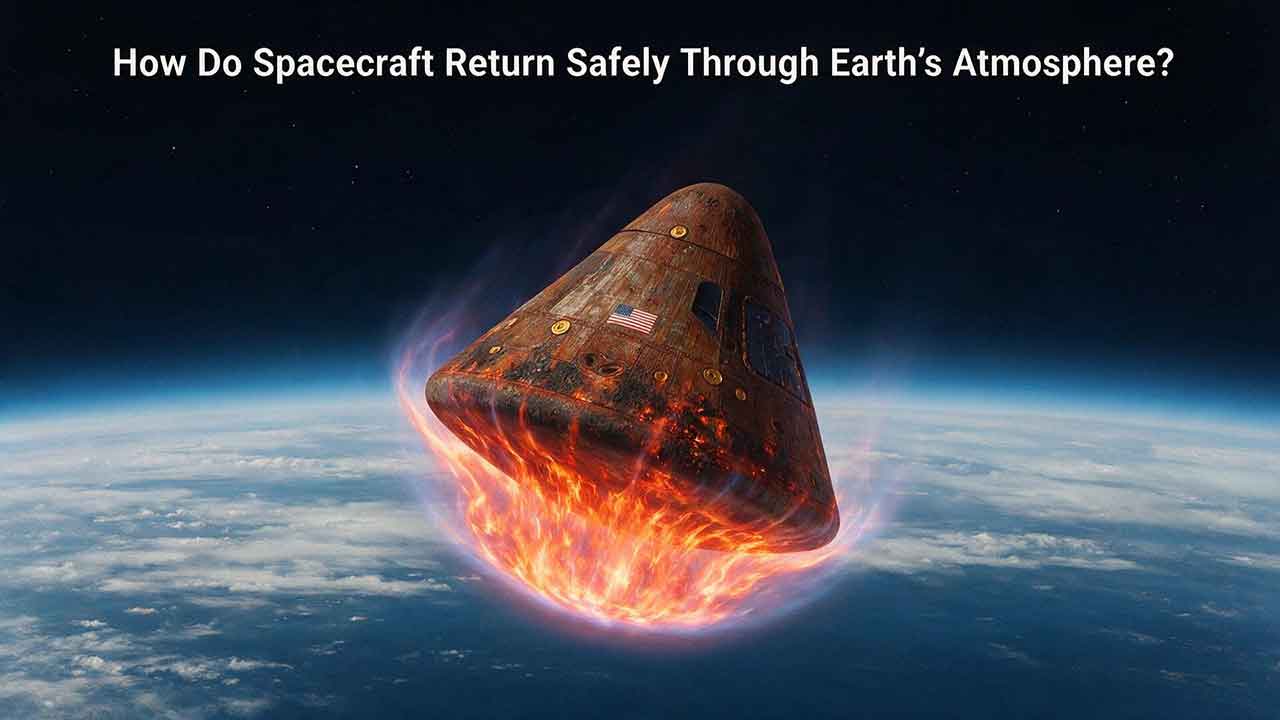
How Do Spacecraft Return Safely Through Earth’s Atmosphere?
Spacecraft return safely through Earth’s atmosphere by managing an enormous amount of energy through a carefully coordinated sequence of trajectory control, thermal protection, aerodynamic deceleration, landing, and recovery. This article explains how deorbit burns and entry corridors guide a spacecraft toward its landing region, why blunt heat shields reduce the danger of hypersonic heating, and how guidance systems control attitude, range, and structural loads. It includes an original comparison of low-Earth-orbit and lunar-return energy, a practical review of ablative and reusable heat-shield technologies, and the CosmoBasics Four-Layer Reentry Framework covering path, protection, control, descent, and recovery. Real-world lessons from Artemis I and the crewed Artemis II mission show why postflight inspection remains essential even after a successful splashdown. Readers will also learn how parachutes, wings, landing rockets, flotation systems, and recovery teams complete the return safely.
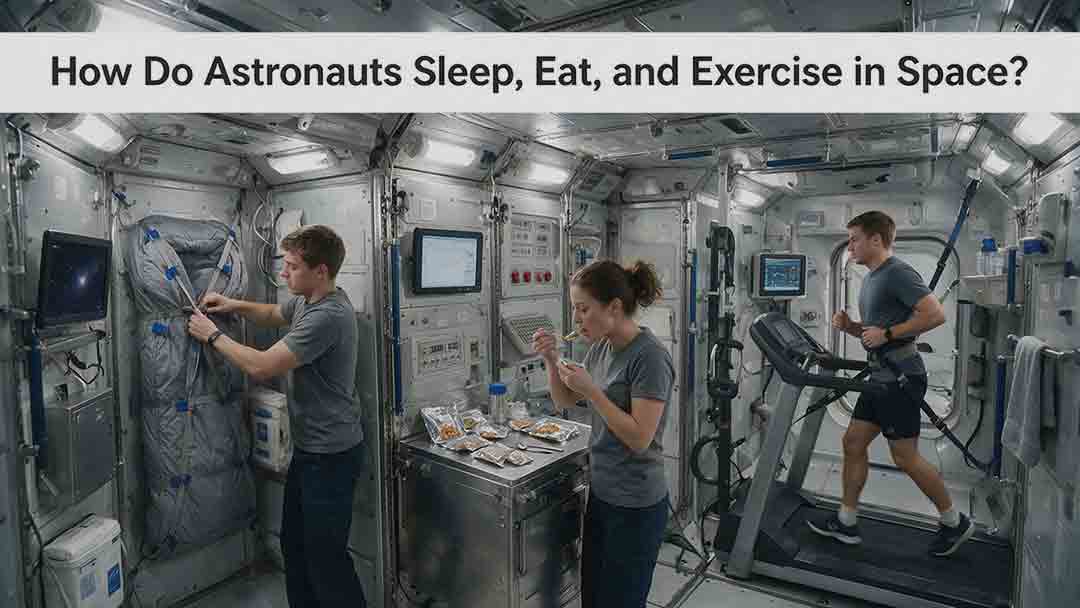
How Do Astronauts Sleep, Eat, and Exercise in Space?
Astronauts must redesign ordinary routines when they live in microgravity. This article explains how crew members sleep in secured bags inside ventilated quarters, prepare packaged meals without letting food or liquids drift through the cabin, and use specialized exercise equipment to protect their physical condition. It examines the roles of the Advanced Resistive Exercise Device, the T2 treadmill, and the CEVIS cycle ergometer, while clarifying the difference between active workout time and the full scheduled exercise period. Readers will also learn why tortillas are practical in space, how airflow affects sleep, why ordinary weights do not work normally in orbit, and how nutrition, rest, and exercise support one another. NASA and ESA sources provide the factual foundation, while original comparison tables and practical evaluation frameworks show how spacecraft systems replace functions normally supplied by gravity. The article also distinguishes current International Space Station practices from possible future Moon and Mars mission requirements.
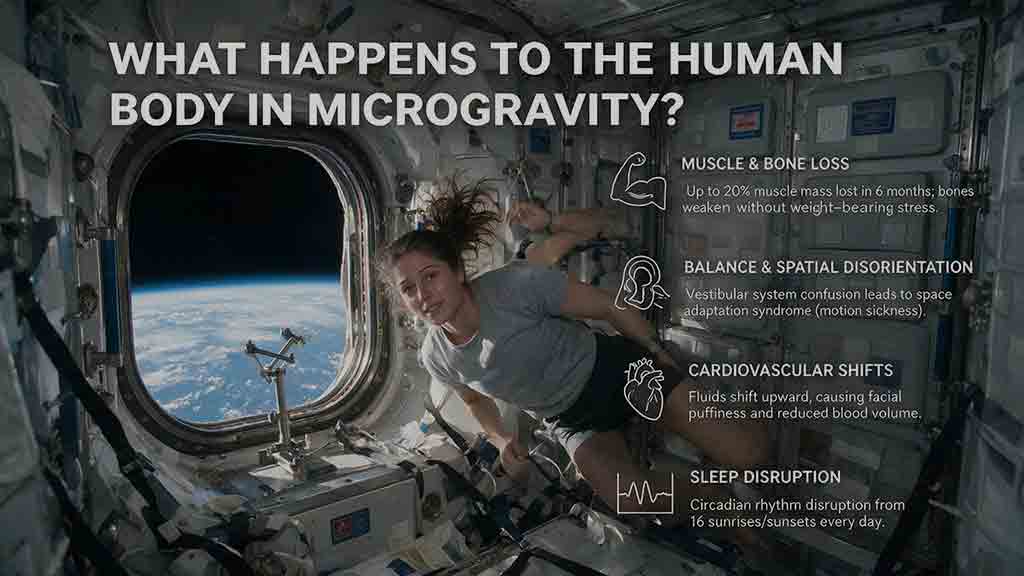
What Happens to the Human Body in Microgravity?
Microgravity changes the human body because fluids are no longer pulled toward the legs, muscles and bones receive less mechanical loading, and the brain loses gravity as a dependable orientation signal. This article explains how weightlessness affects balance, circulation, muscle strength, bone density, vision, blood, immunity, digestion, sleep, and spinal length. It also examines why astronauts may struggle to stand or walk after landing and how exercise, nutrition, monitoring, and rehabilitation help reduce these risks. Two original tools—the Load–Flow–Orientation Framework and the Gravity-Transition Readiness Matrix—connect physiological changes with real mission demands. Drawing on NASA standards, NASA technical reports, ESA materials, and peer-reviewed human spaceflight research, the guide clearly separates established observations from experimental countermeasures and unresolved questions. It also explains what these effects could mean for future missions to the Moon and Mars without treating population averages as predictions for individual astronauts.