Reusable vs Expendable Rockets: What Is the Difference?

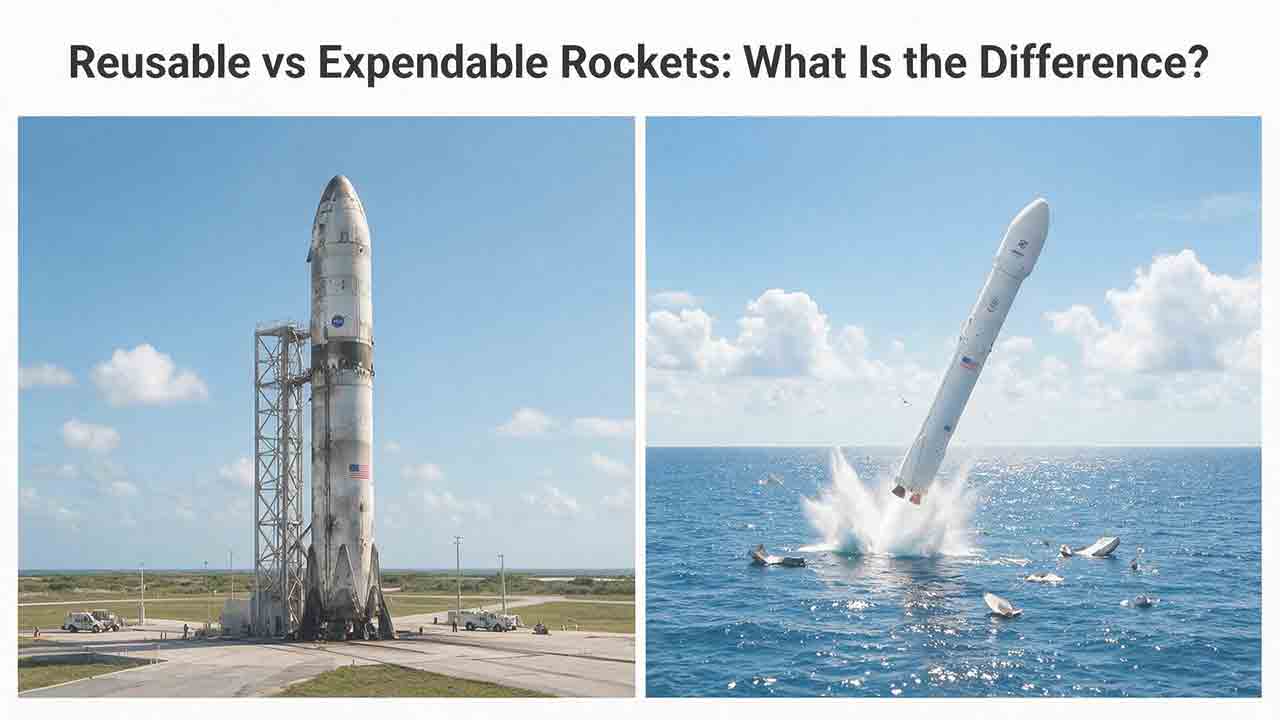
Reusable vs Expendable Rockets: What Is the Difference?
Reusable rockets recover and fly again one or more major components, while expendable rockets use each propulsive stage once. Reuse can spread hardware cost across multiple missions and support frequent launches, but it adds recovery mass, reserved propellant, inspection, and refurbishment. Expendable designs sacrifice the hardware to preserve maximum mission performance or avoid recovery complexity. Neither architecture is universally better.
Key Takeaways
- Most operational reusable rockets are partially reusable: a booster may return while the upper stage is discarded.
- Reuse can lower average hardware cost when recovered components survive, fly often, and require manageable processing.
- Expendable operation can provide greater payload performance because no landing hardware or recovery propellant is required.
- Reliability depends on vehicle history, manufacturing quality, inspection, configuration control, and mission assurance.
- The better architecture depends on the payload, destination, performance margin, flight rate, schedule, and total mission value.
This guide explains how reusable and expendable rockets differ in design, cost, payload capability, reliability, operations, and mission suitability. It also provides a fictional cost-sensitivity example, an original RAMP comparison framework, a decision tree, and a practical evaluation checklist.
Scope note: This is a high-level educational comparison. It does not provide propellant recipes, rocket-construction instructions, launch procedures, recovery-control sequences, or operational safety guidance.
What Is the Core Difference Between Reusable and Expendable Rockets?
An expendable launch vehicle uses each propulsive stage only once. A reusable launch vehicle is designed to recover at least one significant flight component so that it can be inspected, prepared, and flown again.
The U.S. regulatory definition describes an expendable launch vehicle as one whose propulsive stages are flown only once. NASA educational material similarly distinguishes expendable stages from systems that recover vehicle components for later use. See 14 CFR 401.7—Definitions and NASA’s Launch Vehicle Fleet overview.
| Comparison factor | Reusable rocket | Expendable rocket |
|---|---|---|
| Hardware after launch | One or more major components are recovered | Propulsive stages are not flown again |
| Recovery equipment | May include landing systems, control surfaces, parachutes, thermal protection, or additional avionics | Normally carries no equipment intended to return a stage |
| Propellant use | May reserve propellant for entry, diversion, or landing | Can direct available propellant primarily toward ascent |
| Post-flight work | Recovery, transport, inspection, testing, and possible refurbishment | Manufacturing and acceptance testing of replacement hardware |
| Cost opportunity | Hardware cost may be spread across several missions | A new stage is required for each mission |
| Main performance advantage | Potentially lower recurring hardware cost and greater fleet utilization | Potentially greater payload or mission-energy capability |
| Main operational challenge | Reliable recovery and predictable reflight preparation | Efficient production, quality control, and supply-chain capacity |
| Common real-world form | Partially reusable | Fully expendable |
The classification should follow the specific mission configuration, not only the launch vehicle’s name. A rocket family that normally recovers its first stage may still fly expendably when a mission requires additional performance.
Does “Reusable” Mean the Entire Rocket Comes Back?
Usually not. Most reusable launch systems recover only selected components.
| Reusability level | What may be recovered? | What is normally discarded? |
|---|---|---|
| Fully expendable | No propulsive stage for reflight | Boosters, core stage, and upper stage |
| Component recovery | Selected hardware, such as a fairing | Most major propulsive stages |
| Partially reusable | A booster or first stage | Upper stage and sometimes other components |
| Fully reusable | Booster and orbital stage are both intended for repeated flight | Ideally little major flight hardware |
Partial reuse is more common because a first stage separates earlier and at a lower speed than an orbital upper stage. An upper stage may approach orbital velocity and must dissipate far more energy if it returns through the atmosphere.
A reusable upper stage may therefore need substantial thermal protection, controlled reentry capability, landing systems, additional structure, and sufficient margin for repeated flights. All of that hardware must be carried during ascent.
A returning payload capsule also does not make the entire launch vehicle reusable. Capsules, fairings, boosters, first stages, and upper stages can each have separate recovery plans.
How Does Reusability Change Rocket Design?
Reusability turns a launch stage into both an ascent vehicle and a returning vehicle. That additional role affects mass, structures, propulsion, thermal protection, guidance, and ground operations.
Recovery Systems Use Payload-Producing Capacity
A recoverable stage may need:
- Landing legs, parachutes, or another descent system
- Additional guidance and navigation equipment
- Thermal protection
- Structural reinforcement
- Propellant reserved for recovery maneuvers
- Control surfaces or attitude-control hardware
- Recovery tracking and communications
- Equipment that supports inspection and repeated use
Every kilogram assigned to recovery is unavailable for another purpose. It cannot simultaneously serve as payload, ascent propellant, or mission-specific equipment.
NASA research identifies the performance lost while enabling recovery as an important variable in reusable-launch economics. The size of the penalty depends on the vehicle, trajectory, separation conditions, landing method, propulsion system, and required reserves. See Performance Efficient Launch Vehicle Recovery and Reuse, NTRS citation 20160012009.
Reusable Hardware Must Survive More Than Ascent
An expendable stage must operate correctly through its assigned portion of the launch. A reusable stage may also need to survive:
- Atmospheric entry
- Aerodynamic heating
- Engine restarts
- High-altitude attitude control
- Landing or water-impact loads
- Weather or saltwater exposure
- Post-recovery transportation
- Repeated pressure, vibration, and thermal cycles
These requirements can increase development work and structural mass. They can also influence material selection, engine design, sensors, protective systems, and access for inspection.
Recovery Is Not the Same as Reflight
A stage has not demonstrated operational reuse merely because it returned intact.
Before reflight, an operator may need to evaluate:
- Structures and joints
- Engines and turbomachinery
- Valves, seals, and pressure systems
- Avionics and wiring
- Thermal protection
- Landing hardware
- Life-limited components
- Data from any in-flight anomaly
NASA’s broader Methodology for Assessing Reusability of Spaceflight Hardware discusses systematic evaluation of reusable spaceflight hardware, including fully reusable vehicles, partially reusable stages, and individual components.
For propulsion hardware specifically, A Framework for Assessing the Reusability of Hardware (Reusable Rocket Engines), NTRS citation 20170000442, provides a framework for evaluating reusable rocket-engine hardware, including recovery and refurbishment cost, reliability, design intent, and operational requirements.
An efficient reusable system aims to minimize invasive inspection and major disassembly. If every mission requires extensive rebuilding, the economic value of recovering the hardware becomes harder to maintain.
Which Type of Rocket Costs Less?
A reusable rocket can cost less per mission when expensive hardware completes enough successful flights and recovery-related costs remain controlled. An expendable rocket can be more economical when launches are infrequent, performance demands are high, or recovery and refurbishment are expensive.
“Launch cost” can refer to several different values:
- Vehicle manufacturing cost
- Operator cost for one additional mission
- Price charged to a customer
- Customer’s total mission cost
- Average cost after development expenses
- Cost per kilogram to a specified destination
- Cost of maintaining a fleet and launch infrastructure
- Expected cost of delays, failures, or lost hardware
These figures are not interchangeable. A customer price may reflect contracts, competition, insurance, payload integration, scheduling, and commercial strategy—not only the physical cost of the rocket.
A Simple Reuse-Cost Relationship
A useful first-pass relationship is:
Average reusable-stage cost per mission =
Reusable-stage construction cost ÷ successful uses
+ recovery operations
+ inspection and refurbishment
+ expected loss and early-retirement reserve
An expendable-stage comparison can be simplified as:
Expendable-stage cost per mission =
Construction and acceptance cost of one new stage
This relationship does not include every program expense. Development, launch-site infrastructure, upper stages, payload processing, regulatory work, financing, storage, and company profit may materially change the result.
Illustrative Hardware-Only Cost Sensitivity
The following example uses fictional units. It is not based on the internal costs of SpaceX, NASA, ESA, or another launch organization.
Assume:
- New expendable stage: 48 units per mission
- Reusable stage with recovery hardware: 72 units
- Recovery, inspection, and routine refurbishment: 6 units per mission
- Expected loss and early-retirement reserve: 3 units per mission
| Successful uses | Hardware allocation | Recovery and processing | Loss and retirement reserve | Calculated average per mission |
|---|---|---|---|---|
| 1 | 72 ÷ 1 = 72 | 6 | 3 | 81 units |
| 2 | 72 ÷ 2 = 36 | 6 | 3 | 45 units |
| 3 | 72 ÷ 3 = 24 | 6 | 3 | 33 units |
| 6 | 72 ÷ 6 = 12 | 6 | 3 | 21 units |
| 10 | 72 ÷ 10 = 7.2 | 6 | 3 | 16.2 units |
Under this deliberately simplified, hardware-only scenario, the reusable stage’s calculated average falls below the 48-unit expendable stage after its second successful use.
This is not a real-program break-even estimate.
The model does not include:
- Reusable-system development costs
- Recovery vessels or landing-site infrastructure
- Major unplanned refurbishment
- Long-term storage
- Fleet-management expenses
- Schedule disruption after an anomaly
- Upper-stage manufacturing
- Launch-site and mission-support costs
- Payload value lost to the recovery penalty
The useful conclusion is not that two flights are always enough. The example shows that reuse economics are sensitive to construction cost, successful flight count, processing cost, vehicle loss, and available demand.
How Does Reusability Affect Payload Capacity?
Reusable operation usually reduces the maximum payload available from a given basic vehicle because the rocket must carry recovery hardware and preserve energy for its return.
A recoverable booster may need propellant for:
- Changing or limiting its downrange trajectory
- Controlling atmospheric entry
- Reducing speed before landing
- Diverting toward a safe recovery area
- Maintaining operational reserves
When the same rocket can fly in reusable or expendable modes, its expendable configuration may provide greater payload performance. SpaceX’s official Capabilities & Services document states that its listed maximum Falcon performance represents a fully expendable vehicle.
This does not mean reusable rockets can carry only small payloads. It means performance figures must be compared under matching conditions:
- Same destination orbit
- Same orbital inclination
- Same launch site
- Same recovery method
- Same fairing configuration
- Same mission reserves
- Same definition of payload mass
- Same vehicle version and publication date
A low Earth orbit figure cannot be compared directly with a figure for geostationary transfer orbit, lunar injection, or an interplanetary trajectory.
Are Reusable Rockets More Reliable?
Not automatically. Reused and newly manufactured stages present different assurance questions.
A reflown stage has already operated in a real flight environment. Engineers can examine its flight data, but the stage has also experienced vibration, heating, pressure cycles, engine operation, and structural loading.
A new expendable stage has no accumulated flight wear, but the assembled unit has never flown. Manufacturing variation, supplier changes, workmanship, and assembly defects can still affect new hardware.
| Questions for reused hardware | Questions for new expendable hardware |
|---|---|
| Did inspection identify flight-related damage? | Did production and acceptance testing identify manufacturing defects? |
| Are fatigue and component-life limits understood? | Does the unit match the qualified design and process? |
| Were previous-flight anomalies fully resolved? | Have suppliers, materials, or manufacturing methods changed? |
| Did refurbishment alter the controlled configuration? | Is the vehicle configuration sufficiently mature? |
| Is accumulated exposure within approved limits? | Are workmanship and quality controls effective? |
Meaningful evidence includes flight history, anomaly investigations, corrective actions, qualification, acceptance testing, configuration control, and payload-specific mission assurance.
NASA launch-service policy considers mission risk classification, vehicle certification, failure resolution, and major configuration changes. It does not treat “reusable” or “expendable” as complete reliability ratings. See NASA’s Launch Services Risk Mitigation Policy, NPD 8610.7D and Launch Services Risk Classification Fact Sheet.
Can Reusable Rockets Launch More Frequently?
Reusable hardware can support a high launch cadence when recovery and reflight preparation require less time and production capacity than building replacement stages. Recovery alone does not guarantee rapid turnaround.
A reusable system can still be constrained by:
- Recovery weather
- Landing-zone or recovery-vessel availability
- Inspection capacity
- Refurbishment work
- Engine and component-life limits
- Launch-pad availability
- Upper-stage production
- Fairing availability
- Payload readiness
- Range scheduling
- Regulatory approvals
An expendable vehicle can also launch frequently when its production system, workforce, suppliers, and launch facilities are designed for volume.
The more useful question is:
How quickly can the complete launch system provide another mission-ready vehicle, upper stage, launch site, payload, and authorized launch opportunity?
A recovered booster waiting for inspection does not create cadence by itself. Neither does a newly manufactured stage waiting for a launch pad.
Are Expendable Rockets Simpler?
Expendable rockets eliminate the requirement to return a stage, but they remain highly complex machines.
They may avoid landing systems, reentry control, and post-flight refurbishment, yet they still require:
- High-performance propulsion
- Lightweight structures
- Guidance and navigation
- Stage separation
- Flight-safety systems
- Ground processing
- Quality control
- Payload integration
- Replacement hardware for every launch
Their main architectural advantage is narrower responsibility: an expendable stage does not need to remain usable after completing its ascent task.
That can be valuable for missions requiring maximum energy, unusual trajectories, limited flight frequency, or hardware that would be especially difficult to recover.
Is Reuse Automatically Better for the Environment?
Reusability alone is not enough to determine which launch system has the lower environmental impact. A meaningful comparison requires a defined life-cycle boundary and comparable missions.
A useful assessment may need to consider:
- Manufacturing avoided through repeated use
- Additional propellant used for recovery
- Recovery ships, aircraft, or ground facilities
- Transportation of returned hardware
- Cleaning and refurbishment
- Replacement of damaged components
- Production of landing and thermal-protection systems
- Upper-stage disposal
- Launch-site effects
- Vehicle loss rate
- Number of completed reuses
- Environmental effect per successfully delivered payload
An expendable system requires replacement flight hardware. A reusable system requires recovery and reflight processing.
Without transparent, comparable life-cycle data, the fact that a stage returns—or does not return—is insufficient to establish which architecture has the lower overall impact.
Falcon 9: Operational Partial Reusability
SpaceX describes Falcon 9 as a reusable two-stage rocket and operates missions in which the first stage returns for landing. The second stage continues the orbital mission and is not recovered for routine reflight.
Falcon 9 is therefore best classified as partially reusable. Technical descriptions are available on the SpaceX Falcon 9 page and in the Falcon User’s Guide.
The same vehicle family can be flown without recovering its first stage when a mission needs additional performance or cannot support the normal recovery profile. The mission configuration therefore matters more than the product name alone.
Space Launch System: Expendable Propulsive Stages
NASA’s Space Launch System uses two solid rocket boosters and a core stage during its initial ascent. After the boosters complete their burns, they separate while the core stage continues operating.
The solid rocket boosters separate and descend into the Atlantic Ocean; they are not recovered for reflight. NASA states that SLS boosters are optimized for single use, unlike the Space Shuttle boosters that were designed for reuse. The SLS core stage is also not designed to return for another mission.
NASA provides further details on its SLS Solid Rocket Booster reference page and in The Great Escape: SLS Provides Power for Missions to the Moon.
SLS demonstrates why expendability remains part of modern launch architecture. Its design emphasizes high-energy exploration missions and substantial payload capability rather than routine recovery of its propulsive stages.
Themis: A Reuse Technology Demonstrator
Themis is an ESA rocket-stage prototype intended to demonstrate European recovery and reuse technologies. It is not an established commercial orbital launch service.
Themis completed its first wet dress rehearsal at Esrange Space Center in Sweden on July 23, 2026. ESA published its report on July 30, 2026, explaining that the rehearsal allowed teams to practice countdown and post-flight procedures, test the prototype under cryogenic conditions, and identify remaining anomalies while preparing for its first hop.
The current status is documented in ESA’s Major Rehearsal Takes Themis One Step Closer to Flight and Themis program overview.
Program status checked July 31, 2026.
As of that review date, Themis had reached launch-site testing and first-flight preparation but had not demonstrated routine, low-cost, or high-cadence reuse.
| System | Current category | Recovered element | What the example demonstrates |
|---|---|---|---|
| Falcon 9 | Operational, partially reusable | First stage on suitable missions | Reuse can be incorporated into regular orbital launch operations |
| Space Launch System | Expendable | No propulsive stage for reflight | Mission energy and payload requirements can take priority over recovery |
| Themis | Reuse technology demonstrator | Prototype stage intended for recovery testing | Reuse requires development of flight hardware and ground operations |
What Are the Main Pros and Cons?
| Architecture | Potential advantages | Important limitations |
|---|---|---|
| Reusable | Can divide hardware cost across flights; may support frequent launch; allows post-flight examination; can reduce replacement-stage manufacturing | Recovery reduces performance; inspection is required; recovery may fail; development can be expensive; benefit depends on flight rate |
| Expendable | Focuses available performance on ascent; avoids landing equipment; does not depend on stage-recovery scheduling | Requires replacement hardware; production capacity can limit cadence; major components are lost |
| Partially reusable | Recovers a valuable or accessible component while retaining an expendable upper stage | Requires both recovery operations and continued production of expendable hardware |
These are typical tradeoffs rather than guaranteed outcomes. The result depends on how efficiently the complete system is designed, manufactured, and operated.
Step 1: Define the Mission
Record:
- Payload mass and dimensions
- Destination orbit or trajectory
- Orbital inclination
- Launch window
- Required arrival conditions
- Payload environmental limits
- Schedule constraints
“Payload to orbit” is not specific enough. Low Earth orbit, geostationary transfer orbit, lunar injection, and interplanetary trajectories impose different performance requirements.
Step 2: Identify What Is Actually Reusable
Determine which components are intended to return:
- First stage
- Side boosters
- Engines
- Fairings
- Upper stage
- Payload capsule
Then distinguish among:
- Designed to be reusable
- Successfully recovered
- Successfully flown again
Step 3: Compare Performance in the Correct Mode
Use payload figures for the mission’s actual recovery configuration.
Check the orbit, inclination, launch site, landing plan, fairing, vehicle version, and document date behind each number.
Step 4: Estimate a Plausible Reuse Count
Consider:
- Demonstrated reflight history
- Planned service life
- Inspection burden
- Loss probability
- Retirement criteria
- Available demand for future missions
A design target is not proof that every individual stage will reach that number of flights.
Step 5: Separate Price From Cost
Distinguish among:
- Advertised price
- Negotiated contract price
- Incremental mission cost
- Average program cost
- Payload-integration cost
- Insurance exposure
- Delay and schedule risk
Step 6: Evaluate Mission Assurance
Review flight history, configuration changes, anomaly investigations, certification status, acceptance testing, and payload-specific requirements.
Step 7: Include Schedule and Operational Value
A lower-priced launch is not necessarily the better option if it cannot meet the required launch window, destination, payload environment, or integration schedule.
The objective is to complete the mission—not merely to select the least expensive rocket hardware.
How Does the RAMP Framework Compare Reuse and Expendability?
RAMP is an original editorial framework for early comparison. It is not a NASA, FAA, ESA, or industry certification standard.
R — Recovery Penalty
How much payload, energy, or operational flexibility is lost when recovering the stage?
A severe penalty can favor expendable operation when the mission approaches the vehicle’s performance limit.
A — Annual Demand
How many missions can realistically use the recovered hardware?
Frequent and predictable demand creates more opportunities to spread construction cost across flights.
M — Mission Margin
Does the vehicle retain comfortable performance margin after accounting for payload growth, trajectory needs, operational reserves, and recovery propellant?
A mission with little margin may require expendable operation even when the vehicle normally lands.
P — Processing Proof
Is there credible evidence that recovery, inspection, and reflight preparation can be completed predictably?
Repeated recovery and reflight provide stronger evidence than an announced design target.
RAMP Early-Screening Score
Score each factor from 1 to 5.
| RAMP factor | 1 point | 3 points | 5 points |
|---|---|---|---|
| Recovery Penalty | Recovery seriously compromises mission performance | The penalty is noticeable but potentially manageable | Recovery has limited effect on the required mission |
| Annual Demand | Little realistic demand for reflight | Demand exists but is limited or uncertain | Demand is frequent and predictable |
| Mission Margin | The mission is near the vehicle’s performance limit | Some usable margin exists | Substantial performance margin remains |
| Processing Proof | Recovery and turnaround are unproven | Partial flight or processing evidence exists | Recovery, turnaround, and reflight have been repeatedly demonstrated |
Add the four scores:
| Total score | Early interpretation |
|---|---|
| 4–8 | Expendable operation deserves initial priority, or the reuse case needs stronger evidence |
| 9–14 | Compare both approaches through mission-specific analysis |
| 15–20 | Reusable operation is a strong candidate for further evaluation |
The score ranges are editorial screening thresholds created for this guide. They have not been statistically validated and should not be treated as engineering acceptance criteria.
A high score does not mean reusable operation should automatically be selected. It means reuse appears compatible enough with the mission to justify deeper performance, cost, schedule, and risk analysis.
RAMP Decision Tree
Does the mission require nearly all available vehicle performance?
- Yes: evaluate expendable operation first.
- No: continue.
Can the relevant hardware be recovered under the required trajectory?
- No: an expendable or component-recovery architecture is more practical.
- Yes: continue.
Is there enough demand to fly the hardware repeatedly?
- No: examine fleet and ownership costs carefully.
- Yes: continue.
Are recovery, inspection, and refurbishment requirements understood?
- No: include additional cost and schedule margin.
- Yes: continue.
Does reusable operation still meet payload, reliability, and schedule requirements?
- No: use expendable mode or compare another vehicle.
- Yes: reusable operation may provide better total mission value.
Which Approach Fits Different Mission Types?
| Mission situation | Approach that may deserve priority | Reason |
|---|---|---|
| Frequent launches to similar low Earth orbits | Reusable or partially reusable | Repeated demand can support hardware amortization |
| Payload near the vehicle’s maximum capability | Expendable mode | Recovery reserves may reduce usable performance |
| Rare, high-value deep-space mission | Mission-specific comparison | Mission energy and assurance may outweigh hardware reuse |
| Commercial constellation deployment | Reusable | Repeated mission profiles may favor fleet utilization |
| Technology demonstration with a small payload | Either | Schedule and availability may matter more than architecture |
| Mission with a strict launch window | Whichever system provides the stronger schedule fit | Missing the window may outweigh a nominal price difference |
| New vehicle with limited flight history | Case-by-case review | Configuration maturity and assurance evidence require scrutiny |
| Government or scientific payload | Certified service matching the mission’s risk posture | Architecture alone does not determine acceptable risk |
These are early-screening recommendations, not universal rules.
Assuming the Entire Rocket Is Reusable
A recoverable first stage does not make the upper stage reusable. Identify the fate of each major component.
Comparing Different Destinations
Compare payload figures only when the destination orbit, launch site, and recovery assumptions match.
Treating Advertised Price as Production Cost
Customer price and internal manufacturing cost are different measures.
Ignoring Recovery Mode
Payload capability may change depending on whether a booster returns to the launch site, lands offshore, or is expended.
Treating Planned Reuse as Demonstrated Reuse
A design goal becomes operational evidence only after recovery, inspection, and reflight have been demonstrated.
Using the Architecture Label as a Safety Rating
New and reused hardware require different evidence, but neither category is inherently safe or unsafe.
How Can Confusing Rocket Comparisons Be Troubleshot?
| Comparison problem | Likely reason | What to verify |
|---|---|---|
| Two payload figures for the same rocket do not match | Different orbit, recovery mode, or vehicle version | Destination, inclination, landing plan, and publication date |
| A normally reusable booster is expended | The mission needed additional performance or recovery was unavailable | Provider statement and mission profile |
| A recovered stage does not fly again quickly | Inspection, refurbishment, fleet scheduling, or component limits | Turnaround history rather than landing date alone |
| A launch price appears lower than an estimated manufacturing cost | Customer price and internal cost are different measures | Contract scope and included services |
| A vehicle has landed but is not yet operationally reusable | Recovery has not progressed to repeated reflight | Reflight record and program status |
| Reliability claims conflict | Different configurations, periods, or definitions are being compared | Vehicle version, mission count, and anomaly treatment |
Practical Launch-Architecture Checklist
Before concluding that one approach is better, verify:
- The payload destination and orbital requirements match.
- Payload figures use the same recovery assumptions.
- “Reusable” is defined by the component being recovered.
- Planned reuse is separated from demonstrated reflight.
- Customer price is not presented as internal production cost.
- Recovery, inspection, and refurbishment are included.
- Flight rate and realistic reuse count are considered.
- Vehicle loss and premature retirement are acknowledged.
- Reliability claims use comparable configurations and periods.
- Schedule, integration, and launch-window value are included.
- Environmental claims use an appropriate life-cycle boundary.
- Current specifications are checked with the responsible organization.
- Dynamic program information includes a review date.
- Regulatory requirements are checked for the relevant country and launch site.
Who This Guide Helps—and Where It Stops
This guide is intended for general readers, students, technical writers, and researchers conducting an early comparison of launch-system architectures.
It does not replace mission-specific performance analysis, payload integration agreements, provider engineering data, regulatory authorization, or a formal mission-assurance review.
In the United States, commercial launch and reentry activities may require FAA licenses, permits, reviews, or other approvals depending on the operation. Current information is available through the FAA’s Vehicle Operator Licenses and Getting Started with Licensing pages.
Other countries and launch sites operate under their own legal, range-safety, airspace, and environmental requirements.
Which Architecture Should a Mission Use?
Reusable rockets make the strongest case when valuable hardware can be recovered with an acceptable performance penalty, flown frequently, and returned to service through predictable processing.
Expendable rockets remain practical when a mission requires maximum performance, launches infrequently, follows a trajectory unsuitable for recovery, or cannot justify the mass and infrastructure required for reuse.
For an early comparison, use the RAMP score and checklist in this guide. For a real mission, obtain configuration-specific performance, integration, schedule, and risk information from qualified launch providers.
Are reusable rockets always cheaper than expendable rockets?
No. Reuse can lower average hardware cost when a recovered component flies several times and requires manageable processing. Low demand, vehicle losses, or extensive refurbishment can weaken that advantage.
Can a reusable rocket be launched expendably?
Yes. A provider may choose not to recover a normally reusable stage when a payload requires additional performance or the mission profile does not support recovery.
Is Falcon 9 fully reusable?
No. Falcon 9 is partially reusable. Its first stage can be recovered and reflown, while its second stage is not recovered for routine reflight.
Why are upper stages harder to reuse?
Upper stages travel much faster and may reach orbital velocity. Returning them requires thermal protection, controlled reentry, guidance, and landing capability that must be carried during ascent.
Do expendable rockets always carry more payload?
Not when comparing unrelated designs. However, an expendable configuration of the same basic vehicle can often provide more performance because it does not preserve the same mass and propellant for recovery.
Does a successful landing prove that a stage is ready to fly again?
No. Landing demonstrates recovery. Reflight also requires inspection, flight-data review, component-life assessment, any necessary maintenance, and approval under the operator’s applicable processes.
How This Article Was Researched and Reviewed
This article was prepared using publicly available first-party material from government agencies, regulators, technical archives, and launch organizations.
The review followed these principles:
- Regulatory definitions were checked against the Electronic Code of Federal Regulations and FAA material.
- NASA technical reports were used to examine performance penalties, hardware reuse, refurbishment, reliability, and operational considerations.
- NTRS citation 20160012009 was matched to Performance Efficient Launch Vehicle Recovery and Reuse.
- NTRS citation 20170000442 was matched to A Framework for Assessing the Reusability of Hardware (Reusable Rocket Engines) and used only for rocket-engine hardware.
- Broader spaceflight-hardware observations were supported by NTRS citation 20170008970.
- Provider performance statements were tied to the configuration described in the provider’s official documentation.
- The Themis test date, ESA publication date, and program status were checked separately.
- The fictional cost example was created for this article solely to illustrate how reuse count and processing expenses affect an average.
- No rocket hardware was tested or independently inspected for this article.
- The article does not represent a mission-level engineering, safety, licensing, or certification review.
The article should be reviewed again when a cited regulation changes, a vehicle configuration materially changes, or a development program reaches a new operational milestone. The review date should change only after the content and relevant sources have actually been checked.
Sources
Electronic Code of Federal Regulations. 14 CFR 401.7—Definitions. Accessed July 31, 2026.
NASA Launch Services Program. Launch Vehicle Fleet. Accessed July 31, 2026.
NASA Technical Reports Server. Performance Efficient Launch Vehicle Recovery and Reuse. NTRS citation 20160012009. Accessed July 31, 2026.
NASA Technical Reports Server. A Framework for Assessing the Reusability of Hardware (Reusable Rocket Engines). NTRS citation 20170000442. Accessed July 31, 2026.
NASA Technical Reports Server. Methodology for Assessing Reusability of Spaceflight Hardware. NTRS citation 20170008970. Accessed July 31, 2026.
SpaceX. Falcon 9. Accessed July 31, 2026.
SpaceX. Falcon User’s Guide. Dated May 9, 2025. Accessed July 31, 2026.
SpaceX. Capabilities & Services. Accessed July 31, 2026.
NASA. SLS Solid Rocket Booster. Accessed July 31, 2026.
NASA. The Great Escape: SLS Provides Power for Missions to the Moon. Accessed July 31, 2026.
European Space Agency. Major Rehearsal Takes Themis One Step Closer to Flight. Published July 30, 2026. Accessed July 31, 2026.
European Space Agency. Themis. Accessed July 31, 2026.
NASA. Launch Services Risk Mitigation Policy, NPD 8610.7D. Accessed July 31, 2026.
NASA. Launch Services Risk Classification Fact Sheet. Accessed July 31, 2026.
Federal Aviation Administration. Vehicle Operator Licenses. Accessed July 31, 2026.
Federal Aviation Administration. Getting Started with Licensing. Accessed July 31, 2026.
More from Rockets & Launch Systems
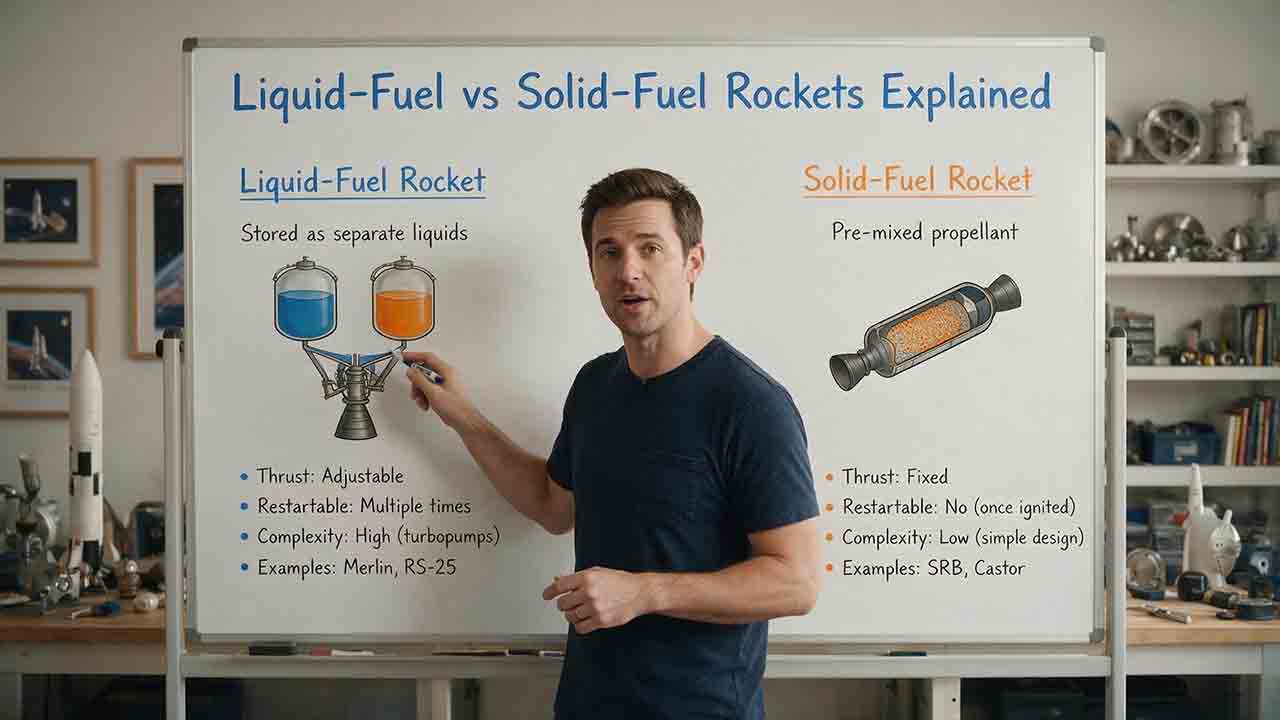
Liquid-Fuel vs Solid-Fuel Rockets Explained
Liquid-fuel and solid-fuel rockets solve different engineering problems. Liquid rocket engines store fuel and oxidizer separately, allowing many systems to regulate thrust, shut down, or restart during flight. Solid rocket motors contain prepared solid propellant and can deliver compact, powerful thrust with fewer active feed-system components, although conventional motors offer limited control after ignition. This article compares both propulsion types across thrust, specific impulse, storage, mechanical complexity, reliability, cost, reusability, and environmental considerations. It also explains why solid motors often serve as launch boosters while liquid engines are widely used for core stages, upper stages, and powered recovery. An original calculation demonstrates how specific impulse affects ideal velocity change, while a five-part mission framework helps readers evaluate propulsion choices based on control, performance, packaging, operations, and lifecycle requirements. Real launch systems, including SLS, Ariane 6, Falcon 9, and Vulcan Centaur, show why no single propulsion type is best for every mission.
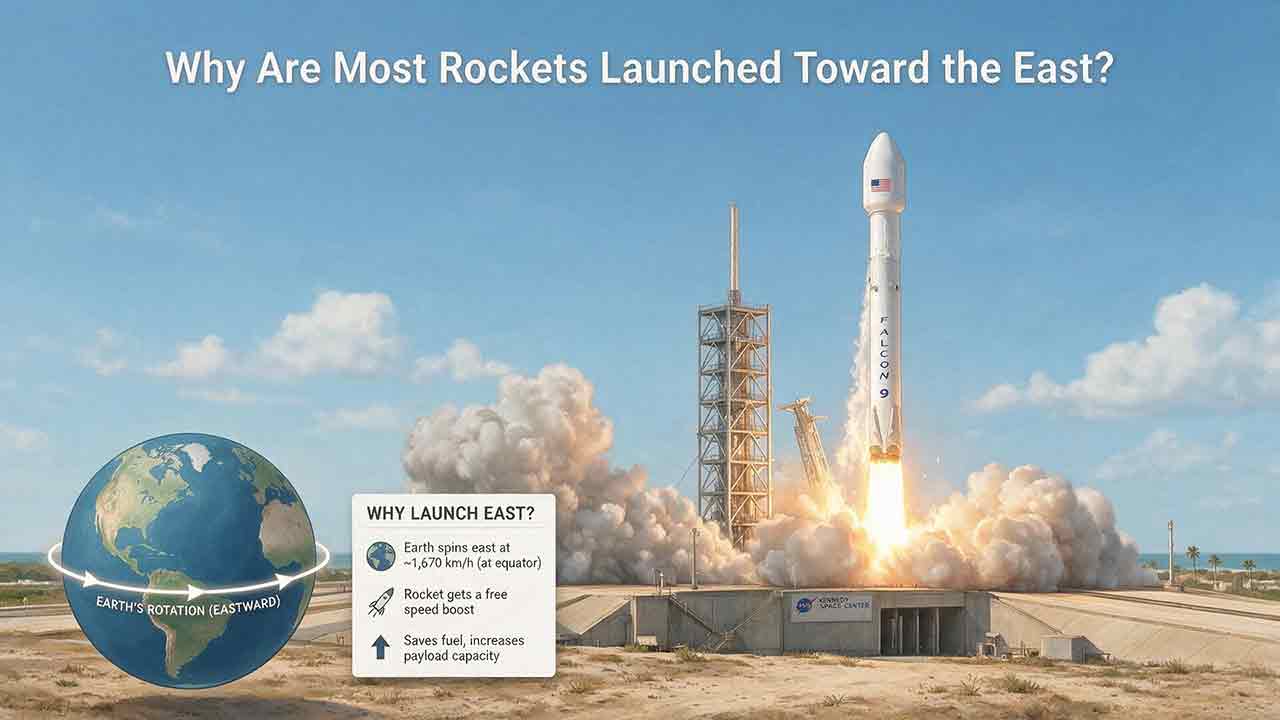
Why Are Most Rockets Launched Toward the East?
Most orbital rockets launch generally toward the east because Earth rotates from west to east, giving launch vehicles useful initial velocity before liftoff. This advantage is strongest near the equator and can reduce the additional speed a rocket must produce for compatible prograde orbits. However, launch direction is not determined by efficiency alone. Target orbital inclination, launch-site latitude, populated areas, stage-impact zones, range-safety rules, and mission objectives may require a rocket to travel northeast, southeast, south, or along a retrograde trajectory. This article explains how Earth’s rotation contributes to launch performance, compares Kourou with Cape Canaveral through a transparent calculation, and shows how latitude and launch azimuth affect the usable speed component. It also introduces the reader-friendly EAST framework for evaluating real missions and explains why polar, Sun-synchronous, and range-constrained launches often do not fly directly east.
How Does a Rocket Work?
A rocket works by carrying propellant and accelerating exhaust backward at high speed, producing forward thrust through conservation of momentum. This article explains the complete process from engine ignition and liftoff to guidance, staging, orbit insertion, and payload separation. It shows why rockets carry both fuel and an oxidizer, how a nozzle converts pressure into exhaust velocity, why rocket engines can operate in a vacuum, and why reaching orbit requires substantial horizontal speed rather than altitude alone. Readers will also find transparent examples for calculating thrust-to-weight ratio and ideal delta-v, along with comparisons of liquid, solid, and hybrid propulsion systems. Practical tables explain Max Q, launch phases, steering methods, payload fairings, mission tradeoffs, and common launch-broadcast terminology. Based on authoritative NASA and European Space Agency references, the guide clearly separates established physics, simplified estimates, and original explanatory frameworks while avoiding construction, ignition, propellant, or operational launch instructions.
Explore More Topics
How Do Spacecraft Return Safely Through Earth’s Atmosphere?
Spacecraft return safely through Earth’s atmosphere by managing an enormous amount of energy through a carefully coordinated sequence of trajectory control, thermal protection, aerodynamic deceleration, landing, and recovery. This article explains how deorbit burns and entry corridors guide a spacecraft toward its landing region, why blunt heat shields reduce the danger of hypersonic heating, and how guidance systems control attitude, range, and structural loads. It includes an original comparison of low-Earth-orbit and lunar-return energy, a practical review of ablative and reusable heat-shield technologies, and the CosmoBasics Four-Layer Reentry Framework covering path, protection, control, descent, and recovery. Real-world lessons from Artemis I and the crewed Artemis II mission show why postflight inspection remains essential even after a successful splashdown. Readers will also learn how parachutes, wings, landing rockets, flotation systems, and recovery teams complete the return safely.

How Do Astronauts Sleep, Eat, and Exercise in Space?
Astronauts must redesign ordinary routines when they live in microgravity. This article explains how crew members sleep in secured bags inside ventilated quarters, prepare packaged meals without letting food or liquids drift through the cabin, and use specialized exercise equipment to protect their physical condition. It examines the roles of the Advanced Resistive Exercise Device, the T2 treadmill, and the CEVIS cycle ergometer, while clarifying the difference between active workout time and the full scheduled exercise period. Readers will also learn why tortillas are practical in space, how airflow affects sleep, why ordinary weights do not work normally in orbit, and how nutrition, rest, and exercise support one another. NASA and ESA sources provide the factual foundation, while original comparison tables and practical evaluation frameworks show how spacecraft systems replace functions normally supplied by gravity. The article also distinguishes current International Space Station practices from possible future Moon and Mars mission requirements.

What Happens to the Human Body in Microgravity?
Microgravity changes the human body because fluids are no longer pulled toward the legs, muscles and bones receive less mechanical loading, and the brain loses gravity as a dependable orientation signal. This article explains how weightlessness affects balance, circulation, muscle strength, bone density, vision, blood, immunity, digestion, sleep, and spinal length. It also examines why astronauts may struggle to stand or walk after landing and how exercise, nutrition, monitoring, and rehabilitation help reduce these risks. Two original tools—the Load–Flow–Orientation Framework and the Gravity-Transition Readiness Matrix—connect physiological changes with real mission demands. Drawing on NASA standards, NASA technical reports, ESA materials, and peer-reviewed human spaceflight research, the guide clearly separates established observations from experimental countermeasures and unresolved questions. It also explains what these effects could mean for future missions to the Moon and Mars without treating population averages as predictions for individual astronauts.