How Does a Rocket Work?

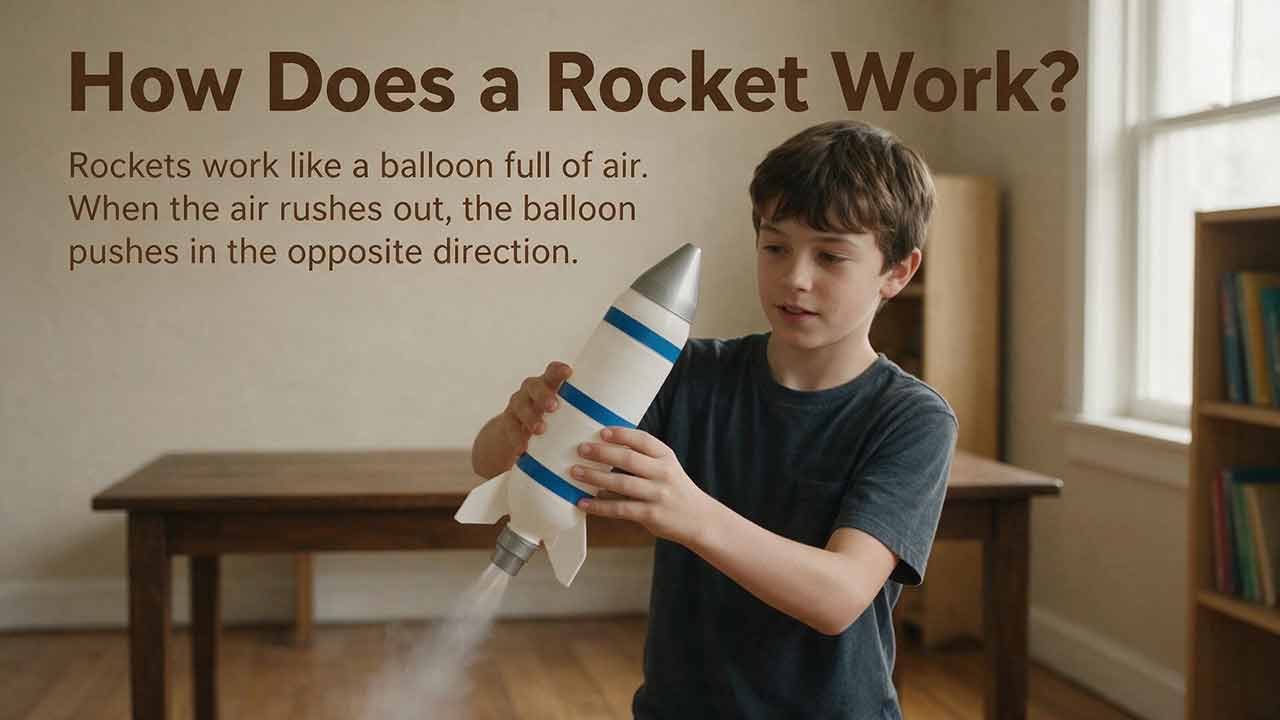
How Does a Rocket Work?
A rocket works by carrying propellant and accelerating part of that propellant backward as a high-speed exhaust stream. Conservation of momentum pushes the vehicle forward. During ascent, flight computers steer the rocket, structures withstand changing loads, and stages discard empty mass. To reach orbit, the upper stage must build enough horizontal velocity—not merely climb above the atmosphere.
Key Takeaways
- A rocket produces thrust by accelerating exhaust in one direction, causing the vehicle to move in the opposite direction.
- Chemical rockets carry both fuel and an oxidizer, so their engines can operate without atmospheric oxygen.
- Reaching orbit requires substantial horizontal velocity as well as altitude.
- Guidance, navigation, and control systems continually measure and correct the rocket’s motion.
- Staging improves performance by removing tanks, engines, and structures that are no longer useful.
This guide will help you follow the complete process from engine start to payload separation. It includes a six-action explanation framework, two transparent calculation examples, launch-phase tables, a mission-selection framework, and a decoder for common launch-broadcast terms.
How Does a Rocket Work From Launch to Orbit?
A rocket completes six connected actions: it stores propellant, converts chemical energy, accelerates exhaust, directs thrust, discards unnecessary mass, and delivers a payload.
This sequence explains more than the familiar image of a rocket rising from a launchpad. An orbital launch is a coordinated interaction among propulsion, structures, aerodynamics, sensors, software, staging systems, and orbital mechanics.
The Six-Action Rocket Framework
| Action | What happens | Why it matters |
|---|---|---|
| Store | The vehicle carries propellant, electrical energy, pressurized fluids, avionics, and payload hardware | A rocket must bring nearly everything required for powered flight |
| Convert | Fuel and oxidizer react, releasing chemical energy | The reaction creates high-temperature, high-pressure gas |
| Accelerate | The gas expands through a nozzle and leaves at high velocity | Accelerating exhaust backward produces forward thrust |
| Direct | Engines and control systems aim the thrust vector | The rocket must follow a planned trajectory rather than simply rise |
| Discard | Empty stages, boosters, and the payload fairing separate | Removing unnecessary mass improves the remaining vehicle’s performance |
| Deliver | The final stage establishes the required velocity and direction | Mission success depends on the final trajectory, not altitude alone |
The framework can be remembered as:
Store → Convert → Accelerate → Direct → Discard → Deliver
Each action solves a different engineering problem. A powerful engine is not enough if the structure is too heavy, the guidance is inaccurate, or the upper stage cannot deliver the required final velocity.
How Does a Rocket Engine Produce Thrust?
A rocket engine produces thrust by accelerating propellant backward through a nozzle. The exhaust gains momentum in one direction, while the rocket gains momentum in the opposite direction.
A commonly used form of the rocket thrust equation is:
$$
F = \dot{m}V_e + A_e(p_e - p_0)
$$
Where:
- $F$ is thrust.
- $\dot{m}$ is propellant mass flow rate.
- $V_e$ is exhaust velocity at the nozzle exit.
- $A_e$ is nozzle exit area.
- $p_e$ is pressure at the nozzle exit.
- $p_0$ is surrounding atmospheric pressure.
The first term represents momentum thrust from the exhaust stream. The second represents pressure thrust caused by the difference between nozzle-exit pressure and ambient pressure.
Nozzle shape influences the exhaust velocity, exit pressure, mass flow, and overall engine performance. The NASA Glenn rocket thrust equation reference provides a fuller explanation of these relationships.
What Is Rocket Propellant?
Propellant is the material expelled by a rocket to produce thrust.
In a chemical rocket, the propellant system normally includes a fuel and an oxidizer. The fuel and oxidizer react to release chemical energy, producing hot gases that expand through the nozzle.
The oxidizer is not merely an accessory that “supports” energy from the fuel. The chemical reaction between both components releases the energy used by the engine.
Because a chemical rocket carries its oxidizer, it does not depend on oxygen from the atmosphere. This allows the engine to continue operating at high altitude and in space. NASA distinguishes rockets from air-breathing engines on this basis in its liquid rocket engine overview.
What Does the Rocket Nozzle Do?
The nozzle converts the energy of pressurized gas into a fast, directed exhaust stream.
Most large chemical rocket engines use a converging-diverging nozzle. The flow first passes through a narrowing section, reaches the nozzle throat, and then expands through a widening section.
The nozzle is therefore more than an opening at the bottom of an engine. Its dimensions affect how effectively pressure and thermal energy become exhaust velocity.
A nozzle intended mainly for sea-level operation faces different ambient-pressure conditions from one intended for vacuum. Upper-stage engines often use larger nozzle expansion ratios because they operate where surrounding pressure is much lower.
Can a Rocket Work in a Vacuum?
A rocket works in a vacuum because it exchanges momentum with its own exhaust rather than pushing against the surrounding air.
The engine pushes exhaust backward. The exhaust exerts an equal and opposite force on the engine and vehicle. No atmosphere is required for this exchange.
A useful analogy is a person standing on a low-friction cart and throwing a heavy object. The object moves one way, while the person and cart move the other way. The motion comes from an exchange of momentum, not from pushing against the room.
The same principle allows a rocket engine to operate in space. In fact, reduced ambient pressure can improve the effective performance of a nozzle designed for vacuum conditions.
How Does a Rocket Lift Off?
A rocket lifts off when its upward thrust becomes greater than its weight and the vehicle is released or cleared to leave the launch structure.
A useful first measure is the thrust-to-weight ratio:
$$
TWR = \frac{T}{mg}
$$
Where:
- $T$ is total thrust.
- $m$ is vehicle mass.
- $g$ is local gravitational acceleration.
A thrust-to-weight ratio above 1 means that thrust exceeds weight. It does not, by itself, describe the entire launch performance because drag, engine orientation, changing mass, and other forces also matter.
Worked Example: Initial Thrust-to-Weight Ratio
Given values
Consider a hypothetical launch vehicle with:
- Liftoff mass: 500,000 kilograms
- Total liftoff thrust: 7.5 million newtons
- Standard gravitational acceleration: 9.80665 meters per second squared
Step 1: Calculate the vehicle’s weight
$$
W = mg
$$
$$
W = 500{,}000 \times 9.80665
$$
$$
W \approx 4.90 \text{ million newtons}
$$
Step 2: Calculate the thrust-to-weight ratio
$$
TWR = \frac{7.5}{4.90}
$$
$$
TWR \approx 1.53
$$
Step 3: Estimate initial net upward acceleration
Ignoring aerodynamic drag:
$$
a = \frac{T-W}{m}
$$
$$
a =\frac{7{,}500{,}000 - 4{,}903{,}325}{500{,}000}
$$
$$
a \approx 5.19 \text{ m/s}^2
$$
Interpretation
The rocket begins with thrust equal to about 1.53 times its weight. Its estimated net upward acceleration is approximately 5.19 meters per second squared before accounting for drag and other real-flight effects.
Assumptions and limitations
This is an illustrative calculation, not a prediction for a real launch vehicle. It assumes:
- Constant thrust at the instant being examined
- Vertical thrust alignment
- No aerodynamic drag
- No wind or side forces
- No change in mass during the calculation
- Standard gravitational acceleration
A real flight model would update thrust, mass, gravity, drag, orientation, atmospheric density, winds, and engine performance throughout ascent.
Which Forces Act on a Rocket During Launch?
A rocket’s motion is mainly shaped by thrust, gravity, aerodynamic drag, and side forces created by airflow or control inputs.
| Force | Typical effect | Main cause |
|---|---|---|
| Thrust | Accelerates the rocket along the commanded direction | Exhaust leaving the propulsion system |
| Weight | Pulls the vehicle toward Earth | Gravity acting on the rocket’s mass |
| Drag | Opposes motion through the atmosphere | Pressure forces and skin friction |
| Aerodynamic side force | Produces bending or rotation | Wind, angle of attack, steering, or uneven airflow |
These forces change continuously. The rocket becomes lighter as propellant is consumed, atmospheric density generally decreases with altitude, and vehicle speed rises rapidly during early ascent.
What Is Max Q?
Max Q is the point during ascent when dynamic pressure reaches its maximum value.
Dynamic pressure is commonly expressed as:
$$
q = \frac{1}{2}\rho V^2
$$
Where:
- $q$ is dynamic pressure.
- $\rho$ is local atmospheric density.
- $V$ is vehicle speed relative to the surrounding air.
Near liftoff, the atmosphere is dense but the rocket is moving slowly. At high altitude, the rocket may be moving much faster, but the air is thinner.
Max Q occurs between those conditions, when speed and atmospheric density combine to produce the highest dynamic pressure. The NASA Glenn dynamic-pressure reference explains how dynamic pressure rises and then falls during ascent.
Some launch vehicles reduce thrust around this period to keep structural and aerodynamic loads within design limits. The exact throttle profile depends on the vehicle, weather, trajectory, and mission.
Why Does a Rocket Turn Sideways After Launch?
A rocket turns sideways because orbit requires horizontal velocity, not just altitude.
A vehicle launched straight upward would eventually slow and fall back unless it followed an escape trajectory. To enter orbit, the rocket must accelerate the payload sideways until the payload moves fast enough to keep falling around Earth rather than directly back toward the surface.
That continuous free fall is an orbit.
Why Does the Rocket Start Vertically?
The early vertical climb allows the rocket to:
- Clear the launch structure
- Move away from ground facilities
- Establish controlled flight
- Begin passing through the dense lower atmosphere
- Align with a safe downrange trajectory
Soon after liftoff, the rocket begins a programmed pitch maneuver. The flight path becomes progressively less vertical as the vehicle builds horizontal velocity.
NASA’s flight-to-orbit explanation emphasizes that orbital flight requires both altitude and horizontal speed.
How Fast Is Low Earth Orbit?
A spacecraft in a typical low Earth orbit travels at approximately 7.8 kilometers per second, although the exact speed depends on orbital altitude and shape.
The European Space Agency gives approximately 7.8 km/s as a representative low-Earth-orbit speed, with an orbital period of roughly 90 minutes. (ESA: Low Earth orbit)
That figure is the spacecraft’s orbital speed, not the complete performance requirement imposed on the launch vehicle.
The rocket must provide additional velocity capability to compensate for:
- Gravity losses while the engines are firing
- Atmospheric drag
- Steering losses
- The selected launch site
- Orbital altitude
- Orbital inclination
- The mission’s final trajectory
For this reason, “about 7.8 km/s in low Earth orbit” should not be interpreted as the rocket’s entire required launch delta-v.
What Happens During a Typical Rocket Launch?
A typical orbital launch moves through engine start, liftoff, trajectory shaping, maximum aerodynamic loading, staging, upper-stage flight, and payload separation.
The exact order and timing vary by vehicle. The following table describes a representative sequence rather than one specific rocket.
| Phase | What happens | Main objective |
|---|---|---|
| 1. Engine start and verification | Engines or boosters begin operating and onboard systems assess key conditions | Establish acceptable propulsion before release where the design permits |
| 2. Liftoff | Thrust exceeds weight and the rocket leaves the pad | Begin controlled ascent |
| 3. Pitch and roll maneuvers | The rocket aligns with its planned launch azimuth and downrange path | Begin building horizontal velocity |
| 4. Supersonic flight | The vehicle exceeds the local speed of sound | Continue accelerating through the atmosphere |
| 5. Max Q | Dynamic pressure reaches its maximum and then declines | Remain within aerodynamic and structural limits |
| 6. Engine cutoff | A stage or booster stops producing useful thrust | End that propulsion phase |
| 7. Stage separation | The spent stage is released | Remove mass that no longer contributes useful performance |
| 8. Upper-stage ignition | Another engine continues the acceleration | Add velocity in thin atmosphere or vacuum |
| 9. Fairing separation | The protective payload enclosure is discarded | Remove mass after atmospheric protection is no longer needed |
| 10. Orbit insertion | The upper stage reaches the required trajectory | Establish the target orbit or transfer path |
| 11. Payload separation | The spacecraft detaches from the launch vehicle | Begin independent spacecraft operations |
Some missions include a coast period followed by a second or third upper-stage burn. These burns may circularize an orbit, change its shape, or place the payload on a transfer trajectory.
Not every rocket follows the same sequence. Suborbital vehicles, direct-injection missions, reusable stages, and deep-space launches can use substantially different flight profiles.
How Do Rockets Steer During Launch?
Rockets steer through a guidance, navigation, and control system, often abbreviated as GNC.
Each part of GNC has a different function:
- Navigation estimates the rocket’s position, velocity, acceleration, and orientation.
- Guidance determines the desired path and calculates the required corrections.
- Control commands hardware that changes the vehicle’s motion.
The flight computer compares the measured state of the rocket with the planned trajectory. It then commands actuators, engines, or thrusters to reduce the difference.
Which Systems Measure the Rocket’s Motion?
Depending on the vehicle, navigation sensors may include:
- Accelerometers
- Gyroscopes
- Inertial measurement units
- Satellite-navigation receivers
- Pressure instruments
- Stage and engine sensors
- Mission-specific tracking systems
The rocket does not rely on a human pilot making continuous manual corrections. Modern launch vehicles normally use onboard computers to execute the planned guidance logic.
Which Hardware Changes the Rocket’s Direction?
Common steering methods include:
- Engine or nozzle gimbaling: The engine or nozzle pivots, changing the direction of thrust.
- Differential throttling: Engines on different sides produce unequal thrust.
- Aerodynamic control surfaces: Fins or other surfaces create forces while sufficient atmosphere remains.
- Reaction-control thrusters: Small thrusters rotate or translate a stage in thin atmosphere or space.
- Solid-motor thrust-vector control: Specialized mechanisms redirect the effective thrust of a solid motor.
NASA’s rocket control reference explains how control forces create torque about the vehicle’s center of mass.
Why Do Rockets Use Multiple Stages?
Staging improves performance by removing tanks, engines, and structures that no longer contribute useful thrust.
After a stage has consumed most of its propellant, its empty tanks and supporting hardware become a burden. Separating that stage means the remaining engines no longer need to accelerate its dry mass.
The European Space Agency describes each stage as a major launch-vehicle element containing propulsion, structure, tanks, and supporting equipment. (ESA: Materials, Structure and Stages)
How Does the Rocket Equation Explain Staging?
The ideal rocket equation connects velocity change, propulsion efficiency, and mass ratio:
$$
\Delta v =I_{sp}g_0\ln\left(\frac{m_0}{m_1}\right)
$$
Where:
- $\Delta v$ is ideal change in velocity.
- $I_{sp}$ is specific impulse.
- $g_0$ is standard gravitational acceleration.
- $m_0$ is initial mass.
- $m_1$ is final mass after propellant consumption.
- $\ln$ is the natural logarithm.
Specific impulse is an efficiency-related measure that connects thrust with propellant flow. A higher specific impulse generally means a propulsion system produces more impulse from a given propellant weight flow.
The NASA Glenn ideal rocket equation and specific impulse reference explain why mass ratio and propulsion efficiency are central to rocket performance.
Worked Example: Ideal Upper-Stage Delta-V
Given values
Consider a simplified upper stage with:
- Initial mass, $m_0$: 100,000 kilograms
- Final mass, $m_1$: 20,000 kilograms
- Specific impulse, $I_{sp}$: 350 seconds
- Standard gravitational acceleration, $g_0$: 9.80665 meters per second squared
Step 1: Calculate the mass ratio
$$
\frac{m_0}{m_1}\frac{100{,}000}{20{,}000}5
$$
Step 2: Apply the ideal rocket equation
$$
\Delta v =350\times9.80665\times\ln(5)
$$
$$
\Delta v\approx5{,}520 \text{ m/s}
$$
Result
The calculated ideal delta-v is approximately:
$$
5.52 \text{ km/s}
$$
Interpretation
The example shows why final stage mass matters. If the stage carried more empty structure through the burn, $m_1$ would increase, the mass ratio would decrease, and the available ideal delta-v would fall.
Assumptions and limitations
This result is not a complete prediction of real flight performance. The ideal rocket equation does not fully represent:
- Gravity losses
- Atmospheric drag
- Steering losses
- Engine startup and shutdown transients
- Residual or unusable propellant
- Changes in engine performance
- Propellant reserved for disposal or recovery
- Mission-specific operating limits
The example is intended to show the relationship among mass ratio, specific impulse, and ideal velocity change.
What Is Hot Staging?
Most readers picture one stage separating completely before the next engine starts. That is common, but it is not the only possible architecture.
In a hot-staging sequence, the next stage begins producing thrust before complete physical separation. This requires a vehicle specifically designed to manage exhaust flow, structural loads, separation clearance, and timing.
Hot staging is a specialized architecture and is not used by every launch vehicle. It should not be treated as the default sequence for all multistage rockets.
Which Is Better: Solid, Liquid, or Hybrid Propulsion?
No propulsion type is best for every mission. The correct choice depends on thrust, controllability, storage, efficiency, cost, restart requirements, reliability goals, and vehicle architecture.
| Propulsion type | Basic arrangement | Common advantages | Common limitations | Typical roles |
|---|---|---|---|---|
| Liquid | Fuel and oxidizer are stored separately and fed into an engine | Can support throttling, shutdown, restart, and precise mixture control, depending on design | Requires tanks, valves, plumbing, feed systems, seals, and more complex operations | Core stages, upper stages, reusable boosters, spacecraft propulsion |
| Solid | Fuel and oxidizer are incorporated into a solid propellant grain | High thrust, compact packaging, storage potential, and comparatively simple major architecture | Usually limited throttling, shutdown, and restart capability | Strap-on boosters, launch stages, kick stages |
| Hybrid | Commonly combines solid fuel with a separately stored liquid or gaseous oxidizer | Separates major reactants and may allow throttling or shutdown | Combustion stability, scaling, and fuel regression can complicate development | Research, suborbital vehicles, and selected commercial systems |
These are broad tendencies, not universal rules. Individual propulsion systems can depart from the general pattern.
NASA notes that the basic thrust relationship applies to both liquid and solid rocket engines, even though their internal arrangements differ. (NASA Glenn: Liquid Rocket Engine)
How Does a Rocket Survive Launch Loads?
A rocket survives launch by combining a lightweight load-bearing structure with carefully controlled trajectories, verified materials, tested joints, and operating limits.
The structure must withstand:
- Compression
- Bending
- Vibration
- Acoustic energy
- Aerodynamic pressure
- Thermal effects
- Engine loads
- Stage-separation shock
The central tradeoff is mass. Adding structure can increase strength, but every additional kilogram must also be accelerated.
ESA identifies propulsion, structural elements, guidance systems, and electrical subsystems as core launcher components. It also lists quasi-static, dynamic, thermal, acoustic, and shock loads among the environments a launcher must survive. (ESA: Launcher Systems)
What Protects the Payload?
Most orbital payloads are enclosed within a payload fairing, a streamlined protective shell near the top of the rocket.
The fairing helps protect the spacecraft from:
- Aerodynamic pressure
- Heating during atmospheric ascent
- Acoustic energy
- Weather and contamination before launch
- Direct high-speed airflow
Once the atmosphere is thin enough, the fairing becomes unnecessary mass and is separated.
NASA states that payload fairings protect spacecraft from aerodynamic pressure and heating during ascent. Its PACE mission documentation provides a clear mission example. (NASA: PACE Spacecraft Encapsulated in Payload Fairing)
The exact fairing-separation altitude and timing vary by mission. A fairing should not be discarded until the payload can tolerate the surrounding environment.
How Does a Rocket Know When to Separate a Stage?
Stage separation occurs when onboard logic determines that the current stage has completed its useful role and the required separation conditions have been met.
The decision can depend on:
- Propellant depletion
- Engine cutoff
- Elapsed flight time
- Measured velocity and altitude
- Guidance-computed trajectory state
- Vehicle orientation
- Stage readiness signals
- Separation-system status
Mechanical connections are then released, and a separation system creates enough relative motion to prevent the stages from colliding.
The next engine may start before, during, or after separation, depending on the vehicle’s architecture. The timing must account for exhaust flow, structural loads, clearance, propellant behavior, and control authority.
Why Is Reaching Orbit Harder Than Reaching Space?
Reaching a commonly used boundary of space requires altitude. Reaching orbit requires the correct combination of altitude, horizontal velocity, and direction.
Organizations do not all use exactly the same altitude when describing the boundary of space. The atmosphere also does not end at a perfectly sharp physical line; it becomes progressively thinner with altitude.
Orbit is a different concept. A payload must move sideways fast enough for its path to curve around Earth.
A suborbital vehicle can rise above a commonly used space boundary and still return to Earth without completing an orbit. An orbital vehicle must deliver the payload to a sustained trajectory with the correct:
- Altitude
- Velocity
- Direction
- Inclination
- Orbital shape
- Timing
This is why an orbital rocket is solving a much more demanding problem than a vehicle designed only to reach a high altitude.
What Happens After the Payload Reaches Orbit?
After the upper stage reaches the planned separation trajectory, the payload detaches and begins operating as an independent spacecraft.
Early spacecraft activities may include:
- Establishing communication with ground stations
- Confirming spacecraft health
- Stabilizing attitude
- Deploying solar arrays or antennas
- Performing orbit-correction maneuvers
- Testing instruments and subsystems
- Beginning mission commissioning
The upper stage may also have post-separation responsibilities. Depending on its design and mission, it may perform a disposal burn, lower its orbit for reentry, move to a disposal orbit, or remain on its final trajectory.
Payload separation is therefore a handoff rather than the absolute end of launch operations.
Which Rocket Design Choices Fit Different Missions?
Rocket design begins with the payload and destination. Engineers work backward from the required mass, volume, orbit, deployment conditions, acceleration limits, and mission energy.
Mission-to-System Selection Framework
| Mission requirement | Important design priorities | Main tradeoff |
|---|---|---|
| Heavy payload to low Earth orbit | High liftoff thrust, large propellant capacity, strong structures | Larger vehicle and ground infrastructure |
| Small payload to a precise orbit | Accurate guidance, precise cutoff, restart capability | Lower total payload capacity may be acceptable |
| Lunar or interplanetary mission | Efficient upper stage, high total delta-v, long coast capability | Greater complexity and stricter thermal management |
| Multiple satellites | Several deployment events and collision avoidance | More demanding integration and sequencing |
| Reusable first stage | Recovery propellant, thermal protection, landing control, inspection | Recovery hardware and reserve propellant add mass |
| Human spaceflight | Redundancy, abort capability, environmental control, strict verification | Additional mass, testing, cost, and operational complexity |
This framework shows why rocket comparisons based only on height or liftoff thrust are incomplete.
A vehicle optimized for heavy cargo to low Earth orbit solves a different problem from a launcher designed for precise delivery to a high-energy transfer orbit.
How Can You Understand a Rocket Launch Broadcast?
Launch commentators use short callouts because events happen quickly. The terminology can vary among launch providers, but the following meanings are common.
| Callout | Typical meaning |
|---|---|
| T-minus | Time remaining before a scheduled event, usually liftoff |
| Liftoff | The vehicle has left the launch platform |
| Pitch program | The rocket has begun turning toward its planned trajectory |
| Supersonic | The vehicle is moving faster than the local speed of sound |
| Max Q | The rocket is passing through maximum dynamic pressure |
| Throttle down | Engine thrust is being reduced according to the flight plan |
| Throttle up | Engine thrust is being increased after a limiting condition |
| MECO | Main engine cutoff |
| Stage separation | One stage has detached from another |
| Second-stage ignition | The next propulsion stage has begun operating |
| Fairing separation | The protective payload enclosure has been discarded |
| Nominal | A measured condition remains within its expected operating range |
| Acquisition of signal | A ground station has established communication |
| Payload separation | The spacecraft has detached from the launch vehicle |
A callout should always be interpreted within the mission’s published timeline. The same abbreviation may be used differently by different organizations.
Why Might a Rocket Miss Its Planned Orbit?
A rocket can miss its target when it fails to deliver the required velocity, direction, timing, or structural integrity.
| High-level problem | Possible result | What investigators examine |
|---|---|---|
| Early engine shutdown | Insufficient velocity | Engine data, commands, sensors, and propellant conditions |
| Reduced propulsion performance | Lower-than-planned acceleration | Thrust estimates, mass flow, engine conditions, and vehicle mass |
| Guidance deviation | Incorrect direction or orbital plane | Navigation data, software, sensors, and actuators |
| Stage-separation problem | Added mass, collision risk, or loss of the next stage | Release commands, mechanical systems, and relative motion |
| Fairing-separation failure | Excess mass remains attached | Release hardware, electrical commands, and separation indications |
| Structural failure | Loss of vehicle integrity | Loads, materials, joints, vibration, and aerodynamic conditions |
| Upper-stage restart failure | A transfer or circularization burn is missed | Ignition systems, propellant state, thermal conditions, and commands |
| Payload deployment problem | Spacecraft remains attached or enters an unintended state | Deployment hardware, timing, and electrical interfaces |
This is an educational system-level framework. It is not a procedure for operating, modifying, or troubleshooting real launch hardware.
Actual accident investigations require complete telemetry, engineering models, physical evidence, test records, and vehicle-specific expertise.
“A rocket pushes against the air”
A rocket gains momentum by accelerating exhaust backward. It does not need surrounding air and can operate in a vacuum.
“Orbit means escaping gravity”
Gravity remains strong in low Earth orbit. A spacecraft stays in orbit because gravity continuously bends its path around Earth.
“The goal is to fly straight up”
A rocket initially climbs upward, but an orbital mission requires substantial sideways velocity.
“More thrust always means a better rocket”
Thrust must be considered with vehicle mass, efficiency, burn duration, structural limits, reliability, staging, and mission requirements.
“All parts of the rocket reach orbit”
Boosters, first stages, payload fairings, and other components are often separated before the payload reaches its final trajectory.
“Specific impulse is the same as thrust”
Thrust is force. Specific impulse is an efficiency-related propulsion measure. A high-thrust engine does not automatically have the highest specific impulse.
“One engine reaching space means the vehicle can be single-stage-to-orbit”
These are different questions.
Some engines can operate across a wide altitude range, although one nozzle design will not normally be optimal at both sea level and vacuum. A single-stage-to-orbit vehicle must also satisfy extremely demanding requirements for structural mass, propellant fraction, engine performance, thermal protection, and payload capacity.
A Practical Checklist for Understanding Any Rocket
When evaluating a launch vehicle, ask:
- What payload and destination is the rocket designed to serve?
- Which engines or boosters provide liftoff thrust?
- What is the approximate thrust-to-weight ratio at launch?
- How many stages or boosters are discarded?
- Which propulsion system is used on each stage?
- How does the vehicle steer?
- When is the payload fairing separated?
- Does the upper stage need to restart?
- What final altitude, velocity, direction, and inclination are required?
- Which components are recovered, disposed of, or left in orbit?
- Are the quoted figures official specifications, estimates, or simplified calculations?
- Does the comparison account for mission type rather than only rocket size?
These questions create a more useful picture than comparing rockets only by height, appearance, or maximum advertised payload.
Who This Article Is—and Is Not—For
This article is intended for:
- Readers seeking a clear explanation of how rockets work
- Students learning introductory propulsion and orbital concepts
- Launch viewers who want to understand common mission events
- Writers and educators checking basic spaceflight terminology
- Readers preparing to explore thrust, staging, guidance, or orbital mechanics in more detail
This article is not:
- A rocket-engine construction guide
- A propellant formulation guide
- An ignition or launch-operations manual
- A pressure-vessel design reference
- A substitute for formal aerospace engineering education
- A substitute for applicable laws, range-safety procedures, licenses, or manufacturer instructions
Anyone participating in model, amateur, academic, or commercial rocketry should follow the laws, airspace rules, safety requirements, and approved procedures that apply in the relevant jurisdiction.
How This Article Was Reviewed
This article was source-checked against publicly available NASA and European Space Agency educational and technical material.
The two numerical examples were independently calculated for illustration and include their assumptions and limitations. They do not represent test results from a real launch vehicle.
The article was not presented as having been reviewed by an unnamed engineer or technical expert. No external reviewer is claimed unless a real reviewer is later identified and their contribution can be documented.
Why You Can Trust This Guide
This guide separates three types of information:
- Established principles, such as conservation of momentum and the role of horizontal velocity in orbit
- Simplified calculations, which are labeled with assumptions and limitations
- Original explanatory tools, including the six-action framework and mission-selection table
The guide is based on authoritative educational references, published aerospace documentation, and transparent illustrative calculations rather than hands-on rocket testing.
What This Article Does Not Claim
This article does not claim that:
- Every rocket follows exactly the same launch sequence
- One propulsion type is best for every mission
- The worked examples predict real launch performance
- A particular speed guarantees orbital insertion
- High thrust alone determines vehicle quality
- All launch vehicles use the same staging or steering architecture
- Source-checking is equivalent to independent expert review
- Reading an introductory guide qualifies someone to build or operate launch hardware
What Should You Remember About How a Rocket Works?
A rocket works by converting stored energy into a fast exhaust stream and using the resulting momentum exchange to produce thrust.
During an orbital launch, the rocket must do much more than rise. It must steer through the atmosphere, survive changing loads, discard unnecessary mass, and build the correct horizontal velocity.
The simplest accurate summary is:
- The rocket stores propellant.
- The engine releases chemical energy.
- The nozzle accelerates exhaust.
- The vehicle gains thrust in the opposite direction.
- Guidance systems shape the trajectory.
- Stages remove unnecessary mass.
- The upper stage establishes the required orbit or transfer path.
- The payload separates and begins its mission.
Key Concepts to Review
A complete understanding of rocket flight connects five ideas: thrust, staging, orbital velocity, guidance and control, and propulsion tradeoffs. Thrust must overcome weight and accelerate the vehicle; staging discards mass that has finished its job; orbital flight requires sufficient horizontal velocity; guidance and control keep the vehicle on the planned path; and propulsion choices balance efficiency, controllability, storage, complexity, and mission requirements.
How fast does a rocket need to travel to reach orbit?
A spacecraft in a typical low Earth orbit travels at roughly 7.8 kilometers per second, although the exact orbital speed depends on altitude and orbit shape.
The launch vehicle must normally provide more total velocity capability than this orbital speed because it also loses performance to gravity, atmospheric drag, steering, and mission-specific trajectory requirements. Launch location and orbital inclination also affect the required performance.
Why do rockets launch vertically instead of horizontally?
A near-vertical launch helps the vehicle clear ground structures, move away from populated facilities, and begin passing through the dense lower atmosphere.
The rocket then turns progressively toward the horizontal direction required for orbit. Some specialized launch systems begin differently, but conventional large orbital rockets usually launch nearly vertically.
Do rocket engines become more efficient in space?
Many rocket engines have better effective performance as ambient pressure decreases, especially when their nozzles are designed for vacuum operation.
However, performance depends on the complete engine and nozzle design. An engine optimized for vacuum may not be suitable for sea-level operation because excessive exhaust-flow separation can create unstable loads.
What happens to a rocket’s first stage?
The result depends on the launch system.
An expendable first stage may fall into a designated region or break up during atmospheric reentry. A reusable first stage may reserve propellant and use controlled maneuvers to reach a landing site or recovery platform.
The first stage usually does not follow the payload to its final orbit.
Can one rocket engine operate from the ground to orbit?
Some engines can operate across a broad altitude range, but their nozzles cannot normally be optimal at both sea level and vacuum.
This is separate from the question of single-stage-to-orbit. Whether an entire vehicle can reach orbit without staging depends on mass ratio, structural mass, propulsion efficiency, thermal protection, recovery hardware, and payload requirements—not simply on whether one engine can keep running.
What is the difference between a rocket and a spacecraft?
A rocket, or launch vehicle, supplies the propulsion needed to carry a payload away from Earth and place it on a planned trajectory.
A spacecraft is the vehicle that performs the mission after launch. It may carry instruments, cargo, communications equipment, or people.
The distinction can become less clear when upper stages, space tugs, landers, or reusable spacecraft perform both transportation and mission functions.
Sources
NASA Glenn Research Center: Rocket Thrust Equation
Explains the relationship among mass flow, exhaust velocity, nozzle pressure, and thrust. Accessed July 31, 2026.NASA Glenn Research Center: Ideal Rocket Equation
Explains how mass ratio and exhaust performance affect ideal velocity change. Accessed July 31, 2026.NASA Glenn Research Center: Specific Impulse
Defines specific impulse and its use as a propulsion-efficiency measure. Accessed July 31, 2026.NASA Glenn Research Center: Flight to Orbit
Explains why orbital flight requires horizontal velocity as well as altitude. Accessed July 31, 2026.NASA Glenn Research Center: Dynamic Pressure
Explains dynamic pressure and the maximum dynamic-pressure point known as Max Q. Accessed July 31, 2026.NASA Glenn Research Center: Rocket Control
Describes how rocket control systems produce torque and alter vehicle orientation. Accessed July 31, 2026.NASA Glenn Research Center: Liquid Rocket Engine
Provides an overview of liquid rocket engines and the distinction between rockets and air-breathing propulsion. Accessed July 31, 2026.NASA Science: PACE Spacecraft Encapsulated in Payload Fairing
Provides an official example of a fairing protecting a payload from aerodynamic pressure and heating. Accessed July 31, 2026.European Space Agency: Launcher Systems
Describes launcher propulsion, structures, guidance systems, electrical systems, and launch loads. Accessed July 31, 2026.European Space Agency: Materials, Structure and Stages
Describes the major components contained within launch-vehicle stages. Accessed July 31, 2026.European Space Agency: Low Earth Orbit
Provides the representative low-Earth-orbit speed of approximately 7.8 kilometers per second. Accessed July 31, 2026.European Space Agency: Spacecraft Orbits
Provides an overview of spacecraft motion around Earth and other celestial bodies. Accessed July 31, 2026.
Editorial review: Source-checked against the NASA and ESA references listed above; not externally expert-reviewed.
More from Rockets & Launch Systems
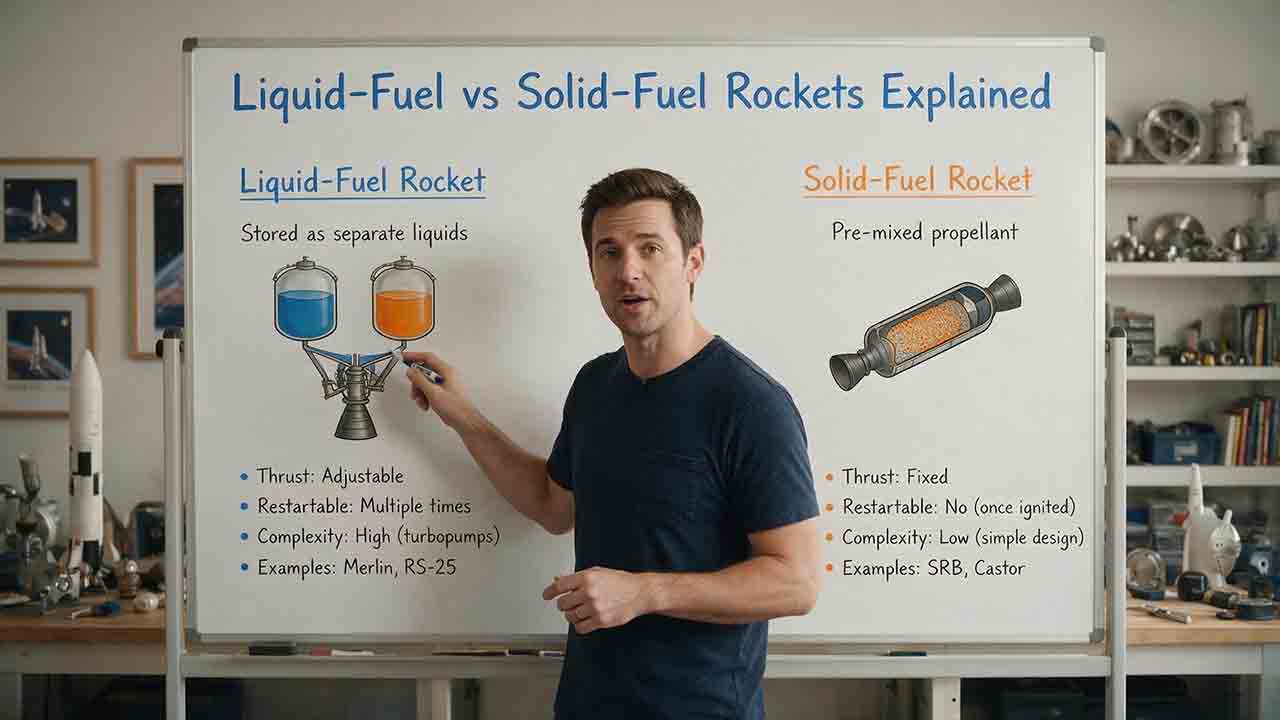
Liquid-Fuel vs Solid-Fuel Rockets Explained
Liquid-fuel and solid-fuel rockets solve different engineering problems. Liquid rocket engines store fuel and oxidizer separately, allowing many systems to regulate thrust, shut down, or restart during flight. Solid rocket motors contain prepared solid propellant and can deliver compact, powerful thrust with fewer active feed-system components, although conventional motors offer limited control after ignition. This article compares both propulsion types across thrust, specific impulse, storage, mechanical complexity, reliability, cost, reusability, and environmental considerations. It also explains why solid motors often serve as launch boosters while liquid engines are widely used for core stages, upper stages, and powered recovery. An original calculation demonstrates how specific impulse affects ideal velocity change, while a five-part mission framework helps readers evaluate propulsion choices based on control, performance, packaging, operations, and lifecycle requirements. Real launch systems, including SLS, Ariane 6, Falcon 9, and Vulcan Centaur, show why no single propulsion type is best for every mission.
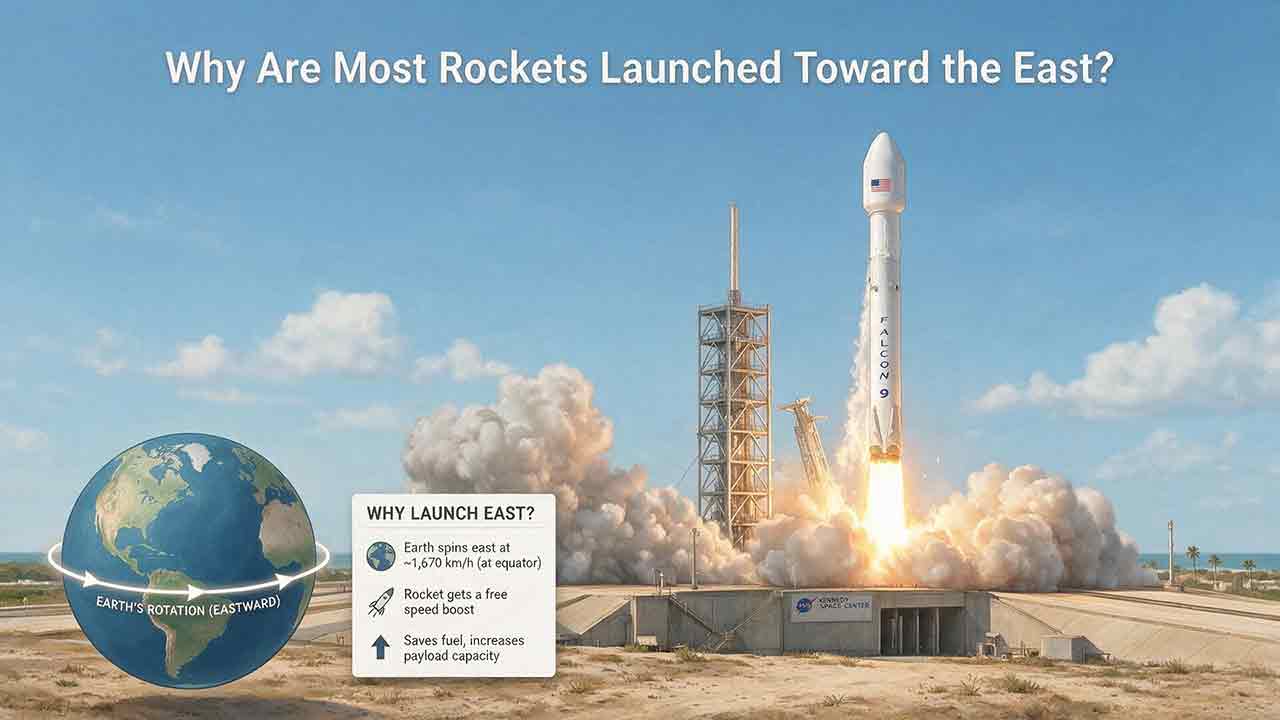
Why Are Most Rockets Launched Toward the East?
Most orbital rockets launch generally toward the east because Earth rotates from west to east, giving launch vehicles useful initial velocity before liftoff. This advantage is strongest near the equator and can reduce the additional speed a rocket must produce for compatible prograde orbits. However, launch direction is not determined by efficiency alone. Target orbital inclination, launch-site latitude, populated areas, stage-impact zones, range-safety rules, and mission objectives may require a rocket to travel northeast, southeast, south, or along a retrograde trajectory. This article explains how Earth’s rotation contributes to launch performance, compares Kourou with Cape Canaveral through a transparent calculation, and shows how latitude and launch azimuth affect the usable speed component. It also introduces the reader-friendly EAST framework for evaluating real missions and explains why polar, Sun-synchronous, and range-constrained launches often do not fly directly east.
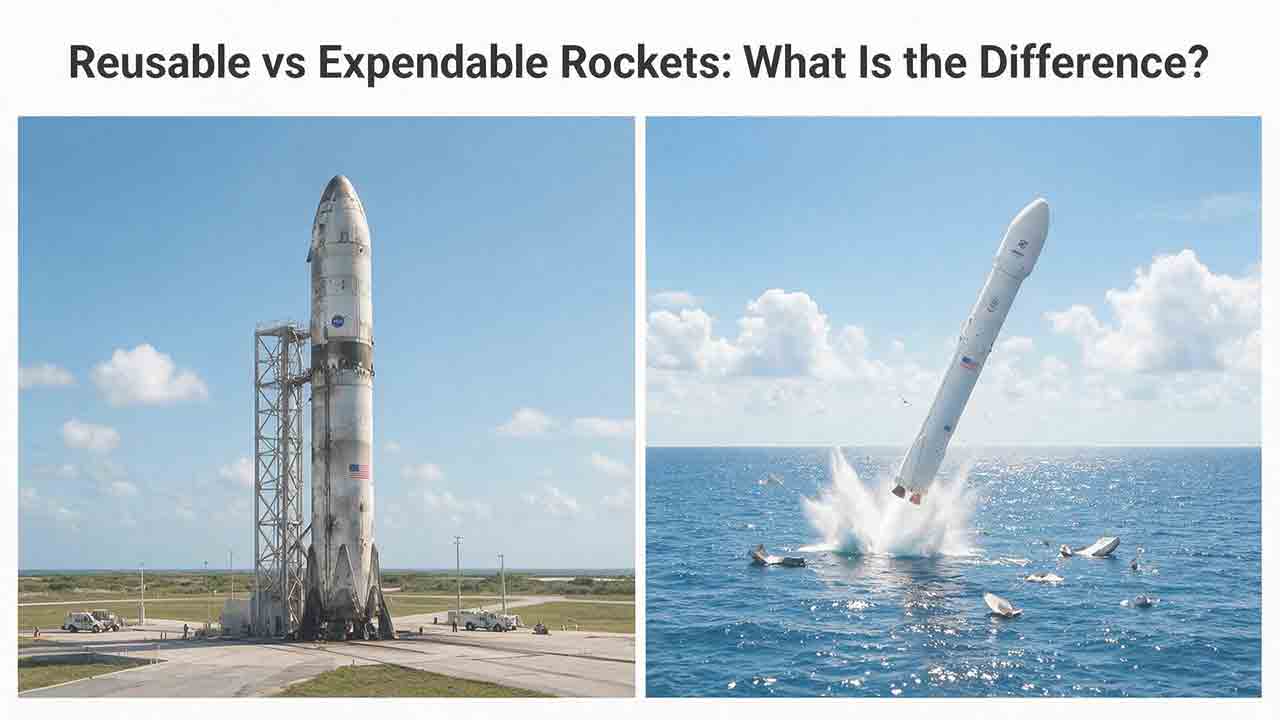
Reusable vs Expendable Rockets: What Is the Difference?
Reusable and expendable rockets follow two different approaches to launch vehicle design. Reusable systems recover and fly again one or more major components, while expendable rockets use each propulsive stage only once. This guide compares the two architectures across payload performance, recovery requirements, launch cadence, reliability, refurbishment, and mission cost. It explains why reusable rockets may reduce average hardware costs when stages fly frequently, while expendable configurations can preserve more performance for demanding payloads or high-energy destinations. The article also distinguishes partial reuse from full reuse, examines Falcon 9, NASA’s Space Launch System, and ESA’s Themis demonstrator, and introduces the original RAMP framework for early mission screening. A fictional cost-sensitivity example, decision tree, troubleshooting table, and practical checklist help readers evaluate launch options without relying on unsupported commercial cost claims or treating either architecture as universally superior.
Explore More Topics
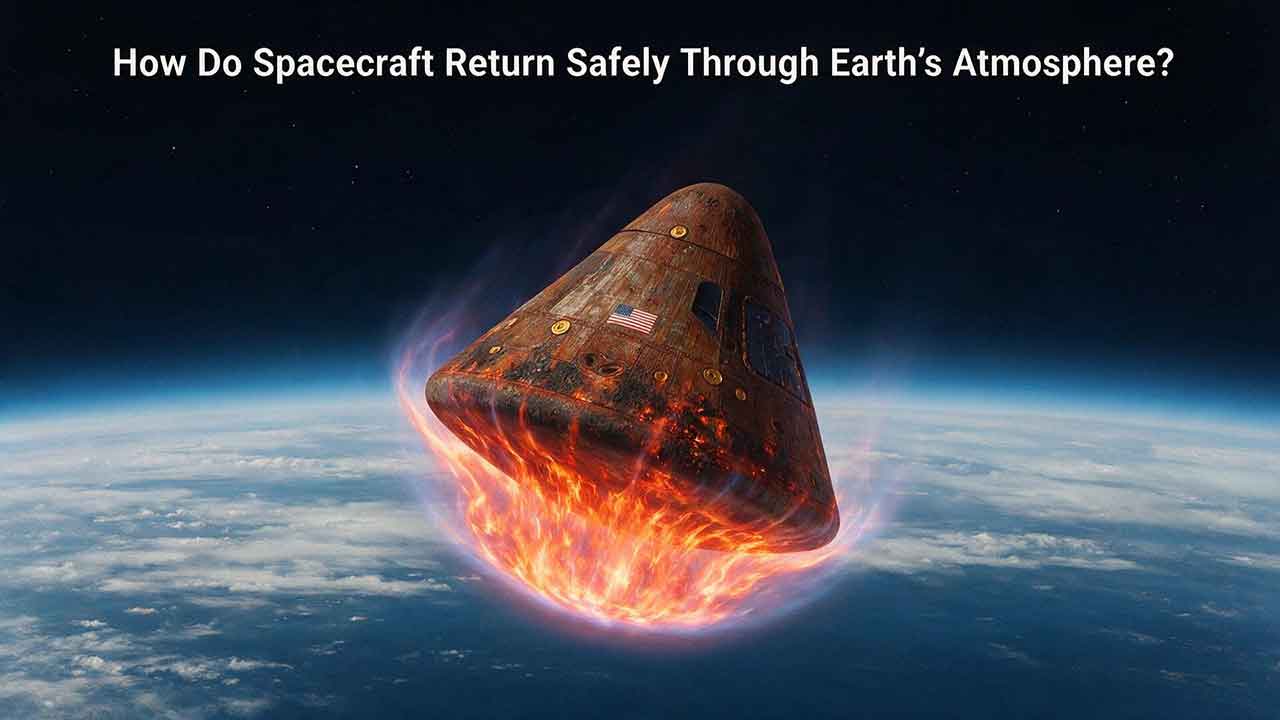
How Do Spacecraft Return Safely Through Earth’s Atmosphere?
Spacecraft return safely through Earth’s atmosphere by managing an enormous amount of energy through a carefully coordinated sequence of trajectory control, thermal protection, aerodynamic deceleration, landing, and recovery. This article explains how deorbit burns and entry corridors guide a spacecraft toward its landing region, why blunt heat shields reduce the danger of hypersonic heating, and how guidance systems control attitude, range, and structural loads. It includes an original comparison of low-Earth-orbit and lunar-return energy, a practical review of ablative and reusable heat-shield technologies, and the CosmoBasics Four-Layer Reentry Framework covering path, protection, control, descent, and recovery. Real-world lessons from Artemis I and the crewed Artemis II mission show why postflight inspection remains essential even after a successful splashdown. Readers will also learn how parachutes, wings, landing rockets, flotation systems, and recovery teams complete the return safely.
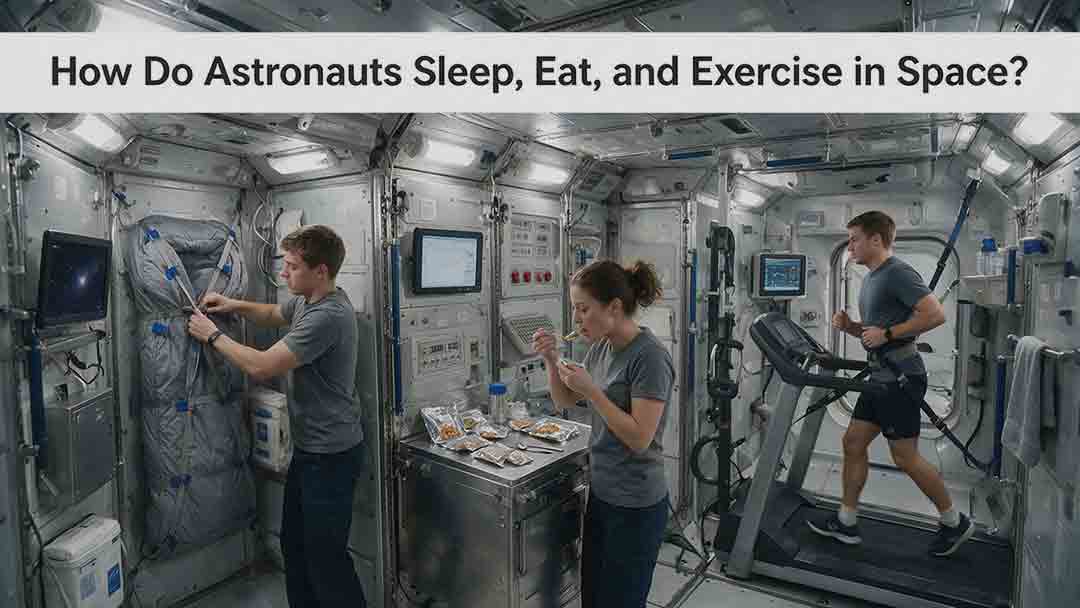
How Do Astronauts Sleep, Eat, and Exercise in Space?
Astronauts must redesign ordinary routines when they live in microgravity. This article explains how crew members sleep in secured bags inside ventilated quarters, prepare packaged meals without letting food or liquids drift through the cabin, and use specialized exercise equipment to protect their physical condition. It examines the roles of the Advanced Resistive Exercise Device, the T2 treadmill, and the CEVIS cycle ergometer, while clarifying the difference between active workout time and the full scheduled exercise period. Readers will also learn why tortillas are practical in space, how airflow affects sleep, why ordinary weights do not work normally in orbit, and how nutrition, rest, and exercise support one another. NASA and ESA sources provide the factual foundation, while original comparison tables and practical evaluation frameworks show how spacecraft systems replace functions normally supplied by gravity. The article also distinguishes current International Space Station practices from possible future Moon and Mars mission requirements.
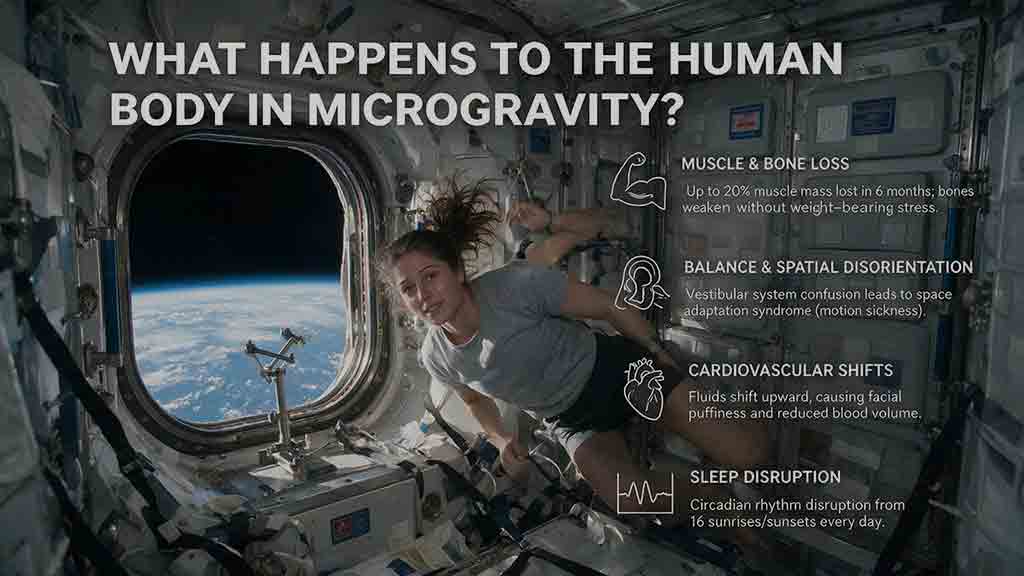
What Happens to the Human Body in Microgravity?
Microgravity changes the human body because fluids are no longer pulled toward the legs, muscles and bones receive less mechanical loading, and the brain loses gravity as a dependable orientation signal. This article explains how weightlessness affects balance, circulation, muscle strength, bone density, vision, blood, immunity, digestion, sleep, and spinal length. It also examines why astronauts may struggle to stand or walk after landing and how exercise, nutrition, monitoring, and rehabilitation help reduce these risks. Two original tools—the Load–Flow–Orientation Framework and the Gravity-Transition Readiness Matrix—connect physiological changes with real mission demands. Drawing on NASA standards, NASA technical reports, ESA materials, and peer-reviewed human spaceflight research, the guide clearly separates established observations from experimental countermeasures and unresolved questions. It also explains what these effects could mean for future missions to the Moon and Mars without treating population averages as predictions for individual astronauts.