Why Are Most Rockets Launched Toward the East?

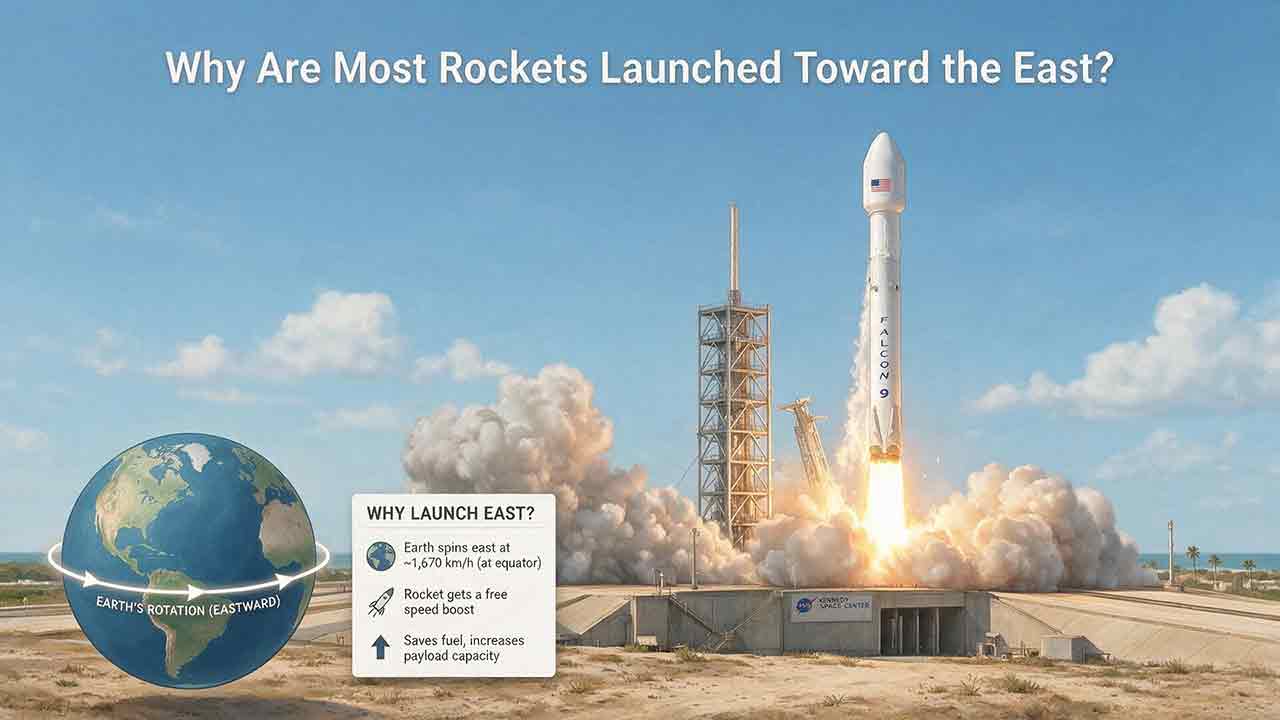
Why Are Most Rockets Launched Toward the East?
Most rockets are launched toward the east because Earth rotates from west to east. A rocket on the pad already has eastward inertial velocity, so an eastbound ascent can preserve and add to that motion. The benefit is largest near the equator, but the target orbit, launch-site geography, range safety, and recovery or debris corridors can require another direction.
Key Takeaways
- Earth’s rotation gives an eastbound rocket an initial velocity advantage before its engines ignite.
- The maximum eastward surface speed is about 465.1 meters per second at the equator and decreases with latitude.[1]
- Launching east is usually most helpful for prograde, low-inclination, geostationary-transfer, and some deep-space missions.
- Polar, Sun-synchronous, retrograde, and geographically constrained missions may launch north, south, or west instead.
- The most efficient theoretical direction is not always the safest or most useful mission direction.
This guide explains where the eastward advantage comes from, how latitude and launch azimuth affect it, why rockets turn after liftoff, and how to interpret the direction of a real launch without mistaking a simplified estimate for a complete mission analysis.
Why Does Launching East Help a Rocket Reach Orbit?
An eastward launch allows a rocket to retain part of the velocity it already has because it is sitting on a rotating planet.
Earth rotates toward the east. Before liftoff, the launch pad, rocket, payload, nearby atmosphere, and observers are all moving eastward around Earth’s rotational axis.
At the equator, the surface travels east at approximately 465.1 meters per second, or 1,674 kilometers per hour.[1] A rocket launched generally eastward can preserve that initial motion and add engine-produced velocity in the same broad direction.
This does not mean Earth suddenly pushes the rocket forward when the engines ignite. The rocket already has eastward inertial velocity while it is standing on the pad.
A useful analogy is walking on a moving walkway. Before taking a step, the person is already moving in the walkway’s direction. Walking forward adds speed relative to the floor, while the walkway supplies part of the person’s speed relative to the building.
NASA uses the same underlying idea when explaining launches from a spinning planet: a launch site is moving before the vehicle leaves the ground, and mission planners must account for that motion.[2]
What Is a Prograde Orbit?
A prograde orbit travels around Earth in the same general direction as Earth rotates—from west to east.
Most artificial satellites use prograde orbits because these orbits can benefit from Earth’s rotation. The alternative is a retrograde orbit, which travels primarily east to west and therefore opposes Earth’s rotational direction.
The distinction concerns the spacecraft’s motion in an Earth-centered reference frame. A ground observer’s camera angle or the apparent direction of a rocket’s exhaust plume does not reliably identify whether the final orbit is prograde or retrograde.
How Important Is the Rotational Advantage?
A spacecraft in a low circular Earth orbit typically travels at roughly 7.8 kilometers per second, although the exact speed depends on orbital altitude and shape.[3]
The maximum 465.1-meter-per-second equatorial contribution is therefore only part of the velocity needed for orbit. It does not replace the launch vehicle’s engines, and it does not compensate for gravity loss, atmospheric drag, steering loss, or the energy needed to climb away from Earth.
Even so, several hundred meters per second can be valuable. Launch vehicle performance depends strongly on the total velocity the propulsion system must provide, so a relatively modest reduction can improve payload capability or preserve mission margin.
How Much Speed Can an Eastward Launch Gain?
A launch site near the equator offers almost 465.1 meters per second of eastward surface velocity. The available value decreases as the launch site moves toward either pole.
A simplified latitude-based estimate is:
Estimated local eastward rotational speed = 465.1 × cos(latitude) m/s
In this expression, latitude is measured in degrees north or south of the equator.
The cosine term reflects the distance a location travels around Earth’s rotational axis. A point on the equator traces a large circle during each rotation. A point at a higher latitude traces a smaller circle during the same period.
At the geographic poles, the local eastward surface speed around the rotation axis approaches zero.
Estimated Rotational Speed by Latitude
| Launch-site latitude | Estimated eastward surface speed | Percentage of equatorial value |
|---|---|---|
| 0° | 465.1 m/s | 100% |
| 5° | 463.3 m/s | 99.6% |
| 15° | 449.3 m/s | 96.6% |
| 28.5° | 408.7 m/s | 87.9% |
| 45° | 328.9 m/s | 70.7% |
| 60° | 232.6 m/s | 50.0% |
| 90° | Approximately 0 m/s | 0% |
These are first-order calculated estimates, not measurements of a particular rocket’s launch performance.
Worked Example: Kourou Versus Cape Canaveral
Kourou in French Guiana lies at approximately 5°3′ north latitude, or about 5.05°N.[4] Its proximity to the equator is one reason Europe’s Spaceport is well suited to geostationary-transfer missions.[5]
Cape Canaveral and Kennedy Space Center are near 28.5°N. A due-east launch from this region can directly enter an orbit with an inclination of approximately 28.5°, subject to the mission’s detailed trajectory.[6]
Using the simplified latitude formula:
Kourou
Estimated rotational speed
= 465.1 × cos(5.05°)
≈ 463.3 m/s
Cape Canaveral region
Estimated rotational speed
= 465.1 × cos(28.5°)
≈ 408.7 m/s
Estimated difference
463.3 − 408.7
≈ 54.6 m/s
Rounded to a practical comparison, Kourou has about 55 meters per second more local eastward surface velocity than a site at 28.5° latitude.
That difference is meaningful, but it cannot be converted directly into a fixed increase in payload mass. Payload capability also depends on the launch vehicle, staging, destination, trajectory losses, upper-stage design, propellant reserves, fairing configuration, and recovery requirements.
Assumptions Used in This Estimate
- Earth is represented with a simplified latitude-based rotation model.
- The calculation estimates local eastward surface velocity.
- It assumes the launch site and payload initially share Earth’s rotational motion.
- It does not include gravity loss, atmospheric drag, steering loss, staging, reserves, recovery maneuvers, or upper-stage performance.
- It is not an estimate of payload capacity.
- A real trajectory may use only part of the available eastward component.
- Small differences caused by Earth’s exact shape and local site coordinates are outside the purpose of this comparison.
The calculation is useful for comparing launch-site geometry. It is not a substitute for a mission-specific trajectory simulation.
How Does Launch Azimuth Change the Available Advantage?
A rocket receives the largest direct along-track benefit when its horizontal heading is due east.
Launch azimuth is the horizontal direction of the launch trajectory, conventionally measured clockwise from true north.[11]
Under this convention:
- 0° is due north.
- 90° is due east.
- 180° is due south.
- 270° is due west.
A simple projection estimate can connect latitude and heading:
Useful along-track rotation component ≈ 465.1 × cos(latitude) × sin(launch azimuth) m/s
A positive result represents an eastward, prograde contribution. A value near zero means Earth’s eastward rotation contributes little directly along the rocket’s initial horizontal heading. A negative result means the heading is generally westward.
Simplified Example at 28.5° Latitude
| Initial launch azimuth | General direction | Estimated along-track rotation component |
|---|---|---|
| 90° | Due east | +408.7 m/s |
| 135° | Southeast | +289.0 m/s |
| 180° | Due south | Approximately 0 m/s |
| 225° | Southwest | −289.0 m/s |
| 270° | Due west | −408.7 m/s |
A due-north or due-south heading receives little direct along-track benefit from Earth’s eastward rotation. However, the launch vehicle still begins with the launch site’s eastward inertial velocity, and the complete mission trajectory must account for it.
This projection formula is a local, first-order teaching tool. It does not calculate orbital insertion velocity, and it does not describe an entire ascent. Real rockets continuously change altitude, pitch, heading, speed, and reference frame during flight.
Why Do Rockets Rise Vertically Before Turning East?
Orbital rockets usually begin with a near-vertical climb to clear the launch structure and move through the dense lower atmosphere before building most of their horizontal velocity.
Launching east does not mean pointing the rocket horizontally from the pad. A vehicle traveling sideways near the surface would encounter terrain, infrastructure, and dense atmosphere while experiencing severe aerodynamic loads.
After clearing the tower, the guidance system commands a gradual pitch maneuver. The rocket follows a curved ascent and becomes increasingly horizontal as it climbs.
The basic sequence is:
- Clear the launch pad and nearby structures.
- Climb through the dense lower atmosphere.
- Pitch toward the required launch azimuth.
- Accelerate primarily to build horizontal velocity.
- Separate stages as planned.
- Enter the target orbit or departure trajectory.
NASA emphasizes that orbital flight requires both altitude and horizontal velocity. A vehicle can cross a commonly used boundary of space without reaching orbit if it lacks sufficient sideways speed.[7]
This is why “going up” is only the beginning of an orbital launch. The rocket’s larger task is to accelerate sideways fast enough that its falling path curves around Earth.
How Does the Target Orbit Determine Launch Direction?
The target orbital plane usually matters more than obtaining the maximum possible eastward speed.
An orbit is not defined only by altitude. It also has an orientation around Earth.
One of the most important parameters is orbital inclination, the angle between the orbital plane and Earth’s equator.[13]
- An equatorial orbit has an inclination near 0°.
- A moderate-inclination orbit reaches corresponding northern and southern latitudes.
- A polar orbit has an inclination near 90°.
- A retrograde orbit has an inclination greater than 90°.
For a direct prograde launch, the minimum practical orbital inclination is generally related to the launch site’s latitude. A due-east launch from a site near 28.5°N naturally produces an orbit near 28.5° inclination.[6]
A rocket can launch northeast or southeast to reach a higher inclination. Reaching an inclination lower than the launch site’s latitude normally requires additional maneuvering, a different launch site, or a more complex mission design.
Why Not Enter Any Orbit and Change the Plane Later?
Changing an orbital plane means changing the direction of a spacecraft’s velocity.
Because an orbiting spacecraft may already be traveling several kilometers per second, a substantial plane change can require a large amount of additional propulsion. Mission designers therefore try to enter an orbital plane close to the final requirement during launch.
The most eastward trajectory is useful only when it is compatible with the orbit the payload actually needs.
How Do Mission Planners Choose the Launch Direction?
The EAST framework is a reader-friendly mnemonic developed for this guide. It is not an official aerospace industry standard used by NASA, ESA, launch providers, or range authorities.
It organizes the major public-facing factors behind a launch direction into four questions.
E — Endpoint: Where Must the Payload Go?
Mission planners begin with the destination, not the compass heading.
The required endpoint may be:
- A low-inclination low Earth orbit
- A moderate-inclination crewed orbit
- A polar orbit
- A Sun-synchronous orbit
- A geostationary transfer orbit
- A lunar departure trajectory
- An interplanetary trajectory
The endpoint establishes the acceptable orbital planes, insertion conditions, and launch windows.
A communications satellite intended for geostationary orbit benefits from a low-inclination prograde departure. An Earth-observation satellite needing consistent global coverage may require a near-polar orbit even though that means giving up much of the direct eastward advantage.
A — Allowed Corridors: Which Directions Are Safe and Available?
A launch trajectory must remain within approved geographic and safety boundaries.
Mission planners account for:
- Populated areas
- National borders
- Aircraft routes
- Shipping traffic
- Planned stage-impact regions
- Fairing and hardware disposal zones
- Tracking coverage
- Off-nominal debris areas
- Booster recovery zones
- Environmental and regulatory restrictions
A heading that appears efficient on a globe may be unavailable because it would carry the vehicle over populated land or outside the launch range’s approved corridor.
S — Spin Benefit: How Much of Earth’s Rotation Can the Mission Use?
The local rotational advantage depends on both latitude and heading.
A due-east launch near the equator can use nearly the full eastward surface velocity. A northeast or southeast trajectory receives a smaller along-track component. A north-south trajectory receives little direct initial along-track contribution, while a westward trajectory opposes the direction of Earth’s rotation.
The spin benefit is valuable, but it is only one entry in the mission’s velocity and performance budget.
T — Tradeoffs: What Complete Mission Profile Works Best?
The final direction must balance multiple constraints:
- Payload mass
- Vehicle performance
- Target inclination
- Gravity and atmospheric losses
- Steering losses
- Upper-stage coast periods
- Propellant reserves
- Launch window timing
- Range availability
- Weather
- Tracking and communications
- Booster recovery, when applicable
- Abort or contingency requirements
For lunar and planetary missions, the best launch azimuth may also change with launch time because Earth rotates relative to the required departure plane.
The EAST framework prevents a common oversimplification: “east is efficient” does not mean “east is always correct.”
How Do Eastward, Polar, and Westward Launches Compare?
| General direction | Common mission types | Direct use of Earth’s rotation | Main advantage | Main limitation |
|---|---|---|---|---|
| East or mostly east | Prograde LEO, low-inclination missions, GTO, some deep-space departures | Strong positive contribution | Improves performance for compatible prograde missions | Cannot directly satisfy every orbital inclination |
| Northeast or southeast | Moderate- and high-inclination prograde missions | Partial positive contribution | Reaches more orbital planes while retaining some eastward benefit | May introduce additional steering and corridor constraints |
| North or south | Polar and near-polar missions | Little direct along-track contribution | Enables high-latitude and global coverage | Gives up most of the direct rotational advantage |
| West or mostly west | Retrograde missions | Negative along-track contribution | Reaches specialized retrograde orbital planes | Requires the vehicle to overcome the opposing initial direction |
| Dogleg or curved ground track | Range-constrained missions | Depends on each trajectory segment | Avoids restricted or unsafe areas | Adds steering loss and operational complexity |
These are general categories. A real launch trajectory is curved and three-dimensional, and its heading can change significantly between liftoff and orbital insertion.
Low-Inclination Low Earth Orbit Missions
A generally eastward launch is efficient when the required orbital inclination is close to the launch site’s latitude.
Cape Canaveral and Kennedy Space Center are well positioned for west-to-east and relatively low-inclination launches.[8] A due-east trajectory from the region naturally enters an orbit near 28.5° inclination.[6]
A spacecraft requiring a higher inclination can launch northeast or southeast, depending on the permitted range corridor.
Geostationary-Transfer Missions
Geostationary spacecraft ultimately operate above Earth’s equator and travel eastward at the same angular rate as Earth.
A near-equatorial launch site offers two important advantages:
- It provides almost the maximum rotational speed.
- It allows the spacecraft to begin with relatively little orbital inclination.
Kourou lies at approximately 5°3′N and has open access toward the Atlantic.[4][5] Its position makes it especially useful for launching spacecraft toward geostationary transfer orbit.
The spacecraft or upper stage must still raise and circularize the orbit. The equatorial location reduces part of the challenge; it does not eliminate the energy needed to reach geostationary altitude.
Some Lunar and Interplanetary Missions
Many deep-space missions begin with an eastward ascent into a parking orbit before an upper stage performs a departure burn.
However, the exact heading depends on the target’s position, the required departure plane, the launch date, and the available launch window. A mission may use a heading north or south of due east to align with its later trajectory.
For deep-space launches, “eastward is helpful” remains a starting principle rather than a complete mission rule.
Why Are Some Rockets Launched North or South?
Northward or southward launches are commonly used when the payload needs a polar or near-polar orbit.
A polar-orbiting satellite passes over or close to both poles. As Earth rotates beneath the orbital plane, the satellite can observe different regions during successive passes.
Polar and near-polar orbits are useful for:
- Weather observation
- Environmental monitoring
- Mapping
- Ice and ocean measurements
- Agricultural imaging
- Scientific surveys
- Reconnaissance
- Global communications constellations with high-latitude coverage
NASA identifies Vandenberg Space Force Base in California as a preferred launch site for spacecraft requiring north-south or polar orbits.[8] Its location allows southward trajectories over the Pacific Ocean instead of over major populated regions.
A real-world example is the Sentinel-6 Michael Freilich mission. Its Falcon 9 launch from Vandenberg used an initial azimuth of 151° from true north, carrying the rocket south-southeast over the Pacific.[12]
What Is a Sun-Synchronous Orbit?
A Sun-synchronous orbit is a near-polar orbit designed so that the orbital plane precesses at approximately the same rate that Earth moves around the Sun.
This geometry allows the satellite to cross a given latitude at roughly the same local solar time on successive passes.[10] Consistent lighting is useful when comparing Earth images taken on different days.
Many Sun-synchronous orbits are slightly retrograde, commonly with inclinations greater than 90°. For these missions, consistent observation geometry matters more than maximizing the eastward launch contribution.
Why Would a Rocket Launch West?
A generally westward launch is used when a required retrograde orbit or an unusual mission constraint outweighs the performance disadvantage.
A westbound rocket begins with the launch site’s eastward inertial velocity. It must cancel the along-track component of that motion before building substantial westward inertial velocity.
In an idealized equatorial comparison, the difference in initial along-track inertial velocity between a due-east and a due-west trajectory is about 930 meters per second:
465 m/s eastward versus 465 m/s westward.
This is not the complete performance difference between two real launch missions. It excludes gravity loss, drag, ascent geometry, staging, target altitude, inclination, and vehicle-specific performance.
Westward or retrograde missions may be selected for:
- A required retrograde orbital plane
- A Sun-synchronous orbit
- Specialized coverage or revisit geometry
- Launch-range restrictions
- National geography
- Scientific objectives
- Security or operational requirements
Retrograde launches are less common because they usually require more launch-vehicle performance for a comparable altitude and payload.
Why Can Range Safety Matter More Than Eastward Efficiency?
A launch direction must be safe and legally available before its performance advantage matters.
Launch vehicles may release stages, fairings, or other hardware during ascent. Mission planners must also account for possible off-nominal trajectories and debris.
The U.S. Space Force describes the Eastern Range as extending from Cape Canaveral eastward over the Atlantic, supporting tracking, telemetry, and safe launch corridors that avoid populated areas.[9]
This geography helps explain why Florida is well suited to eastward launches. The Atlantic provides a long downrange corridor, while Earth’s rotation supports prograde missions.
Vandenberg provides a different geographic advantage. Southward trajectories can travel over the Pacific, making the site suitable for polar and Sun-synchronous missions.[8]
Why Do Some Rockets Fly a Dogleg?
A dogleg trajectory deliberately changes the rocket’s ground-track direction to avoid a restricted area or satisfy range constraints.
Doglegs may be necessary to avoid:
- Populated regions
- National borders
- Islands
- Restricted airspace
- Unsafe stage-impact zones
- Incompatible recovery areas
The maneuver can make a mission possible, but it usually adds steering loss. The rocket spends some of its available performance changing direction instead of accelerating along the most efficient path.
Mistake 1: Saying Earth Pushes the Rocket After Liftoff
The rocket already has eastward momentum before ignition. Earth’s rotation is an initial condition, not an extra engine that continues accelerating the rocket after it leaves the pad.
Mistake 2: Saying Every Rocket Launches Due East
Many rockets launch northeast, southeast, south, or along a changing ground track. The required orbit and allowed corridor determine the direction.
Mistake 3: Confusing Reaching Space With Reaching Orbit
Altitude alone does not produce orbit. A spacecraft must develop enough horizontal velocity for its path to curve around Earth.[7]
A suborbital vehicle can travel above a conventional boundary of space and still fall back without completing an orbit.
Mistake 4: Treating 465.1 m/s as Extra Engine Velocity
The rocket does not receive 465.1 m/s from an additional propulsion event. It already shares the launch site’s rotational motion.
The useful contribution depends on latitude, heading, target orbit, and reference frame.
Mistake 5: Converting Surface Speed Directly Into Payload Mass
A 50- or 100-meter-per-second difference does not correspond to a universal number of additional kilograms.
Payload effects depend on the entire launch system, including staging, mass ratios, engine performance, reserves, trajectory losses, and destination.
Mistake 6: Assuming the Equator Is Best for Every Mission
A near-equatorial site is attractive for low-inclination and geostationary missions. It may be unsuitable for polar missions, unavailable for political or logistical reasons, or limited by geography and range safety.
Mistake 7: Calling the Effect a Gravity Assist
A launch from a rotating Earth is not the same as a planetary gravity assist.
The launch advantage comes from the rocket’s initial surface velocity. A gravity assist changes a spacecraft’s trajectory and energy during a later encounter with a moving celestial body.
How Can You Diagnose Why a Rocket Did Not Launch East?
Use the following process when a launch appears to be traveling in an unexpected direction.
1. Identify the Target Orbit
Look for the planned inclination and orbit type.
- Low inclination usually favors an eastward trajectory.
- Moderate inclination may require a northeast or southeast trajectory.
- Near 90° suggests a polar mission.
- Slightly above 90° may indicate a retrograde Sun-synchronous orbit.
- A much larger retrograde inclination may require a strongly westward component.
2. Check the Launch Site
Determine which directions provide safe access over water or unpopulated regions.
A trajectory that is acceptable from Vandenberg may not be acceptable from Cape Canaveral, and the reverse is also true.
3. Check the Published Launch Azimuth
Mission press kits may provide an initial flight azimuth. Remember that the heading can change later in the ascent.
A short broadcast view does not show the complete three-dimensional trajectory.
4. Look for Range or Recovery Constraints
Booster landing zones, stage-impact regions, fairing recovery areas, national borders, and airspace restrictions may influence the ground track.
5. Check the Launch Window
Missions rendezvousing with another spacecraft or departing for the Moon or a planet may need to launch when the site rotates into a specific plane.
The preferred azimuth can therefore depend on launch time.
Public Mission Information Checklist
Before drawing a conclusion, confirm:
- Target orbit or destination
- Planned inclination
- Prograde, polar, Sun-synchronous, or retrograde direction
- Launch-site latitude
- Initial launch azimuth
- Approved downrange corridor
- Stage-impact or recovery areas
- Any dogleg maneuver
- Launch-window requirements
- Whether a number is official or only an estimate
This checklist is intended for interpreting public mission information. It is not a procedure for designing or conducting a launch.
What This Article Does Not Claim
This article does not claim that:
- Every rocket launches due east.
- Earth’s rotation supplies most of the speed required for orbit.
- A near-equatorial launch site is ideal for every mission.
- A simplified velocity estimate predicts payload capacity.
- A northbound or southbound rocket loses its existing eastward inertial velocity.
- A launch’s full orbital trajectory can be determined from a ground video.
- The EAST framework is an official aerospace planning standard.
- First-order formulas can replace professional trajectory analysis.
The formulas and comparisons are intended to make public orbital-mechanics concepts easier to understand.
Sources and Calculation Method
The factual foundation of this guide comes from NASA, ESA, NOAA, NASA’s Jet Propulsion Laboratory, and the U.S. Space Force.
The following values are drawn from institutional sources:
- Earth’s approximate equatorial rotational speed of 465.1 m/s comes from NASA.[1]
- The approximate 7.8 km/s speed for a low circular Earth orbit comes from ESA.[3]
- Kourou’s latitude of approximately 5°3′N comes from ESA.[4]
- The relationship between launch-site latitude and directly accessible inclination is supported by NASA launch-design material.[6]
- Vandenberg’s suitability for north-south and polar missions comes from NASA Launch Services Program documentation.[8]
- The Sun-synchronous orbit explanation comes from NOAA technical documentation.[10]
- The Sentinel-6 initial launch azimuth comes from the official JPL mission press kit.[12]
The Kourou and Cape Canaveral velocity values were calculated for this guide using:
Estimated local eastward rotational speed = 465.1 × cos(latitude) m/s
The along-track examples use:
Useful along-track component = 465.1 × cos(latitude) × sin(launch azimuth) m/s
Both are simplified geometric estimates. They assume a local horizontal heading and do not model Earth’s complete shape, atmospheric motion, gravity loss, drag, staging, changing trajectory direction, reserves, or orbital insertion.
No claim is made that these calculations reproduce an actual launch provider’s performance analysis.
What This Means in Practice
Most rockets launch generally eastward because that direction allows them to preserve and build upon Earth’s rotational velocity. The advantage is greatest near the equator and is particularly useful for prograde, low-inclination, and geostationary-transfer missions.
The rule has clear limits. Polar satellites need north-south trajectories, Sun-synchronous missions commonly use near-polar retrograde orbits, and launch ranges may require a direction that avoids populated land or restricted areas.
For a reader watching a launch, the most useful next step is to check the mission’s target inclination and launch site. For a student, compare latitude, azimuth, and orbital plane. For deeper mission research, rely on the official press kit and range information rather than estimating the trajectory from a camera view.
Do all rockets launch toward the east?
No. Eastward launches are common for prograde missions because they can benefit from Earth’s rotation. Polar and Sun-synchronous satellites often launch north or south, while specialized retrograde missions may include a westward component. Geography and range safety can also prevent a rocket from using the most efficient theoretical direction.
How much speed does Earth’s rotation give a rocket?
The maximum local eastward surface speed is approximately 465.1 m/s at the equator.[1] It decreases with latitude, and only the portion aligned with the launch trajectory provides a direct along-track contribution. This value is an initial motion, not the complete velocity or delta-v required for orbit.
Why are launch sites near the equator valuable?
Near-equatorial sites provide almost the maximum rotational velocity and easier access to low-inclination or equatorial orbits. This is especially useful for geostationary-transfer missions. An equatorial site is not automatically best for polar missions, and it must still have suitable infrastructure, geography, tracking coverage, and safe downrange corridors.
Why are polar satellites often launched from California?
Vandenberg Space Force Base allows rockets to travel southward over the Pacific Ocean rather than over major populated areas. This corridor is well suited to polar and Sun-synchronous missions, which need north-south orbital geometry and do not prioritize the maximum direct eastward speed contribution.[8]
Why can’t a rocket launch horizontally to use the speed boost immediately?
A horizontal surface launch would encounter dense atmosphere, terrain, and severe aerodynamic loading. Orbital rockets first climb away from the surface and then pitch gradually toward the horizontal. Orbit requires substantial sideways velocity, but that velocity is built after the rocket has gained altitude and cleared the densest atmosphere.
Is launching east enough to place a spacecraft in orbit?
No. Earth’s rotation supplies only a fraction of the required motion. A low circular Earth orbit typically requires a speed near 7.8 km/s, depending on altitude.[3] The rocket must also overcome gravity, atmospheric drag, steering losses, and other mission demands.
Sources
NASA Goddard Space Flight Center. The Rotating Earth. Provides Earth’s equatorial circumference, sidereal rotation period, and approximate equatorial velocity of 465.1 m/s. Accessed July 31, 2026.
NASA Space Place. Launch a Rocket From a Spinning Planet. Explains how the motion of a launch site on rotating Earth affects mission planning. Accessed July 31, 2026.
European Space Agency. Low Earth Orbit. Describes typical low Earth orbital speed as approximately 7.8 km/s. Published March 2020. Accessed July 31, 2026.
European Space Agency. Where on Earth? Kourou. Gives Kourou’s location at latitude 5°3′N and describes Europe’s Spaceport. Published June 2024. Accessed July 31, 2026.
European Space Agency. Launch Site. Explains why Kourou’s proximity to the equator benefits geostationary-transfer launches and allows launchers to use Earth’s rotation. Accessed July 31, 2026.
NASA Small Spacecraft Systems Virtual Institute. Constellation Design Considerations for SmallSats. Discusses launch-site latitude, accessible orbital inclination, and the approximately 28.5° Cape Canaveral example. Accessed July 31, 2026.
NASA Glenn Research Center. Flight to Orbit. Explains that orbital flight requires both altitude and horizontal velocity. Accessed July 31, 2026.
NASA Launch Services Program. Launch Services Program Launch Sites. Describes Cape Canaveral’s suitability for west-east or equatorial missions and Vandenberg’s suitability for north-south and polar missions. Accessed July 31, 2026.
National Oceanic and Atmospheric Administration. NOAA Polar Satellite Navigation and Earth Location. Explains Sun-synchronous orbital precession and consistent local solar crossing time. Accessed July 31, 2026.
NASA Science. Chapter 2: Reference Systems. Defines azimuth as an angle measured clockwise from true north and identifies east as 90°. Accessed July 31, 2026.
NASA Jet Propulsion Laboratory. Sentinel-6 Launch Press Kit: Launch Events and Mission Phases. Documents the mission’s 151° initial launch azimuth and south-southeast trajectory from Vandenberg. Published for the 2020 Sentinel-6 launch. Accessed July 31, 2026.
NASA Earth Observatory. Catalog of Earth Satellite Orbits. Explains orbital inclination, polar orbits, and equatorial geostationary orbit geometry. Accessed July 31, 2026.
More from Rockets & Launch Systems
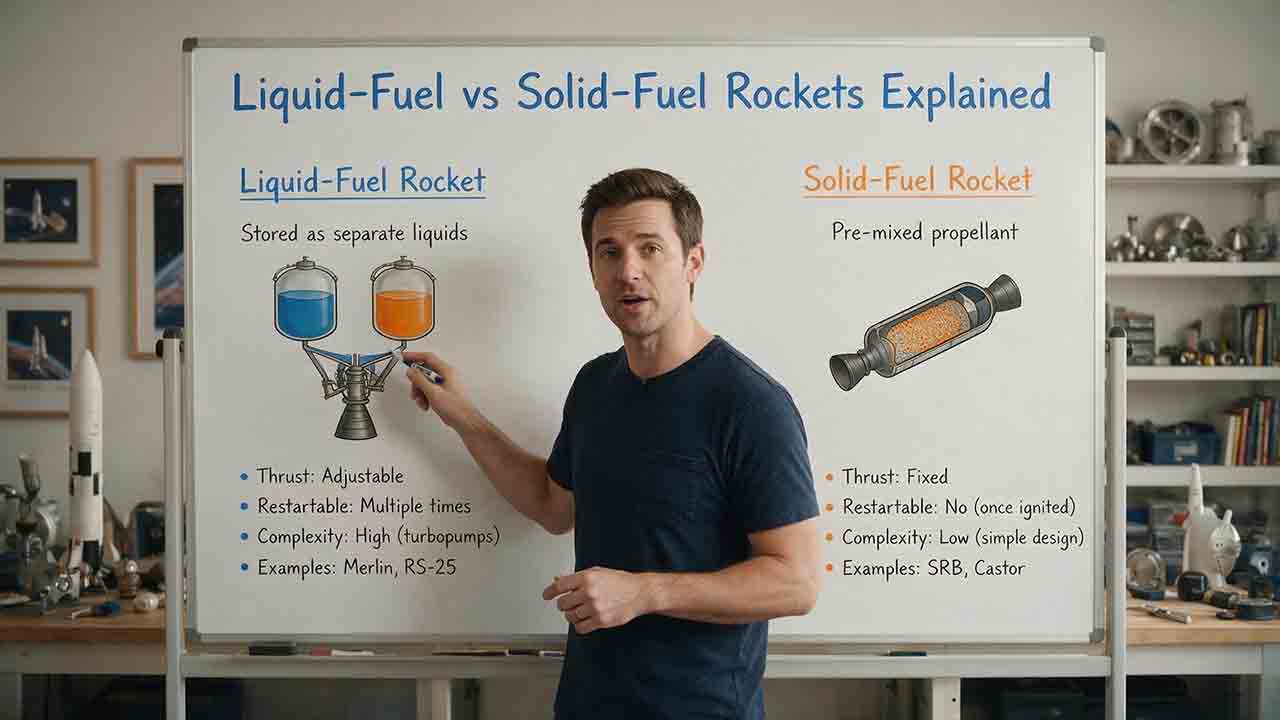
Liquid-Fuel vs Solid-Fuel Rockets Explained
Liquid-fuel and solid-fuel rockets solve different engineering problems. Liquid rocket engines store fuel and oxidizer separately, allowing many systems to regulate thrust, shut down, or restart during flight. Solid rocket motors contain prepared solid propellant and can deliver compact, powerful thrust with fewer active feed-system components, although conventional motors offer limited control after ignition. This article compares both propulsion types across thrust, specific impulse, storage, mechanical complexity, reliability, cost, reusability, and environmental considerations. It also explains why solid motors often serve as launch boosters while liquid engines are widely used for core stages, upper stages, and powered recovery. An original calculation demonstrates how specific impulse affects ideal velocity change, while a five-part mission framework helps readers evaluate propulsion choices based on control, performance, packaging, operations, and lifecycle requirements. Real launch systems, including SLS, Ariane 6, Falcon 9, and Vulcan Centaur, show why no single propulsion type is best for every mission.
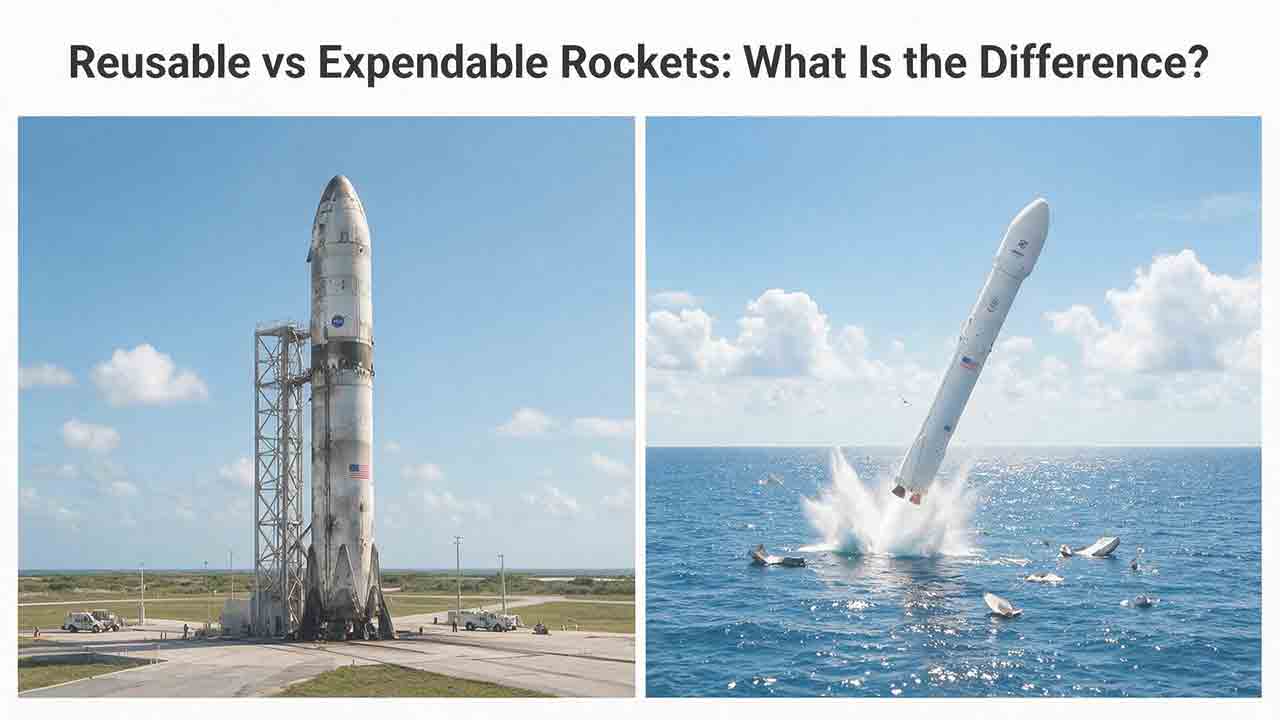
Reusable vs Expendable Rockets: What Is the Difference?
Reusable and expendable rockets follow two different approaches to launch vehicle design. Reusable systems recover and fly again one or more major components, while expendable rockets use each propulsive stage only once. This guide compares the two architectures across payload performance, recovery requirements, launch cadence, reliability, refurbishment, and mission cost. It explains why reusable rockets may reduce average hardware costs when stages fly frequently, while expendable configurations can preserve more performance for demanding payloads or high-energy destinations. The article also distinguishes partial reuse from full reuse, examines Falcon 9, NASA’s Space Launch System, and ESA’s Themis demonstrator, and introduces the original RAMP framework for early mission screening. A fictional cost-sensitivity example, decision tree, troubleshooting table, and practical checklist help readers evaluate launch options without relying on unsupported commercial cost claims or treating either architecture as universally superior.
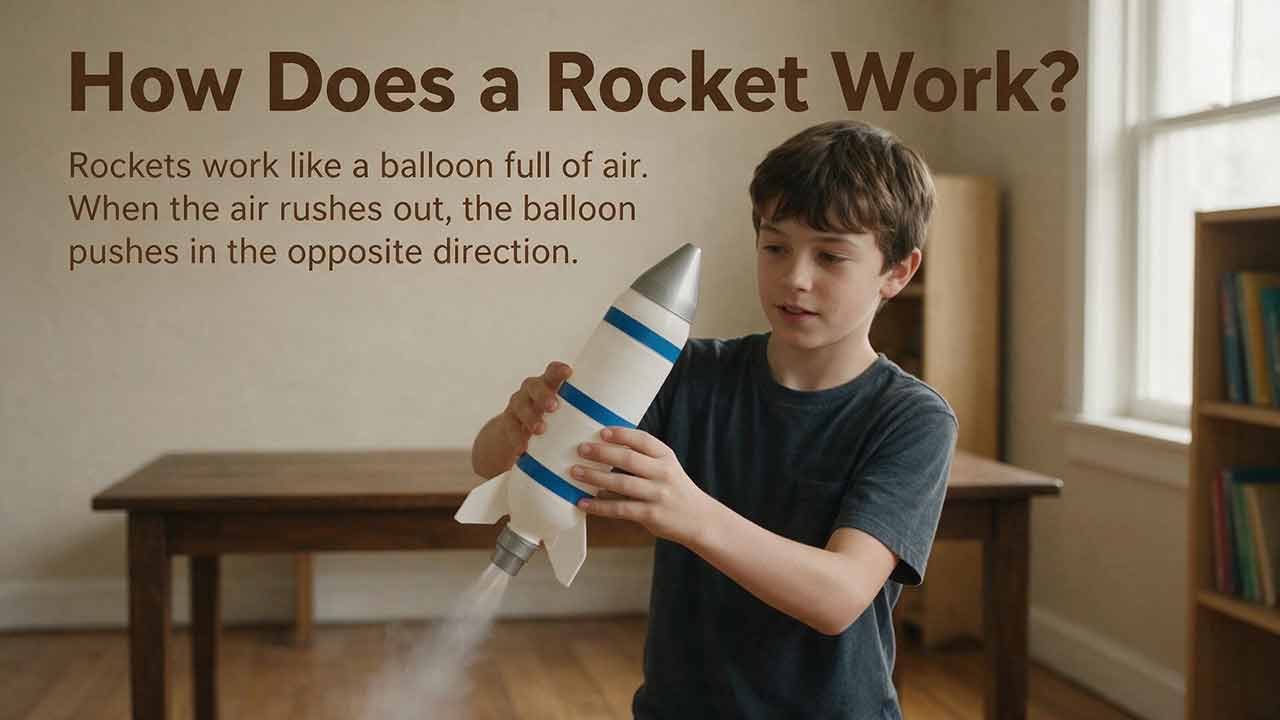
How Does a Rocket Work?
A rocket works by carrying propellant and accelerating exhaust backward at high speed, producing forward thrust through conservation of momentum. This article explains the complete process from engine ignition and liftoff to guidance, staging, orbit insertion, and payload separation. It shows why rockets carry both fuel and an oxidizer, how a nozzle converts pressure into exhaust velocity, why rocket engines can operate in a vacuum, and why reaching orbit requires substantial horizontal speed rather than altitude alone. Readers will also find transparent examples for calculating thrust-to-weight ratio and ideal delta-v, along with comparisons of liquid, solid, and hybrid propulsion systems. Practical tables explain Max Q, launch phases, steering methods, payload fairings, mission tradeoffs, and common launch-broadcast terminology. Based on authoritative NASA and European Space Agency references, the guide clearly separates established physics, simplified estimates, and original explanatory frameworks while avoiding construction, ignition, propellant, or operational launch instructions.
Explore More Topics
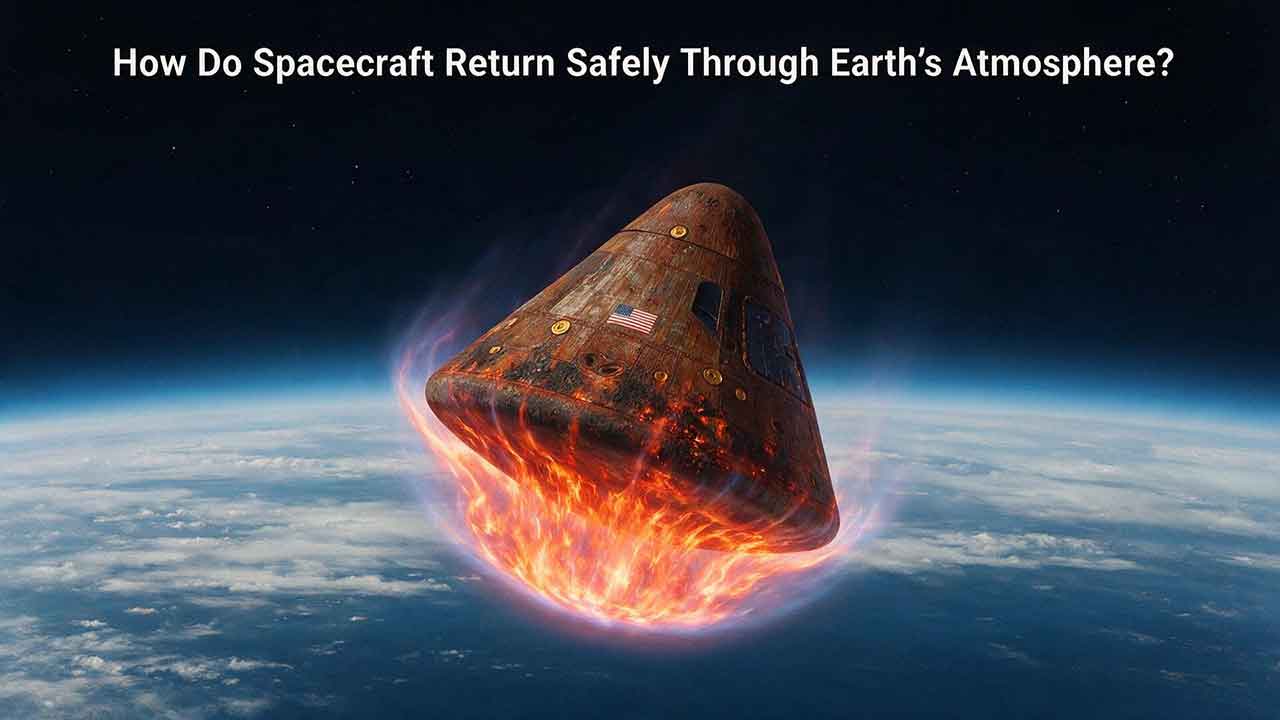
How Do Spacecraft Return Safely Through Earth’s Atmosphere?
Spacecraft return safely through Earth’s atmosphere by managing an enormous amount of energy through a carefully coordinated sequence of trajectory control, thermal protection, aerodynamic deceleration, landing, and recovery. This article explains how deorbit burns and entry corridors guide a spacecraft toward its landing region, why blunt heat shields reduce the danger of hypersonic heating, and how guidance systems control attitude, range, and structural loads. It includes an original comparison of low-Earth-orbit and lunar-return energy, a practical review of ablative and reusable heat-shield technologies, and the CosmoBasics Four-Layer Reentry Framework covering path, protection, control, descent, and recovery. Real-world lessons from Artemis I and the crewed Artemis II mission show why postflight inspection remains essential even after a successful splashdown. Readers will also learn how parachutes, wings, landing rockets, flotation systems, and recovery teams complete the return safely.

How Do Astronauts Sleep, Eat, and Exercise in Space?
Astronauts must redesign ordinary routines when they live in microgravity. This article explains how crew members sleep in secured bags inside ventilated quarters, prepare packaged meals without letting food or liquids drift through the cabin, and use specialized exercise equipment to protect their physical condition. It examines the roles of the Advanced Resistive Exercise Device, the T2 treadmill, and the CEVIS cycle ergometer, while clarifying the difference between active workout time and the full scheduled exercise period. Readers will also learn why tortillas are practical in space, how airflow affects sleep, why ordinary weights do not work normally in orbit, and how nutrition, rest, and exercise support one another. NASA and ESA sources provide the factual foundation, while original comparison tables and practical evaluation frameworks show how spacecraft systems replace functions normally supplied by gravity. The article also distinguishes current International Space Station practices from possible future Moon and Mars mission requirements.
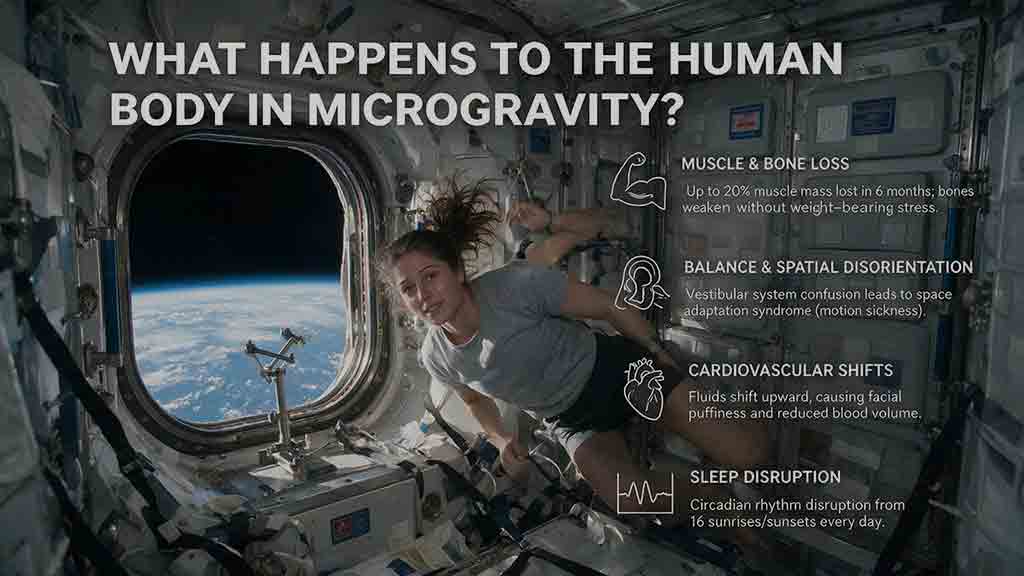
What Happens to the Human Body in Microgravity?
Microgravity changes the human body because fluids are no longer pulled toward the legs, muscles and bones receive less mechanical loading, and the brain loses gravity as a dependable orientation signal. This article explains how weightlessness affects balance, circulation, muscle strength, bone density, vision, blood, immunity, digestion, sleep, and spinal length. It also examines why astronauts may struggle to stand or walk after landing and how exercise, nutrition, monitoring, and rehabilitation help reduce these risks. Two original tools—the Load–Flow–Orientation Framework and the Gravity-Transition Readiness Matrix—connect physiological changes with real mission demands. Drawing on NASA standards, NASA technical reports, ESA materials, and peer-reviewed human spaceflight research, the guide clearly separates established observations from experimental countermeasures and unresolved questions. It also explains what these effects could mean for future missions to the Moon and Mars without treating population averages as predictions for individual astronauts.