What Happens During a Rocket Launch Countdown?

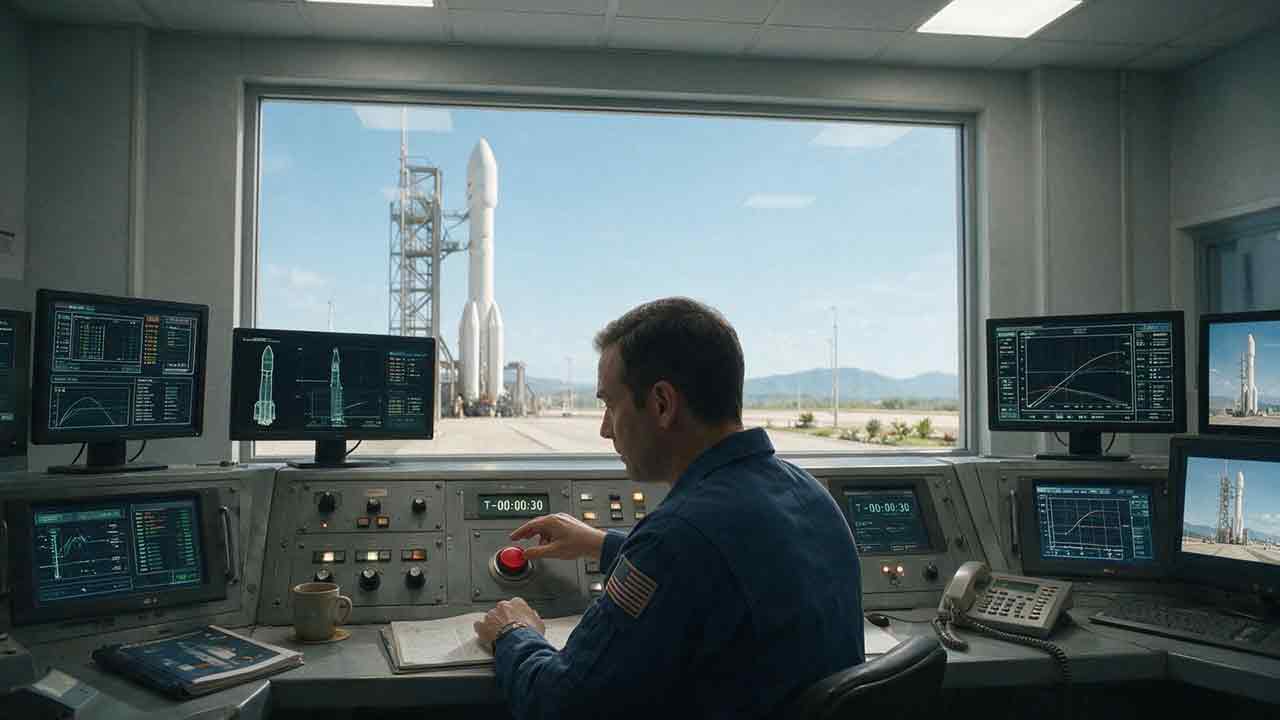
What Happens During a Rocket Launch Countdown?
A rocket launch countdown is a controlled operating sequence that prepares the launch vehicle, spacecraft, ground equipment, flight teams, weather services, and safety range for liftoff. Teams load propellants, verify critical systems, clear hazard areas, evaluate launch constraints, conduct readiness polls, and eventually transfer the final sequence to computers that manage precisely timed commands before ignition and release.
Key Takeaways
- A rocket launch countdown is an operational procedure, not simply a clock counting backward.
- Propellant loading, avionics checks, weather monitoring, range clearance, and launch decisions are coordinated across specialized teams.
- Planned holds are built into many countdowns and do not necessarily delay the targeted liftoff time.
- An unexpected issue may lead to a hold, a recycle to an earlier step, or a scrub of that launch attempt.
- During terminal count, automated systems perform rapid checks and commands while human controllers retain authority to stop the sequence before defined commitment points.
This article explains what happens during a rocket launch countdown, why the clock sometimes stops, how teams decide whether to continue, and what terms such as T-minus, go/no-go, terminal count, recycle, and scrub mean in practice.
How Does a Rocket Launch Countdown Work?
A rocket launch countdown organizes a large number of technical conditions into a repeatable sequence with assigned responsibilities, decision points, and operating limits.
The procedure tells each team what must be completed, which measurements are acceptable, who has authority to approve the next phase, and what should happen if a condition falls outside its permitted range. NASA describes countdown procedures as orderly, step-by-step scripts that reduce the amount of real-time judgment required during time-critical operations.
No universal countdown timeline applies to every rocket. The sequence depends on the launch vehicle, spacecraft, propellants, launch site, mission objectives, crew requirements, and launch window.
For example, NASA’s Artemis I countdown documentation explains that the formal countdown began approximately two days before the planned liftoff. An ESA Ariane 6 countdown overview describes a representative sequence beginning about 10 hours and 31 minutes before launch.
Those different starting times do not indicate that one process is more complete than the other. They reflect different vehicles, facilities, propellant systems, staffing models, and mission rules.
What Is the Difference Between T-Minus and L-Minus?
T-minus time indicates the position within the planned countdown procedure.
L-minus time indicates the actual time remaining before the targeted liftoff.
During a planned hold, the T-minus clock can stop while the L-minus clock continues moving toward the target launch time. NASA uses this distinction in countdown documentation for missions that contain built-in holds.
The two clocks therefore answer different questions:
- T-minus: Where are the teams in the operating sequence?
- L-minus: How much real time remains before the targeted liftoff?
An Original T-Minus and L-Minus Timeline
The following simplified timeline shows how a planned ten-minute hold can work.
| Real time elapsed | L-minus clock | T-minus clock | Countdown status |
|---|---|---|---|
| 0 minutes | L-20:00 | T-10:00 | Planned hold begins |
| 5 minutes | L-15:00 | T-10:00 | T-minus remains stopped |
| 10 minutes | L-10:00 | T-10:00 | Planned hold ends |
| 15 minutes | L-05:00 | T-05:00 | Countdown continues |
| 20 minutes | L-00:00 | T-00:00 | Targeted liftoff |
This is an original educational example, not the timeline of a particular rocket. Actual launch providers define their own clock conventions and hold procedures.
What Are the Main Phases of a Rocket Launch Countdown?
Most orbital launch countdowns include the same broad categories of work even though the order, timing, and terminology vary.
General countdown flow:
Initial configuration → Pad clearance → Propellant operations → Vehicle verification → Weather and range review → Readiness poll → Terminal count → Ignition and liftoff
This sequence is a general explanatory model. It is not an official procedure for operating a launch vehicle.
| Countdown phase | Typical activities | Main purpose |
|---|---|---|
| Initial configuration | Teams report to stations, communication circuits are checked, systems are powered, and procedures begin | Establish a known starting condition |
| Pad preparation | Final physical work is completed and personnel leave restricted areas | Prepare the site for hazardous operations |
| Propellant operations | Transfer systems are conditioned, tanks are filled, and propellant conditions are monitored | Supply the launch vehicle while protecting hardware |
| Vehicle verification | Avionics, navigation, software, power, sensors, valves, and communications are checked | Confirm the vehicle is ready to execute the mission |
| Constraint monitoring | Weather, airspace, waterways, tracking systems, and trajectory safety are evaluated | Protect the public, personnel, and mission |
| Final readiness | Responsible teams report go or no-go and configure systems for terminal count | Confirm that launch criteria are satisfied |
| Terminal count | Automated systems issue tightly timed commands and monitor critical conditions | Move the prepared vehicle toward ignition |
| Launch commitment | Engines or boosters ignite, connections release, and the rocket leaves the pad | Begin powered flight |
How Are the Rocket and Launch Site Prepared?
Early countdown work establishes that the rocket, spacecraft, launch platform, control rooms, tracking assets, and communication networks are in the required configuration.
Teams may:
- Power up vehicle electronics.
- Verify approved software and mission data.
- Test voice and data connections.
- Activate cameras and tracking equipment.
- Confirm that ground power and environmental systems are available.
- Review unresolved technical work.
- Complete final access and closeout procedures.
- Remove equipment that must not remain near the vehicle.
As hazardous operations approach, access to the launch pad becomes increasingly restricted. Personnel complete approved closeout tasks and leave controlled areas before propellant loading or other high-risk operations begin.
What Are Launch Umbilicals?
Launch umbilicals are connections between the rocket or spacecraft and the launch structure.
Depending on the vehicle, they may provide:
- Electrical power.
- Data and communications.
- Propellants.
- Coolant.
- Purge gases.
- Environmental conditioning.
- Mechanical stabilization.
NASA’s Artemis ground-system documentation explains that SLS and Orion umbilicals provide power, communications, and fuel to different parts of the vehicle. During launch, the connections release so the rocket can leave the pad safely.
An umbilical is therefore not merely a cable. It is part of the interface between the flight vehicle and the ground systems supporting it.
How Is a Liquid-Propellant Rocket Fueled Before Launch?
Liquid-propellant rockets are generally loaded through controlled stages rather than filled in one unrestricted flow.
For cryogenic vehicles, teams first condition transfer lines and related hardware for extremely cold fluids. This process is commonly called chilldown.
A generalized propellant-loading sequence may include:
- Configuring and checking ground transfer equipment.
- Slowly cooling transfer lines.
- Beginning an initial slow fill.
- Increasing to bulk loading.
- Monitoring pressures, temperatures, valves, and leak-detection systems.
- Completing tank filling.
- Replenishing propellant lost through normal boil-off.
- Configuring tank pressure for flight.
- Closing or disconnecting selected ground interfaces.
NASA explains that engine pre-chill brings critical components, including pump-related hardware, toward the temperatures required for operation before terminal count.
The ESA Ariane 6 countdown overview similarly describes the gradual cooling of ground pipes before cryogenic propellant loading.
These are examples from particular launch systems. They should not be treated as universal instructions for all liquid-propellant rockets.
Why Does White Vapor Appear Around a Rocket?
Visible white clouds around a fueled rocket are not automatically evidence of a dangerous leak.
Cryogenic equipment can cool the surrounding air enough for atmospheric moisture to condense. Rockets may also vent gases as part of normal pressure and thermal management.
Launch controllers do not decide whether a condition is safe based on appearance alone. They evaluate sensor data, expected venting behavior, leak-detection equipment, temperatures, pressures, and vehicle-specific limits.
Do Solid-Fuel Rockets Need Launch-Day Fueling?
Solid rocket motors contain propellant manufactured into the motor before arrival at the final countdown. They are not filled with solid propellant on the launch pad during the last hours before liftoff.
However, vehicles using solid motors still require extensive countdown work. Teams must verify electrical interfaces, ignition-command systems, sensors, structural connections, flight computers, safety systems, and the condition of the launch site.
| Propulsion configuration | Main countdown implications |
|---|---|
| Cryogenic liquid propellants | Requires thermal conditioning, filling, venting, replenishment, and close monitoring |
| Storable or non-cryogenic liquids | Avoids some extreme-temperature work but still requires controlled loading and verification |
| Solid rocket motors | Propellant is already installed, but ignition and vehicle systems must be verified |
| Mixed liquid-and-solid vehicle | Combines liquid-stage preparation with checks of preloaded solid boosters |
| Crewed launch vehicle | Adds life-support, access, escape-system, cabin, and crew-safety requirements |
Which Rocket Systems Are Checked During the Countdown?
A launch team monitors the rocket as an interconnected system. Propulsion, navigation, software, communications, power, structures, and ground equipment must work together.
How Are Avionics and Flight Computers Checked?
Avionics refers to the electronic systems used for guidance, navigation, control, communication, monitoring, and vehicle management.
Countdown checks may confirm that:
- The approved flight software is installed.
- Mission-specific trajectory data is correct.
- Primary and redundant computers communicate.
- Sensors return plausible measurements.
- Data buses are functioning.
- Fault-detection logic is active.
- Commands can pass between ground and vehicle systems.
- The flight computers can enter the required launch mode.
A software system can be powered and responsive without being ready for launch. Teams must also confirm that the correct configuration, data, and operating state are present.
How Are Navigation and Guidance Systems Prepared?
A rocket must begin flight with an accurate understanding of its orientation, motion, and intended trajectory.
Depending on the vehicle, teams may initialize or verify:
- Inertial measurement units.
- Gyroscopes and accelerometers.
- Satellite-navigation receivers.
- Ground-supplied alignment data.
- Radar-tracking interfaces.
- Approved trajectory and targeting information.
Navigation determines where the vehicle is and how it is moving. Guidance determines the path it should follow. Control systems command the engines, nozzles, aerodynamic surfaces, or other actuators needed to follow that path.
How Is Electrical Power Verified?
Before launch, a rocket may receive electricity from ground equipment. At a defined point, it may transfer to internal batteries or another onboard supply.
Controllers verify:
- Voltage and current.
- Battery condition.
- Power-distribution channels.
- Redundant circuits.
- Hardware temperatures.
- The transition from ground power to flight power.
The rocket must remain stable after entering the electrical configuration it will use during ascent.
What Is Telemetry?
Telemetry is measurement data transmitted from the launch vehicle or spacecraft to receiving systems.
Telemetry can include:
- Tank pressures.
- Valve positions.
- Engine measurements.
- Battery voltage.
- Temperatures.
- Computer status.
- Structural measurements.
- Guidance and navigation data.
NASA’s Launch Services Program describes receiving, processing, recording, and displaying telemetry from prelaunch checkout through launch, spacecraft separation, and orbital insertion.
Reliable telemetry allows controllers to determine whether the vehicle remains within its approved limits. It does not mean that every measurement is reviewed manually in real time; automated systems can evaluate large numbers of parameters and alert controllers when action may be required.
How Does Weather Affect a Rocket Launch Countdown?
Launch weather teams evaluate much more than whether rain is falling at the pad.
Depending on the rocket and mission, weather criteria may cover:
- Natural lightning.
- Triggered-lightning risk.
- Electrically charged clouds.
- Surface winds.
- Upper-level winds.
- Cloud thickness and cloud type.
- Temperature limits.
- Precipitation.
- Visibility.
- Conditions along the ascent corridor.
- Recovery-area weather for crewed or reusable systems.
A rocket can potentially trigger lightning while passing through an electrically active cloud even when natural lightning is not occurring at the launch site at that moment.
The NASA Artemis II Weather Criteria establishes criteria intended to reduce exposure to natural and triggered lightning during ascent.
Upper-level winds also matter because wind changes the aerodynamic loads and steering demands experienced by the vehicle. A launch can therefore be delayed even when conditions seem calm to observers near the ground.
Weather limits are vehicle-specific. A condition acceptable for one rocket, payload, or trajectory may be unacceptable for another.
What Does Range Safety Check Before Launch?
The launch range is the coordinated system used to protect the public, workers, property, airspace, waterways, and restricted land around a launch and its planned flight path.
Range-safety work may include:
- Confirming that hazard areas are clear.
- Monitoring restricted airspace.
- Monitoring designated maritime areas.
- Verifying tracking and communication assets.
- Evaluating the approved trajectory.
- Confirming the availability of flight-safety systems.
- Coordinating with aviation, maritime, emergency, and government authorities.
NASA Range Safety Operations describes range surveillance as the agreements, procedures, and instrumentation used during a countdown to ensure that relevant land, sea, and airspace are clear.
The U.S. Space Force has also explained that flight-safety analysts evaluate launch vehicles, payloads, and proposed trajectories to establish hazard zones spanning land, sea, and air.
Range clearance does not mean that every location beneath the rocket’s complete flight path is empty. It means the defined safety areas and mission requirements have been evaluated according to the approved rules.
Who Controls a Rocket Launch Countdown?
No single person personally checks every part of a launch vehicle.
Responsibility is divided among specialized teams. Each team monitors defined systems and reports through a formal command structure.
| Role or team | Typical responsibility |
|---|---|
| Launch director | Holds overall authority for the launch attempt or a major part of the countdown |
| Launch conductor | Directs the countdown procedure and coordinates calls among teams |
| Propulsion team | Monitors tanks, engines, propellant systems, pressures, valves, and related ground equipment |
| Avionics and software teams | Monitor computers, guidance electronics, data systems, and flight software |
| Spacecraft or payload team | Confirms that the spacecraft is configured and ready |
| Ground-systems team | Monitors the pad, power, environmental systems, transfer equipment, and infrastructure |
| Weather team | Evaluates present and forecast weather against mission criteria |
| Range-safety team | Confirms safety assets, tracking, and restricted-area status |
| Mission or flight team | Evaluates trajectory, mission rules, and post-liftoff readiness |
| Crew team, when applicable | Manages astronaut access, cabin systems, escape systems, and crew-related constraints |
The exact titles vary among agencies and commercial launch providers. The important principle is distributed responsibility: individual disciplines own specific criteria, while designated leaders integrate those reports into the decision to continue or stop.
What Happens During a Go/No-Go Poll?
A go/no-go poll is a structured readiness check in which responsible teams report whether their systems satisfy the criteria required for the next countdown phase.
A “go” does not mean that the system is flawless or guaranteed to remain fault-free. It means the responsible team has evaluated the available information and found no condition that violates the applicable rules at that decision point.
A team may report:
- Go: Required conditions are currently satisfied.
- No-go: A required condition is not satisfied.
- Stand by: More time is needed to evaluate the available data.
- Go with an open item: Used only when the formal procedure permits an unresolved item to remain open until a later decision point.
NASA mission documentation shows that readiness polls may occur before major transitions, including propellant loading and entry into terminal count. For Artemis missions, launch leadership reviews flight systems, ground systems, weather, and other constraints before giving permission to proceed.
A no-go call is not a vote of no confidence in the mission. It is the expected response when a defined rule has not been satisfied.
What Happens During Terminal Countdown?
Terminal count is the final, tightly timed portion of the countdown in which the rocket and ground systems move into their launch configuration.
NASA’s Basics of Space Flight explains that launch operations during the final minutes are controlled mostly by computers because numerous events must occur with precise timing.
Depending on the vehicle, terminal-count events may include:
- Switching the rocket and spacecraft to internal power.
- Configuring propellant tanks for flight.
- Pressurizing tanks.
- Closing or repositioning valves.
- Activating flight computers.
- Enabling autonomous launch logic.
- Confirming navigation readiness.
- Starting water-deluge or sound-suppression systems.
- Retracting access structures.
- Arming separation-related systems.
- Completing final range and launch-management checks.
- Beginning engine-start or booster-ignition sequences.
- Releasing umbilicals and hold-down systems.
A NASA countdown account for the Lucy mission provides a real example: during the final four minutes, the launch vehicle’s tanks were brought to flight pressure, the rocket and spacecraft were confirmed on internal power, and final range and launch-management status checks were completed.
Automated control does not remove human authority. Ground controllers can stop the sequence before defined commitment points, and the automated system can halt if a monitored condition violates its programmed limits.
However, recovery options become narrower as the sequence advances. Some holds can be cleared immediately, while others require teams to return to an earlier countdown point.
What Happens at T-Zero?
T-zero marks the planned launch event, but engine ignition, thrust buildup, release commands, and visible upward motion do not necessarily occur at one identical instant.
For some liquid-engine rockets, engine start begins before release from the pad. Computers evaluate whether the engines have reached acceptable conditions before the hold-down system permits the vehicle to rise.
Other launch systems use different ignition and release sequences. A vehicle with large solid boosters may reach an irreversible commitment point when those boosters ignite.
The rocket lifts off only after the vehicle-specific propulsion, control, ground-release, and safety conditions have been satisfied.
Once the rocket clears the launch structure, control shifts from the ground countdown sequence to onboard flight software. Ground teams continue monitoring telemetry, trajectory, propulsion, structural performance, stage events, fairing separation, and spacecraft deployment.
Why Does the Countdown Clock Sometimes Stop?
A stopped clock does not always indicate a failure.
There are four important possibilities: a planned hold, an unplanned hold, a recycle, or a scrub.
What Is a Planned Hold?
A planned hold is intentionally included in the countdown schedule.
It can provide time to:
- Complete work with variable duration.
- Review technical data.
- Conduct readiness polls.
- Wait for a precise launch opportunity.
- Absorb small delays without moving the targeted liftoff.
NASA Launch Services Program Countdown notes that many launch providers include scheduled hold time as contingency time for issues encountered during countdown operations.
What Is an Unplanned Hold?
An unplanned hold begins when teams need to investigate a new condition, restore a required capability, or wait for a constraint to clear.
Possible reasons include:
- A sensor measurement outside its expected range.
- A temporary communication interruption.
- An aircraft or vessel entering a restricted area.
- A weather criterion becoming temporarily unacceptable.
- A valve or ground-equipment issue.
- An incomplete procedure.
- A flight computer or data-system alert.
An unplanned hold does not automatically mean the launch will be scrubbed. Teams first determine whether the problem can be resolved within the remaining time and operating margins.
What Is a Countdown Recycle?
A recycle returns the countdown to an earlier point so required steps can be repeated in the approved order.
Teams cannot always restart at the exact second where the clock stopped. A hold may change tank conditions, software states, valve positions, battery margins, or other configurations that must be re-established.
For example, NASA’s published Artemis II countdown rules describe specific circumstances in which a hold late in the sequence would require the clock to recycle to an earlier point.
Those rules are specific to that mission and should not be assumed to apply to other rockets.
What Is a Launch Scrub?
A scrub ends the launch attempt for the current opportunity.
A scrub may occur when:
- The launch window will close before work can be completed.
- Weather is not expected to improve in time.
- The issue requires physical access to the vehicle.
- A battery, thermal, crew, or propellant limit would be exceeded.
- The vehicle cannot be restored to a valid launch configuration.
- The range cannot support the remaining attempt.
- A new countdown cycle is required.
A scrub is a safety and mission-protection decision. It does not necessarily mean that the rocket suffered a major failure, and it does not mean that the mission itself has failed.
How Do Teams Decide Whether to Resume, Recycle, or Scrub?
To make launch decisions easier for readers to interpret, this article uses an original Four-C Countdown Framework:
- Clock
- Configuration
- Constraint
- Commitment
The Four-C Framework is an educational model created for this article. It is not an official NASA, ESA, U.S. Space Force, or launch-provider procedure.
1. Clock: Is Enough Time Left?
Teams determine whether the problem can be resolved, required checks repeated, and the remaining countdown completed before the launch window closes.
A ten-minute delay may consume more than ten minutes because the vehicle might need to return to an earlier configuration and repeat several steps.
2. Configuration: Is the Vehicle Still in a Valid State?
The rocket and spacecraft must remain within approved limits.
Relevant constraints can include:
- Propellant condition.
- Tank pressure.
- Battery capacity.
- Hardware temperature.
- Spacecraft thermal limits.
- Crew time.
- Communications availability.
- Ground-system configuration.
A problem may be technically fixed while the vehicle is no longer in a condition that permits an immediate launch.
3. Constraint: Can the Blocking Condition Be Cleared?
Some constraints are temporary.
A cloud may move away. A restricted-area intrusion may be resolved. A communication link may be restored.
Other problems require detailed troubleshooting, replacement hardware, physical access to the pad, or a new planning cycle. Those conditions are less likely to be resolved within the same launch window.
4. Commitment: Has the Sequence Passed a One-Way Point?
Some countdown actions can be reversed or repeated. Others cannot be undone within the current attempt.
As ignition and release approach, the number of safe recovery choices generally decreases. Teams therefore make increasingly strict readiness decisions before passing major commitment points.
| Four-C finding | Likely response |
|---|---|
| Constraint cleared, configuration valid, and sufficient time remains | Resume the countdown |
| Required checks or configurations must be repeated | Recycle to an earlier point |
| Constraint may clear and operating margins remain adequate | Continue holding |
| Time or vehicle margin is insufficient | Scrub the attempt |
| A safety rule is violated near commitment | Stop or abort according to the approved system logic |
The actual decision is made under mission-specific rules, not by this simplified framework.
How Does a Launch Window Affect the Countdown?
A launch window is the approved period during which liftoff can occur while still satisfying the mission’s trajectory and operational requirements.
Launch windows can be influenced by:
- The destination orbit.
- The location of another spacecraft.
- Planetary alignment.
- Lighting conditions.
- Tracking availability.
- Collision-avoidance requirements.
- Recovery conditions.
- Vehicle performance.
- Range availability.
NASA describes a launch window as a span of time during which the vehicle must launch for its payload to achieve the required orbit or trajectory.
An Original Launch-Window Calculation
Consider a hypothetical mission with a 30-minute launch window.
At the start of the window:
- Four minutes remain on the countdown.
- Weather causes a seven-minute hold.
- Reconfiguring and repeating checks takes five minutes.
- The final countdown still requires four minutes.
The total time required is:
7 minutes + 5 minutes + 4 minutes = 16 minutes
The remaining launch-window margin is:
30 minutes − 16 minutes = 14 minutes
Time alone would not force a scrub in this example. The team would still need to confirm that the weather, range, vehicle, spacecraft, and ground systems were acceptable.
This calculation is an original educational example. It does not describe a real mission and does not account for the detailed limits used by actual launch teams.
The main lesson is that a five-minute technical problem can consume more than five minutes of a launch window because recovery and repeated verification also take time.
How Do Different Mission Types Change the Countdown?
The basic countdown logic remains similar, but each mission introduces additional constraints.
| Mission type | Additional countdown considerations |
|---|---|
| Small uncrewed satellite | Payload power, deployment configuration, customer coordination, and insertion timing |
| Large cryogenic rocket | Extended propellant loading, replenishment, thermal conditioning, and complex ground systems |
| Crewed mission | Crew ingress, cabin checks, life support, escape systems, medical status, and recovery forces |
| Planetary mission | Interplanetary geometry, spacecraft thermal limits, deep-space communications, and restricted launch periods |
| Reusable booster mission | Landing-site or recovery-vessel weather, recovery navigation, and post-launch support assets |
| Rendezvous mission | Orbital phasing and arrival timing relative to the destination spacecraft |
A planetary launch opportunity may be constrained by the relative positions of Earth and the destination. A rendezvous mission may need to reach a particular orbital plane at a particular time. A reusable mission may have acceptable weather at the launch site but unacceptable conditions at the booster recovery location.
The countdown therefore prepares not only the rocket but the entire mission system.
“The Rocket Looks Ready, So Why Not Launch?”
A rocket can appear complete and motionless while a required supporting system is unavailable.
Tracking equipment, weather radar, communications, ground valves, range clearance, spacecraft status, recovery assets, or flight-safety systems can prevent launch even when no visible problem exists on the rocket.
“A Hold Means Something Is Broken”
Many holds are intentionally included in the countdown. An unplanned hold may also result from a temporary weather or range condition rather than broken vehicle hardware.
“T-Zero Means the Rocket Must Move Immediately”
T-zero is defined by the vehicle’s countdown design. Engine start, thrust verification, release, and visible motion may occur at slightly different moments.
“White Vapor Means the Rocket Is Leaking”
Visible vapor may result from normal cryogenic venting or moisture condensing around cold equipment. Controllers use instrumentation, not appearance alone, to determine whether a condition is normal.
“A Scrub Means the Mission Failed”
A scrub means that a particular launch attempt did not proceed. The mission remains active unless it can no longer achieve its objectives.
“Computers Make the Entire Launch Decision”
Computers perform rapid checks and precisely timed commands, but people define the rules, evaluate unusual conditions, conduct readiness polls, and retain authority at designated stages of the countdown.
A Practical Checklist for Watching a Launch Countdown
When following a launch broadcast, listen for six categories of information.
1. Vehicle Status
Are propulsion, avionics, electrical power, navigation, and flight computers ready?
2. Spacecraft Status
Is the payload or crew vehicle powered, configured, and ready for the mission?
3. Weather Status
Are conditions acceptable at the pad, through the atmosphere, and at any recovery locations?
4. Range Status
Are the required airspace, maritime areas, tracking systems, and safety assets ready?
5. Clock Status
Is the countdown running, in a planned hold, in an unexpected hold, or recycling?
6. Commitment Status
Has the sequence transferred to automated control? Which ignition, arming, pressurization, or release events are approaching?
This checklist helps viewers interpret commentary without access to proprietary procedures.
What Should You Not Assume From a Launch Broadcast?
A public broadcast provides a simplified view of the countdown.
Do not assume that:
- Every monitored parameter is announced.
- Silence means nothing is happening.
- One rocket’s timeline applies to another.
- A countdown graphic is the legal or technical control clock.
- A commentator’s preliminary explanation is the final engineering conclusion.
- A hold is caused by the most visually obvious condition.
- A launch is guaranteed after a go/no-go poll.
Launch status can change until the vehicle passes its final commitment points.
Who Is This Article For?
This article is intended for:
- Students learning about mission operations.
- Educators explaining launch preparation.
- First-time launch viewers.
- Spaceflight enthusiasts.
- Writers seeking a reliable overview of countdown terminology.
It is not intended for:
- Operating a launch vehicle.
- Designing an ignition system.
- Handling rocket propellants.
- Bypassing safety equipment.
- Replacing official mission procedures.
- Making real-world launch decisions.
The article remains at an educational systems level and intentionally excludes operational parameters, propellant formulations, ignition instructions, and methods for defeating safety controls.
What Should You Remember About a Rocket Launch Countdown?
A rocket launch countdown is a coordinated process for bringing the vehicle, spacecraft, ground systems, teams, weather conditions, and flight corridor into one approved launch configuration.
The clock is only the visible part of that process. The real work involves verifying that each system is ready, each safety rule is satisfied, and each responsible team agrees that the next commitment point can be crossed.
For a first-time viewer, focus on whether a hold is planned or unexpected. For students, follow the progression from ground preparation to automated control. For readers studying mission operations, use the Four-C Framework—Clock, Configuration, Constraint, and Commitment—to understand why a launch continues, recycles, or scrubs.
How This Article Was Researched and Reviewed
This article was prepared using publicly available first-party material from NASA, ESA, and U.S. government spaceflight organizations.
The review process included:
- Comparing general countdown principles with vehicle-specific examples.
- Checking precise countdown claims against official sources.
- Separating universal concepts from mission-specific procedures.
- Avoiding unsupported claims about the number of checks, commands, personnel, or costs involved.
- Reviewing the terminology used for holds, terminal count, range safety, telemetry, and launch windows.
- Identifying the original Four-C Framework and launch-window calculation as educational tools rather than official procedures.
- Checking that the article does not provide actionable instructions for fueling, igniting, constructing, or operating a rocket.
No independent technical reviewer or professional engineering credential is claimed for this page.
Sources
NASA, Artemis I Launch Countdown 101. Used for the Artemis I countdown duration, planned holds, and the distinction between T-minus and L-minus time. Accessed August 1, 2026.
ESA, Ariane 6 Infographic: Countdown to Liftoff. Used for a representative Ariane 6 countdown timeline and cryogenic-line conditioning example. Accessed August 1, 2026.
NASA, Engineers Chill Space Launch System Rocket Engines Before Launch. Used for the explanation of engine pre-chill and thermal conditioning. Accessed August 1, 2026.
NASA, Artemis II Wet Dress Rehearsal: Go for Tanking. Used for the explanation of launch umbilicals and their functions. Accessed August 1, 2026.
NASA Kennedy Space Center, NASA Range Safety Operations. Used for countdown procedures, launch-commit criteria, and range surveillance. Accessed August 1, 2026.
NASA Kennedy Space Center Weather Office, NASA Artemis II Weather Criteria. Used for the explanation of natural and triggered-lightning constraints. Accessed August 1, 2026.
NASA Science, Chapter 14: Launch—Basics of Space Flight. Used for the explanation of computer-controlled final countdown activities and launch-window considerations. Accessed August 1, 2026.
NASA Science, T-4 Minutes and Counting—Lucy Mission. Used as a real mission example of tank pressurization, internal power, and final status checks. Accessed August 1, 2026.
NASA Launch Services Program, Mission Countdown. Used for built-in hold and countdown-clock terminology. Accessed August 1, 2026.
NASA, NASA Releases Artemis II Moon Mission Launch Countdown. Used as a vehicle-specific example of late-countdown holds and recycling. Accessed August 1, 2026.
U.S. Space Force, Space Launch Delta 45 Supports Historic Artemis II Mission. Used for hazard-zone, trajectory-analysis, and range-safety context. Accessed August 1, 2026.
More from Mission Operations & Exploration
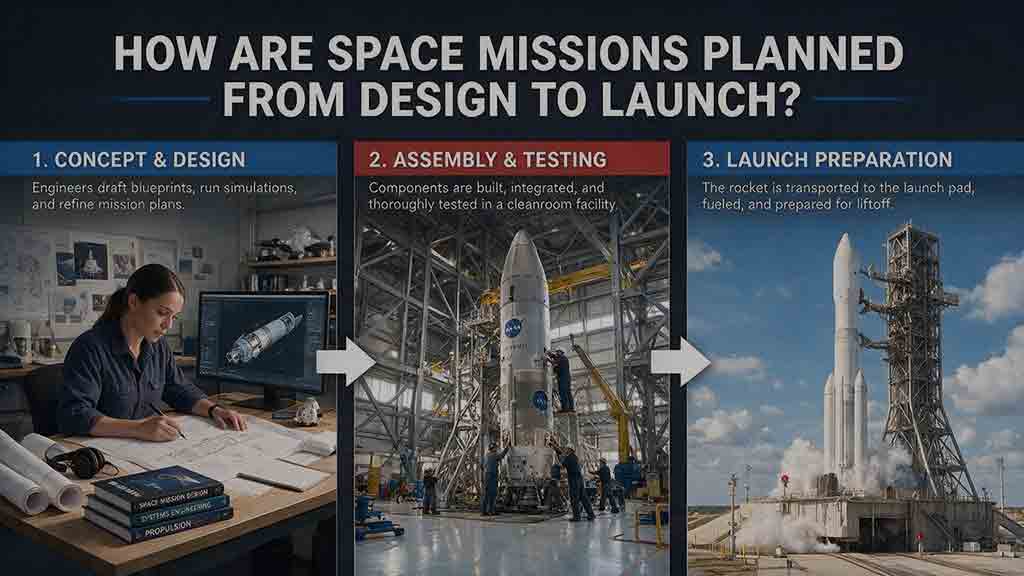
How Are Space Missions Planned From Design to Launch?
Space missions are planned by transforming a scientific, commercial, or exploration goal into a complete system that can be designed, built, tested, launched, operated, and responsibly concluded. This guide follows the full planning lifecycle, from defining measurable objectives and comparing mission concepts to writing requirements, selecting an architecture, managing resource budgets, and controlling interfaces. It explains how payloads, spacecraft platforms, trajectories, launch services, software, ground systems, regulations, and operations must be developed together. Readers will also learn how design reviews, fabrication, environmental testing, end-to-end verification, operator training, licensing, launch integration, and readiness assessments support mission development. Original planning frameworks, worked mass, power, and data calculations, troubleshooting guidance, and a practical checklist show how teams identify weak assumptions and resolve designs that do not close. The central lesson is that mission readiness depends on the entire technical and operational system—not merely on completing the spacecraft.
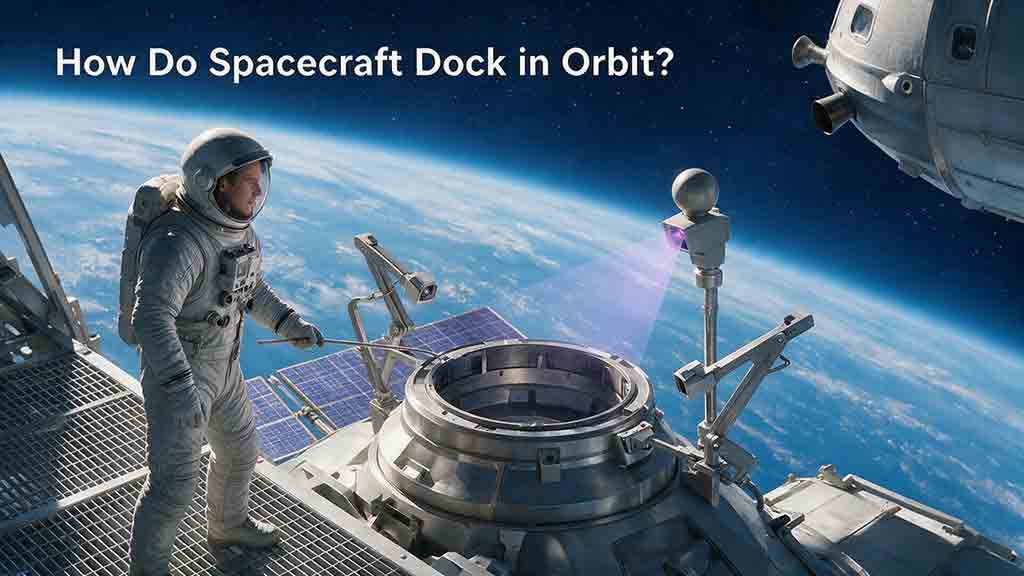
How Do Spacecraft Dock in Orbit?
Spacecraft docking is a carefully controlled process that begins long before two vehicles make physical contact. The approaching spacecraft must first establish compatible orbital geometry, adjust its timing through phasing maneuvers, and reduce differences in position, velocity, and orientation. This guide explains the complete sequence from far-field rendezvous and relative navigation to hold points, final approach, soft capture, and hard capture. It also compares docking with robotic berthing, examines the sensors and control systems used during an approach, and shows how mission teams respond when navigation data, closing rates, or alignment fall outside permitted limits. A simplified orbital calculation demonstrates why a spacecraft in a slightly lower orbit can gradually catch its target. Readers will also find an original five-match framework, a practical docking-safety model, real mission examples, and a checklist for evaluating docking plans. The article clearly distinguishes educational principles from vehicle-specific flight procedures and engineering requirements.
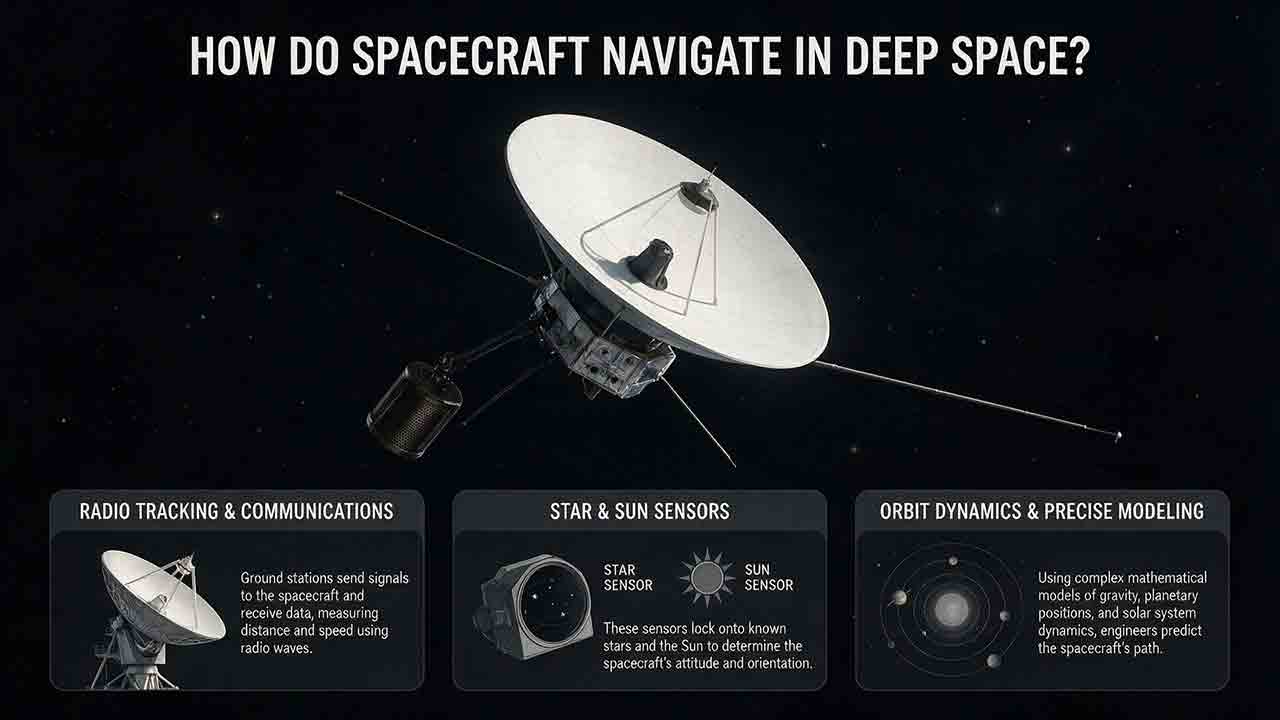
How Do Spacecraft Navigate in Deep Space?
Spacecraft navigate in deep space by comparing a predicted trajectory with repeated radio, optical, and onboard measurements. Ground networks measure distance, line-of-sight velocity, and angular direction. Cameras add destination-relative observations, while attitude sensors establish the spacecraft’s pointing direction. Navigation software combines those observations with force models, estimates position and velocity with uncertainty, and determines whether a trajectory correction is needed.
Explore More Topics
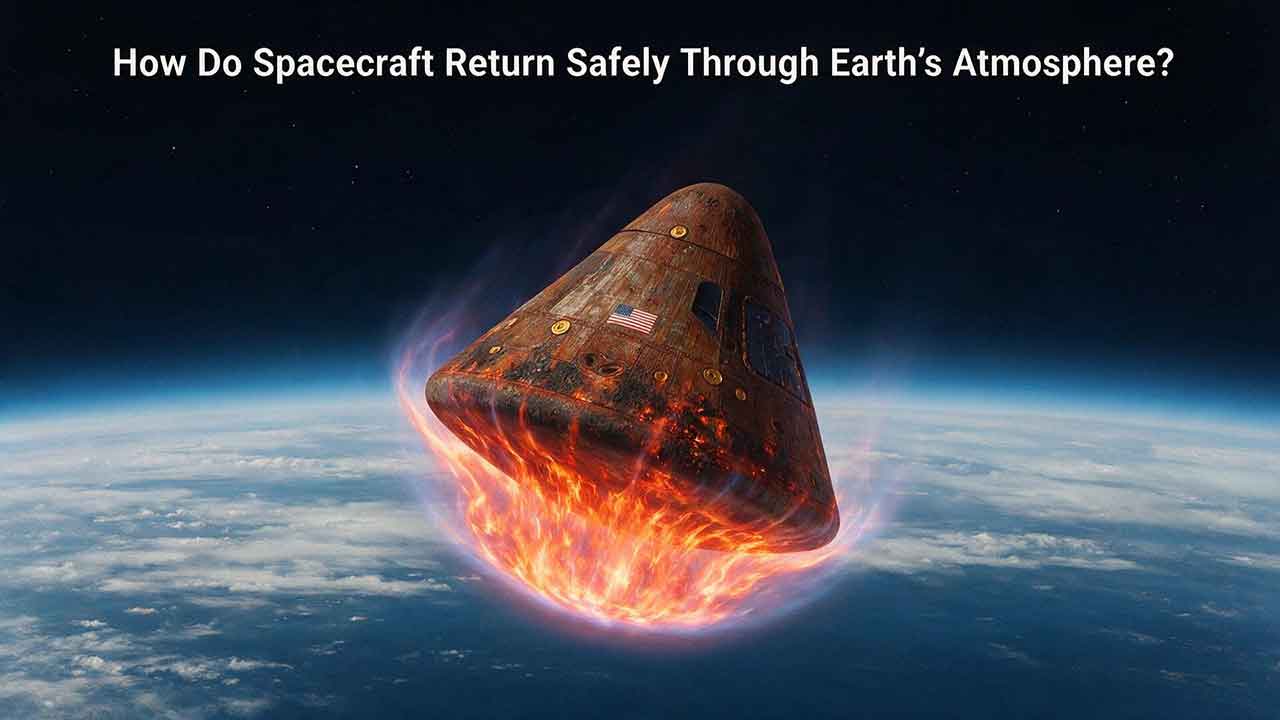
How Do Spacecraft Return Safely Through Earth’s Atmosphere?
Spacecraft return safely through Earth’s atmosphere by managing an enormous amount of energy through a carefully coordinated sequence of trajectory control, thermal protection, aerodynamic deceleration, landing, and recovery. This article explains how deorbit burns and entry corridors guide a spacecraft toward its landing region, why blunt heat shields reduce the danger of hypersonic heating, and how guidance systems control attitude, range, and structural loads. It includes an original comparison of low-Earth-orbit and lunar-return energy, a practical review of ablative and reusable heat-shield technologies, and the CosmoBasics Four-Layer Reentry Framework covering path, protection, control, descent, and recovery. Real-world lessons from Artemis I and the crewed Artemis II mission show why postflight inspection remains essential even after a successful splashdown. Readers will also learn how parachutes, wings, landing rockets, flotation systems, and recovery teams complete the return safely.
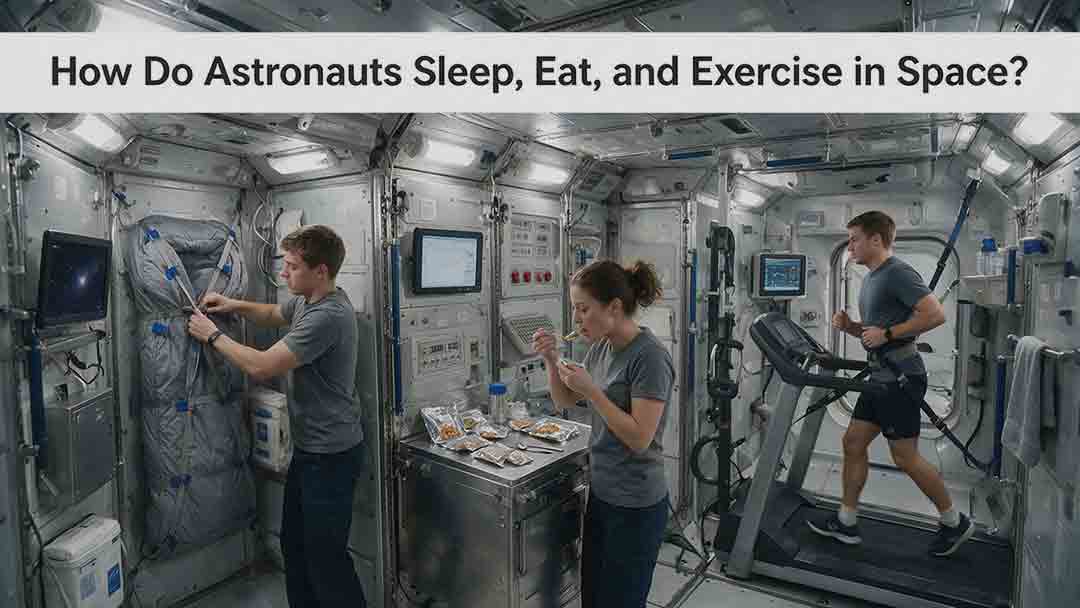
How Do Astronauts Sleep, Eat, and Exercise in Space?
Astronauts must redesign ordinary routines when they live in microgravity. This article explains how crew members sleep in secured bags inside ventilated quarters, prepare packaged meals without letting food or liquids drift through the cabin, and use specialized exercise equipment to protect their physical condition. It examines the roles of the Advanced Resistive Exercise Device, the T2 treadmill, and the CEVIS cycle ergometer, while clarifying the difference between active workout time and the full scheduled exercise period. Readers will also learn why tortillas are practical in space, how airflow affects sleep, why ordinary weights do not work normally in orbit, and how nutrition, rest, and exercise support one another. NASA and ESA sources provide the factual foundation, while original comparison tables and practical evaluation frameworks show how spacecraft systems replace functions normally supplied by gravity. The article also distinguishes current International Space Station practices from possible future Moon and Mars mission requirements.

What Happens to the Human Body in Microgravity?
Microgravity changes the human body because fluids are no longer pulled toward the legs, muscles and bones receive less mechanical loading, and the brain loses gravity as a dependable orientation signal. This article explains how weightlessness affects balance, circulation, muscle strength, bone density, vision, blood, immunity, digestion, sleep, and spinal length. It also examines why astronauts may struggle to stand or walk after landing and how exercise, nutrition, monitoring, and rehabilitation help reduce these risks. Two original tools—the Load–Flow–Orientation Framework and the Gravity-Transition Readiness Matrix—connect physiological changes with real mission demands. Drawing on NASA standards, NASA technical reports, ESA materials, and peer-reviewed human spaceflight research, the guide clearly separates established observations from experimental countermeasures and unresolved questions. It also explains what these effects could mean for future missions to the Moon and Mars without treating population averages as predictions for individual astronauts.