How Does a Spacecraft Life Support System Work?

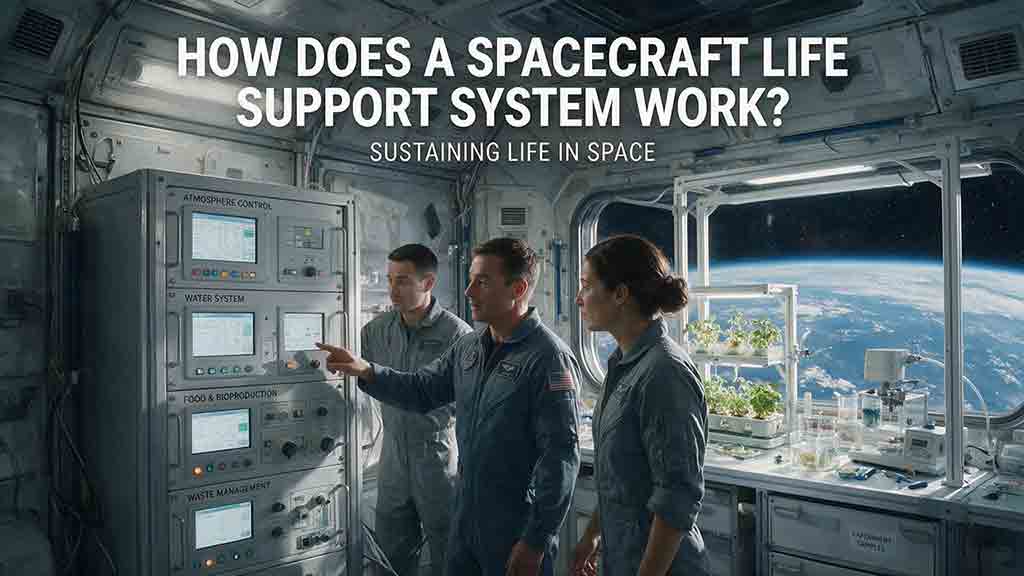
How Does a Spacecraft Life Support System Work?
A spacecraft life support system keeps astronauts alive by continuously controlling cabin pressure, oxygen, carbon dioxide, airflow, temperature, humidity, water quality, waste, and environmental hazards. Some resources are stored and consumed, while others are recovered and reused. The exact design depends on crew size, mission duration, available power, resupply opportunities, and the consequences of equipment failure.
Key Takeaways
- A spacecraft life support system is a connected network, not simply an oxygen tank.
- Oxygen supply and carbon dioxide removal are separate functions that must operate together.
- Fans are essential because microgravity does not circulate warm, humid, carbon-dioxide-rich air as gravity does on Earth.
- Regenerative systems can recover water and air resources, but they add power demand, heat, maintenance, and equipment complexity.
- The best design is not necessarily the one with the highest recycling percentage; it is the one that keeps the crew safe through normal operations and credible failures.
This article focuses on cabin life support in crewed spacecraft and space habitats. Spacesuit portable life support equipment is addressed briefly in the FAQ rather than treated as the main subject.
The most useful way to understand spacecraft life support is to follow four connected flows: air, water, heat, and waste. Each flow has its own equipment, but a change in one can affect the others.
How Does the Life-Support Control Loop Operate?
A spacecraft life support system operates as a continuous cycle of measurement, treatment, replacement, and verification.
NASA commonly calls this collection of equipment the Environmental Control and Life Support System, or ECLSS. Depending on the vehicle, ECLSS functions can include atmospheric pressure control, oxygen supply, carbon dioxide removal, ventilation, temperature and humidity control, water processing, waste management, fire detection, and environmental monitoring.
A simplified control loop works like this:
- Sensors measure cabin conditions. Instruments track pressure, gas composition, temperature, humidity, smoke, water quality, and equipment performance.
- Fans circulate the atmosphere. Cabin air moves through ducts, filters, heat exchangers, and carbon dioxide removal equipment.
- Treatment equipment removes unwanted material. Carbon dioxide, particles, trace chemicals, excess moisture, and heat are separated from the air.
- Supply systems replace consumed resources. Stored gases or oxygen-generation equipment replenish oxygen and maintain cabin pressure.
- Water systems collect and process recoverable streams. Humidity condensate and selected wastewater can be purified and returned to service.
- Waste is contained or processed. Urine, feces, hygiene materials, packaging, and concentrated treatment residues follow different handling paths.
- Controllers verify the result. Water or air that does not meet acceptance criteria is isolated, reprocessed, or kept from reaching the crew.
This loop never becomes completely independent of outside resources. Filters age, components wear, gases leak, concentrated waste accumulates, and maintenance consumes supplies.
Cabin-air management is a continuous loop: oxygen must be supplied, carbon dioxide removed, air circulated, humidity controlled, contaminants filtered, and pressure kept within acceptable limits.
Which Subsystems Make a Spacecraft Habitable?
A crewed spacecraft divides life-support work among several connected subsystems.
| Subsystem | Main job | Typical inputs | Typical outputs |
|---|---|---|---|
| Atmosphere control and supply | Maintains total pressure and gas composition | Stored gases, sensor readings | Controlled cabin atmosphere |
| Air revitalization | Removes carbon dioxide, particles, moisture, and trace contaminants | Used cabin air | Treated cabin air and separated contaminants |
| Oxygen supply or generation | Replaces oxygen consumed by the crew | Stored oxygen or purified water and electricity | Breathing oxygen |
| Ventilation | Moves air through occupied spaces and treatment equipment | Cabin air and electrical power | Mixed, circulating atmosphere |
| Temperature and humidity control | Removes crew and equipment heat and condenses water vapor | Warm, humid air | Cooler air, captured heat, and condensate |
| Water management | Stores, distributes, recovers, and verifies water | Stored water, condensate, selected wastewater | Potable or process water |
| Waste management | Collects and contains human and operational waste | Urine, feces, hygiene waste, trash | Recovered water, stored waste, or concentrated residue |
| Environmental monitoring | Detects unsafe trends or contamination | Air, water, and equipment measurements | Data, warnings, and alarms |
| Fire and emergency protection | Detects and limits fire, smoke, leaks, or hazardous releases | Sensor readings and emergency equipment | Alerts, isolation, suppression, or backup support |
Subsystem boundaries vary among spacecraft. Humidity removal, for example, may be described as part of air revitalization, thermal control, or both. The engineering requirement is not a particular label but complete coverage of every crew-supporting function and every important interface.
How Are Oxygen and Cabin Pressure Controlled?
A spacecraft controls its atmosphere by managing both total cabin pressure and the partial pressure of individual gases.
Total pressure is the combined pressure produced by oxygen, nitrogen, carbon dioxide, water vapor, and other gases. Oxygen partial pressure describes oxygen’s share of that total. A cabin can therefore have an unsafe atmosphere even when an oxygen percentage appears familiar.
NASA’s current human-system standards treat oxygen exposure, pressure, carbon dioxide, ventilation, humidity, contamination, water, and emergency conditions as related but separate design concerns.
Stored Oxygen
Stored oxygen is carried in tanks and delivered through pressure regulators, valves, sensors, and distribution lines.
This approach can be practical for a short mission because the equipment is relatively direct and the mission ends before consumable mass becomes excessive. The limitation is straightforward: every unit of oxygen used or lost must have been launched, generated, or delivered.
Nitrogen or another diluent gas may also be stored when the spacecraft uses a mixed-gas atmosphere.
Oxygen Generated from Water
Longer-duration systems can generate oxygen through water electrolysis, which uses electricity to separate water into oxygen and hydrogen:
2H₂O → 2H₂ + O₂
The oxygen can be supplied to the cabin. The hydrogen must be vented, stored, or directed to another process.
Electrolysis does not create a limitless oxygen supply. It requires purified water, electrical power, cooling, functioning separation hardware, and a safe way to handle the hydrogen byproduct.
Why Backup Oxygen Is Still Needed
A regenerative oxygen system does not remove the need for stored reserves.
Backup oxygen may be required during maintenance, startup, pressure adjustment, airlock operations, temporary processor failure, or another emergency. Human-rated designs therefore use layers of protection rather than depending on one oxygen source.
How Is Carbon Dioxide Removed from the Cabin?
Carbon dioxide is removed by forcing cabin air through equipment that captures the gas while allowing most of the treated air to return to the cabin.
Astronauts produce carbon dioxide continuously through respiration. Supplying additional oxygen does not remove that carbon dioxide. If air circulation or scrubbing stops, a hazardous local concentration can develop even while the cabin still contains oxygen.
Expendable Scrubbers
An expendable scrubber contains a material that chemically binds carbon dioxide. Lithium hydroxide has been used in past spacecraft and remains a familiar example.
The main advantage is operational simplicity. The main limitation is that each cartridge has a finite capacity, so required cartridge mass rises with crew size, mission duration, and contingency margin.
Regenerable Scrubbers
Regenerable equipment captures carbon dioxide in a sorbent and then restores that sorbent for reuse.
A system may regenerate a bed by changing its pressure, temperature, or exposure to vacuum. Alternating beds can allow one bed to collect carbon dioxide while another is being regenerated.
| Removal approach | Main advantage | Main limitation | Suitable use |
|---|---|---|---|
| Expendable chemical cartridge | Limited active hardware and straightforward capacity planning | Consumable mass grows with use | Short missions and emergency backup |
| Regenerable molecular-sieve system | Capture beds can be reused | Valves, heaters, controls, and maintenance add complexity | Long-duration vehicles and habitats |
| Regenerable amine system | Can combine carbon dioxide and moisture control | Performance depends on careful flow and regeneration control | Reusable compact air-treatment loops |
| Biological processing | Could contribute to oxygen, food, and nutrient recovery | Slow response and ecosystem complexity | Future habitats as a supplement to engineered systems |
A regenerable system reduces cartridge demand, but it does not eliminate maintenance. Dust, valve wear, sensor drift, channel blockage, sorbent degradation, and unexpected crew loads can still affect performance.
Can Exhaled Carbon Dioxide Become a Useful Resource?
Captured carbon dioxide can be processed to recover part of the resources associated with it, although current spacecraft do not recover everything.
On the International Space Station, hydrogen produced during water electrolysis can react with captured carbon dioxide in a Sabatier process:
CO₂ + 4H₂ → CH₄ + 2H₂O
The resulting water can return to the water-processing system. Methane is a separate product that must be stored, processed further, or discarded, depending on the architecture.
This process partially closes the oxygen-and-water loop because some water that would otherwise be lost can be recovered. It does not create a perfectly closed system. NASA has reported that current station technology recovers only part of the oxygen contained in exhaled carbon dioxide, which is why higher oxygen recovery remains an active development area.
Why Are Fans Essential in Microgravity?
Fans prevent stagnant pockets by moving cabin air through occupied areas and treatment equipment.
On Earth, warm air tends to rise and cooler air tends to sink. This buoyancy-driven motion contributes to natural room-air circulation. In microgravity, that effect is greatly reduced.
Without forced ventilation, exhaled carbon dioxide, moisture, and heat can remain near a crew member’s face or collect around equipment. Fans also direct smoke and contaminants toward detectors and filters.
Ventilation design must account for:
- Sleeping locations
- Exercise areas
- Equipment bays
- Connected modules
- Airlock operations
- Temporary obstructions
- Changes in crew position
- Fan or duct failures
Airflow is therefore part of atmospheric safety, not merely a comfort feature.
How Are Temperature and Humidity Controlled?
Spacecraft control cabin temperature by collecting heat from people and equipment, transferring it through internal cooling equipment, and ultimately rejecting it outside the spacecraft.
Astronauts, computers, lights, experiments, batteries, pumps, and power electronics all release heat. A sealed cabin cannot remove that heat by opening a window or exchanging air with the environment.
Cabin air is commonly moved across a heat exchanger. As the air cools, part of its water vapor condenses. The drier, cooler air returns to the cabin, while the collected condensate can enter the water-recovery system.
This creates an important connection:
Humidity control is also a source of recoverable water.
The life-support system must coordinate with the spacecraft’s wider thermal-control hardware, including coolant loops, heat exchangers, cold plates, and radiators, because cabin comfort and equipment cooling share the same overall heat-rejection constraints.
How Does Spacecraft Water Recycling Work?
Water recycling collects approved wastewater streams, separates water from concentrated waste, removes contaminants, verifies quality, and returns acceptable water to storage or use.
Recoverable sources can include:
- Cabin humidity condensate
- Water separated from urine
- Water produced by carbon dioxide reduction
- Selected equipment or hygiene wastewater
- Residual water from other approved spacecraft processes
A simplified recovery sequence has six stages:
- Collection: Separate wastewater streams are captured and routed to the appropriate processor.
- Stabilization or pretreatment: The waste stream may be conditioned to limit microbial growth, deposits, gas formation, or processing problems.
- Primary separation: Distillation, membranes, phase separation, or another process separates water from concentrated waste.
- Purification: Filters, sorbents, ion-exchange material, or catalytic treatment remove remaining contaminants.
- Verification: Sensors or approved sampling methods check whether the water meets the required quality criteria.
- Storage or reprocessing: Acceptable water enters a clean-water supply; unacceptable water is isolated or processed again.
Water quality cannot be judged by appearance alone. Spacecraft water systems must consider microorganisms, biofilms, dissolved chemicals, treatment byproducts, material leaching, long storage periods, and repeated contact with plumbing components.
What Does the ISS 98% Water-Recovery Milestone Mean?
NASA reported in 2023 that a particular International Space Station ECLSS configuration demonstrated recovery of approximately 98% of the water available to its regenerative treatment chain.
That result involved the station’s Water Recovery System and an added Brine Processor Assembly, which extracted additional water from concentrated urine-processing residue.
The 98% figure should not be interpreted to mean that:
- Every form of water or waste aboard the station is recoverable
- Every spacecraft can achieve the same performance
- A mission needs to launch only 2% of its expected water use
- Recycling removes the need for startup water and emergency reserves
- A 98% process recovery rate produces a 98% reduction in total launch mass
The milestone describes the recovery performance of designated water streams in a specific station configuration. A real mission must also account for water already inside equipment, food and hygiene requirements, maintenance losses, sampling, leakage, rejected water, contingency reserves, and the mass and power consumption of the recovery hardware itself.
Do Astronauts Drink Recycled Urine?
Astronauts drink purified water produced from several recoverable sources; they do not drink untreated urine.
Urine is one input to a controlled treatment chain. Water is separated from concentrated waste and then passes through additional purification and quality verification before it can enter the potable supply.
The source of a water molecule does not determine the safety of the final product. Treatment performance, monitoring, materials control, and acceptance testing do.
How Are Human Waste and Hygiene Managed?
Waste-management equipment uses airflow, separators, containers, filters, and storage hardware to collect material in microgravity.
Gravity cannot reliably pull urine or feces into a tank, so spacecraft toilets use controlled airflow to direct waste into the intended path. Urine is typically separated because its water may be recoverable. Solid waste, wipes, hygiene materials, packaging, and concentrated processing residue require different containment or disposal methods.
Depending on the mission, solid waste may be:
- Sealed in containers
- Dried or compacted
- Stored for return
- Loaded into a disposable cargo vehicle
- Processed experimentally to recover additional resources
Operational systems do not currently turn all human waste into food, oxygen, and clean water. Waste storage remains necessary because perfect material closure has not been achieved.
How Does Life Support Detect Fires, Leaks, and Contamination?
Environmental monitoring looks for unsafe changes before they develop into a crew-threatening condition.
Monitored variables may include:
- Total cabin pressure
- Pressure-change rate
- Oxygen and carbon dioxide
- Temperature and humidity
- Smoke or combustion products
- Selected toxic or irritating gases
- Airborne particles
- Water quality
- Ventilation flow
- Processor temperature and pressure
- Electrical and mechanical equipment status
A falling cabin pressure can indicate leakage, but it can also reflect a valve operation or sensor fault. Rising carbon dioxide may indicate scrubber saturation, reduced airflow, an unexpected crew load, or inaccurate measurement.
Spacecraft fire detection differs from building fire detection because smoke does not reliably rise toward a ceiling in microgravity. Detector placement and response planning must consider forced-air paths, equipment compartments, material selection, breathing protection, and the ability to isolate part of the spacecraft.
Which Is Better: Open-Loop or Regenerative Life Support?
Neither approach is always better. Mission duration and failure tolerance determine which functions are worth regenerating.
An open-loop system uses stored resources or replaceable consumables that are not restored during normal operation. A regenerative system recovers resources or restores treatment media for repeated use.
| Design factor | Open-loop approach | Regenerative approach |
|---|---|---|
| Initial equipment | Often simpler | Usually more complex |
| Consumable demand | Increases with mission length | Reduced but not eliminated |
| Electrical power | Often lower | Usually higher |
| Heat rejection | Lower for passive consumables | Higher when pumps, heaters, and processors operate |
| Maintenance | Fewer active components | More valves, sensors, filters, and moving parts |
| Short-mission suitability | Often favorable | Benefits may not repay hardware cost |
| Long-mission suitability | Consumable mass becomes limiting | Recycling can provide major logistical value |
| Failure strategy | Spare cartridges or tanks may be simple | Redundancy, repair, and spare modules become important |
A short mission may carry water and breathing gases while using replaceable or regenerable carbon dioxide removal. A long-lived habitat may justify water recovery, oxygen generation, and carbon dioxide reduction because repeated resupply becomes expensive or unavailable.
The decision must be made at the spacecraft level. A processor that saves water may require larger solar arrays, batteries, radiators, pumps, control electronics, spare parts, and crew maintenance time.
How Do the ISS and Orion Use Different Designs?
The International Space Station and Orion illustrate how mission purpose changes life-support architecture.
International Space Station
The ISS supports long crew stays and receives periodic resupply. Its ECLSS includes regenerative water recovery, oxygen generation, carbon dioxide removal, trace-contaminant control, atmosphere monitoring, and other processing equipment.
Large regenerative systems are worthwhile on the station because the same hardware can offset consumable demand over many operating cycles. The ISS also provides a working environment for testing technologies that may support future missions farther from Earth.
Orion
Orion is a smaller spacecraft intended to carry a crew during defined missions rather than operate continuously as a permanent habitat.
Its European Service Module provides resources and spacecraft services that include water, oxygen, nitrogen, electrical power, propulsion, and thermal-control support. Orion uses a mission-specific combination of stored consumables and air-treatment equipment rather than duplicating the station’s full regenerative architecture.
The comparison shows why a spacecraft should not be ranked solely by how much it recycles. Orion and the ISS solve different mission problems.
How Much Water Could Recycling Save?
The following calculation is an original educational example. It shows the scale of water use but is not a spacecraft loading plan.
Assume:
- Four crew members
- A 21-day mission
- An average allocation of 3.8 liters per person per day
- One liter of water has a mass of approximately one kilogram
Step 1: Estimate Gross Water Demand
4 crew × 21 days × 3.8 liters per person per day = 319.2 liters
The gross water demand is therefore approximately 319 kilograms before margins and mission-specific adjustments.
Step 2: Compare Simplified Recovery Cases
| Nominal recovery rate | Unrecovered fraction | Simplified makeup-water amount |
|---|---|---|
| 0% | 100% | 319 kg |
| 50% | 50% | 160 kg |
| 90% | 10% | 32 kg |
| 98% | 2% | 6.4 kg |
The last column is not the amount of water that would actually be loaded.
A real vehicle still requires startup inventory, water held inside plumbing and processors, food-preparation water, hygiene allocations, maintenance allowances, sampling losses, reserves, and a response to equipment failure. The recycling system also has its own mass and resource demands.
The example reveals the real tradeoff: recovery becomes more valuable as the same equipment processes more water over a longer mission.
How Should Life-Support Designs Be Compared?
This article uses an editorial teaching tool called the Four-C Life-Support Framework:
- Crew
- Calendar
- Cargo
- Consequences
The Four-C framework is not a NASA or ESA engineering standard. It is an independent explanatory framework for organizing the main mission-level tradeoffs.
Crew
How many people must the system support, and what are they doing?
Crew size affects oxygen demand, carbon dioxide production, heat, humidity, drinking water, food preparation, hygiene water, and waste production. Exercise and emergency sheltering can produce temporary peak loads that differ from daily averages.
Calendar
How long must the spacecraft remain habitable?
Duration affects consumable mass, filter life, component wear, waste storage, microbial control, and the value of recycling. Designers must also consider launch delays, mission extensions, docking periods, and the time required to return or receive assistance.
Cargo
What total mass, volume, power, cooling, spares, and maintenance burden does the design create?
The relevant comparison is not simply “water tank versus water processor.” It is the tank versus the processor plus its pumps, controls, power generation, heat rejection, replacement parts, plumbing, cleaning requirements, and crew time.
Consequences
What happens when a component fails?
A useful assessment asks:
- How quickly would cabin conditions become unsafe?
- Is there an independent backup?
- Can the affected area be isolated?
- Can the crew replace the failed unit?
- Are compatible spare parts available?
- Could the failure spread contamination into another subsystem?
- Can the spacecraft return, dock, or receive supplies?
The strongest architecture is the one that controls these consequences while meeting mission limits—not necessarily the one with the highest theoretical recovery rate.
What Can Go Wrong in a Life-Support System?
The following table explains high-level relationships between symptoms and system design. It is not a mission procedure. Actual responses depend on the spacecraft, confirmed sensor data, approved flight rules, and trained crew instructions.
| Observed condition | Possible system-level causes | Typical system-level mitigation concept |
|---|---|---|
| Carbon dioxide is rising | Scrubber saturation, reduced airflow, valve failure, unexpected crew load, or sensor error | Confirm measurements and provide independent removal capacity or restore the affected processing path |
| Humidity is increasing | Heat-exchanger fault, fan degradation, blocked condensate path, or increased crew activity | Restore moisture-removal capacity and verify airflow and condensate routing |
| Cabin pressure is declining | Structural leak, hatch or seal problem, valve condition, airlock event, or sensor error | Confirm the trend, limit the affected volume where designed, and preserve breathable atmosphere |
| Trace contaminant is detected | Overheated equipment, material off-gassing, chemical release, or exhausted filter | Identify or isolate the source and increase approved contaminant-control capability |
| Water fails a quality check | Treatment failure, microbial growth, exhausted media, sensor fault, or cross-contamination | Prevent distribution, verify the measurement, and reprocess or isolate the water |
| Cabin temperature is rising | Cooling-loop problem, blocked airflow, excessive equipment load, or limited radiator performance | Reduce avoidable heat generation and restore heat-transfer capability |
| Alarms conflict with other readings | Sensor drift, contamination, electrical problem, or poor sampling location | Compare independent measurements and treat the uncertain sensor as a fault condition |
Many failures are coupled. A loss of electrical power can simultaneously stop ventilation fans, water processors, oxygen generation, sensors, pumps, and heaters. A water-system failure may also limit oxygen production when electrolysis depends on recovered water.
“Life support is an oxygen tank.”
An oxygen tank addresses only one part of the problem. A habitable spacecraft also requires carbon dioxide removal, pressure control, airflow, heat rejection, humidity control, water, waste management, contaminant control, monitoring, and emergency protection.
“Adding oxygen fixes bad air.”
Additional oxygen does not remove carbon dioxide, smoke, or toxic chemicals. Unnecessary oxygen enrichment can also increase fire risk.
“A closed loop recycles everything forever.”
No operational spacecraft is perfectly closed. Some gases and materials are lost, filters wear out, concentrated residues accumulate, and hardware requires replacement.
“The highest recycling rate is automatically best.”
A small gain in recovery can require disproportionately more power, heat rejection, equipment, or maintenance. Mission value depends on the complete architecture.
“Plants can replace mechanical life support.”
Plants and microorganisms may support future oxygen, food, water, and nutrient recovery, but biological systems introduce their own lighting, growth-time, contamination, crop-failure, and control requirements. They are more likely to complement engineered equipment than eliminate it.
High-Level Life-Support Architecture Checklist
This checklist is an educational comparison tool. It does not replace NASA standards, ESA requirements, commercial human-spaceflight rules, certification plans, detailed safety analysis, or vehicle-specific engineering.
- Cabin pressure and gas composition are controlled and monitored.
- Primary and backup oxygen sources are independent enough to survive credible failures.
- Carbon dioxide removal can support normal and peak crew loads.
- Ventilation reaches every occupied space and critical equipment area.
- Heat and humidity can be controlled under changing crew and equipment loads.
- Particles and trace contaminants are removed or contained.
- Potable water can be stored, treated, distributed, and verified.
- Waste streams are collected without contaminating the cabin.
- Smoke, fire, leakage, and hazardous releases can be detected.
- The crew has emergency breathing or pressure protection appropriate to the mission.
- Critical measurements have independent verification or credible fault detection.
- Filters, sorbents, sensors, pumps, and valves can be serviced or replaced as required.
- The spacecraft can provide essential power and cooling during off-nominal conditions.
- Consumables include realistic margins for delays, maintenance, and equipment degradation.
- Failure in one subsystem does not create an uncontrolled cascade into others.
- Testing covers startup, steady operation, peak loads, maintenance, shutdown, and restart.
Detailed human-factors, software, material-compatibility, toxicology, verification, and certification requirements would extend far beyond this high-level list.
What Makes Moon and Mars Life Support More Difficult?
Distance increases the importance of reliability, repair, and resource recovery.
A crew in low Earth orbit may have relatively frequent communication, resupply opportunities, and possible return options. A lunar habitat or Mars mission must operate with fewer immediate alternatives.
Long-distance missions must address:
- Extended component life
- Limited replacement hardware
- Sensor drift over months or years
- Greater water and oxygen recovery
- Concentrated waste accumulation
- Microbial growth and biofilms
- Dust introduced from a planetary surface
- Delayed technical assistance from Earth
- Reduced opportunities for evacuation
- Integration with food production and surface operations
- Repair using limited tools and materials
NASA continues to develop more reliable open- and closed-loop life-support technologies. The European Space Agency’s MELiSSA program studies biological and chemical processes that could recover oxygen, water, food, and nutrients from carbon dioxide and organic waste.
These programs show the direction of development, not evidence that a self-sustaining habitat has already been achieved.
Practical Conclusion
A spacecraft life support system works by continuously measuring and balancing what the crew consumes and produces. It supplies oxygen, removes carbon dioxide, circulates and cleans the atmosphere, controls temperature and humidity, provides safe water, manages waste, and detects environmental hazards.
The clearest way to understand any design is to trace the air, water, heat, and waste flows, then ask how Crew, Calendar, Cargo, and Consequences change the architecture.
Short missions can often accept greater dependence on stored resources. Long missions gain more from regeneration, but only when the recovered resources justify the added equipment, power, cooling, maintenance, and failure risk.
Crew survival also depends on reliable electrical power, thermal control, communications, and radiation-risk management. NASA’s Human Research Program provides authoritative background on human health risks, including space-radiation exposure.
Does a spacecraft produce unlimited oxygen?
No. Oxygen must come from stored gas, water electrolysis, a chemical oxygen source, another vehicle, or another defined supply. Regeneration reduces resupply demand but still depends on water, power, functioning equipment, and reserves.
Why can astronauts not ventilate a spacecraft with outside air?
The environment outside a spacecraft does not contain breathable air at usable pressure. Opening the cabin directly to space would release the atmosphere and cause depressurization.
Is all spacecraft air recycled?
Cabin air is normally recirculated, but its components follow different paths. Carbon dioxide and trace contaminants are removed, oxygen is replenished, moisture may be recovered, and some captured material is stored or discarded.
How long can astronauts survive after a life-support failure?
There is no universal duration. The answer depends on the failed function, cabin volume, crew size, atmospheric conditions, backup systems, spacesuits, stored supplies, isolation options, and the ability to repair or return.
Do spacesuits have separate life support?
Yes. A spacesuit used outside a spacecraft has a portable life-support subsystem that supplies oxygen, removes carbon dioxide, circulates ventilation gas, controls temperature, and manages moisture. It operates separately from the main cabin system but may connect to spacecraft services before or after use.
Could plants support astronauts on Mars?
Plants may contribute food, oxygen production, carbon dioxide removal, and water cycling. A Mars mission would still require dependable mechanical and chemical systems because crops grow slowly and can be affected by equipment failure, contamination, disease, lighting problems, or environmental changes.
How This Article Was Reviewed
This article was reviewed as a source-based educational explainer rather than a report of hardware testing.
The review process included:
- Prioritizing current NASA and European Space Agency material
- Separating general engineering principles from vehicle-specific examples
- Checking the system context and reporting year of the ISS water-recovery milestone
- Treating the water calculation as an illustrative estimate rather than a mission loading plan
- Identifying the Four-C framework as an independent teaching tool rather than an agency standard
- Avoiding claims of expert peer review, institutional approval, or hands-on spacecraft testing
- Checking terminology for consistent use of life support, life-support, open-loop, regenerative, and system-level
Authoritative standards and mission requirements take precedence over this general explanation.
Sources
NASA — Environmental Control and Life Support Systems
Overview of the International Space Station Water Recovery System, Air Revitalization System, Oxygen Generation System, and Sabatier process. Updated April 4, 2025.NASA — Spaceflight Human-System Standard, Volume 2
Current NASA human-system requirements for habitability, environmental health, crew interfaces, and spacecraft internal environments. Revision F approved July 14, 2026.NASA — Water Technical Brief
Background on water quantity, water quality, monitoring, and crew-health considerations in human spaceflight.NASA — Water Recovery Milestone on the International Space Station
Explanation of the approximately 98% recovery demonstration involving the station’s regenerative water-processing configuration. Published June 20, 2023.NASA Johnson Space Center — Life Support Subsystems
Overview of NASA work on open- and closed-loop technologies, air revitalization, oxygen generation, carbon dioxide control, water recovery, and environmental monitoring.NASA — Spacecraft Oxygen Recovery
Explanation of current oxygen-recovery limitations and NASA’s interest in higher-recovery technologies for future crewed missions.NASA — Orion Overview
Description of Orion and the European Service Module’s propulsion, thermal-control, power, water, oxygen, and nitrogen functions.European Space Agency — MELiSSA Closed-Loop Concept
Overview of ESA research into recovering food, water, and oxygen from carbon dioxide, minerals, and organic waste.
Editorial disclosure: This is a source-based educational article. It presents an independent explanatory framework and worked example but does not claim original spacecraft experiments, hands-on flight-hardware testing, institutional review, or proprietary engineering results.
More from Human Spaceflight
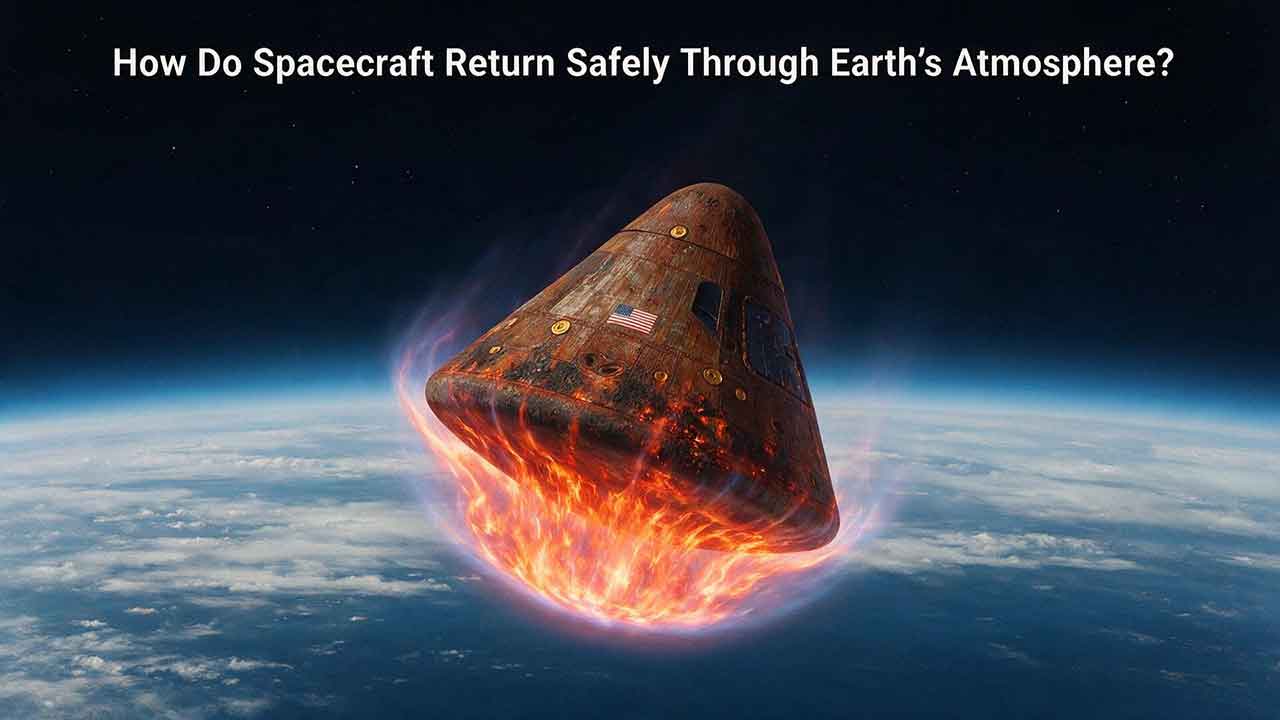
How Do Spacecraft Return Safely Through Earth’s Atmosphere?
Spacecraft return safely through Earth’s atmosphere by managing an enormous amount of energy through a carefully coordinated sequence of trajectory control, thermal protection, aerodynamic deceleration, landing, and recovery. This article explains how deorbit burns and entry corridors guide a spacecraft toward its landing region, why blunt heat shields reduce the danger of hypersonic heating, and how guidance systems control attitude, range, and structural loads. It includes an original comparison of low-Earth-orbit and lunar-return energy, a practical review of ablative and reusable heat-shield technologies, and the CosmoBasics Four-Layer Reentry Framework covering path, protection, control, descent, and recovery. Real-world lessons from Artemis I and the crewed Artemis II mission show why postflight inspection remains essential even after a successful splashdown. Readers will also learn how parachutes, wings, landing rockets, flotation systems, and recovery teams complete the return safely.
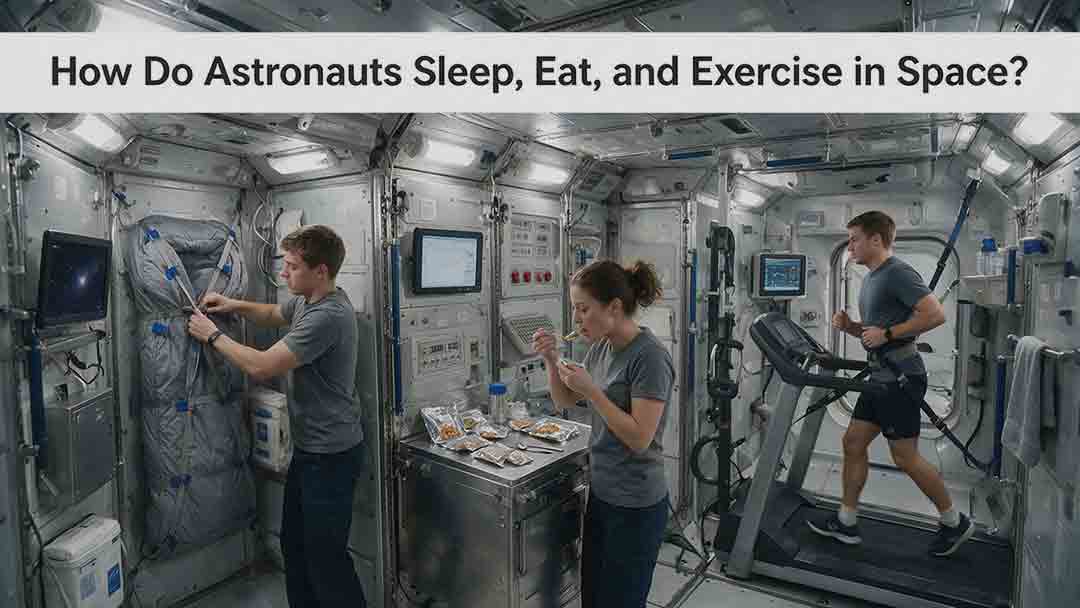
How Do Astronauts Sleep, Eat, and Exercise in Space?
Astronauts must redesign ordinary routines when they live in microgravity. This article explains how crew members sleep in secured bags inside ventilated quarters, prepare packaged meals without letting food or liquids drift through the cabin, and use specialized exercise equipment to protect their physical condition. It examines the roles of the Advanced Resistive Exercise Device, the T2 treadmill, and the CEVIS cycle ergometer, while clarifying the difference between active workout time and the full scheduled exercise period. Readers will also learn why tortillas are practical in space, how airflow affects sleep, why ordinary weights do not work normally in orbit, and how nutrition, rest, and exercise support one another. NASA and ESA sources provide the factual foundation, while original comparison tables and practical evaluation frameworks show how spacecraft systems replace functions normally supplied by gravity. The article also distinguishes current International Space Station practices from possible future Moon and Mars mission requirements.
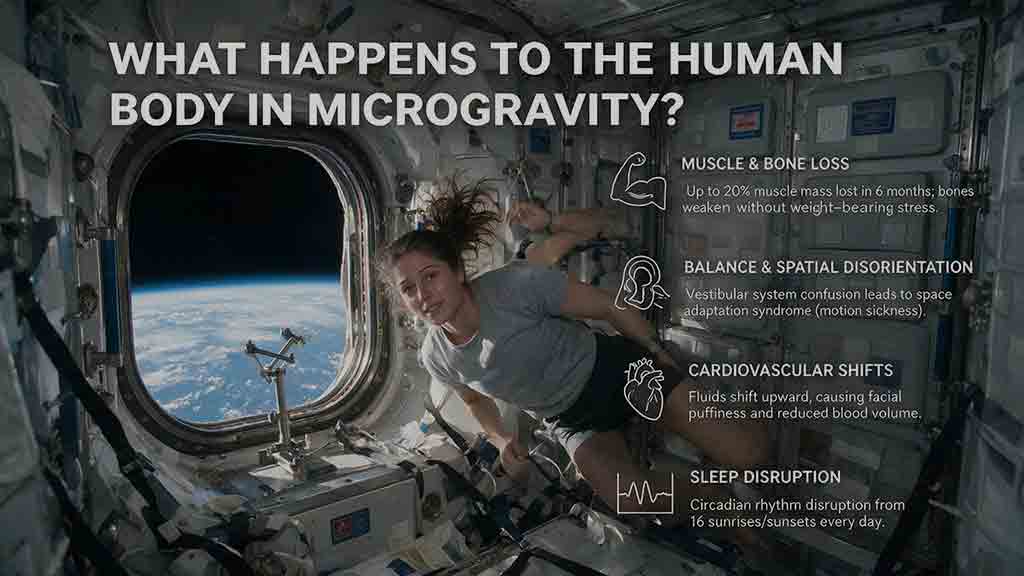
What Happens to the Human Body in Microgravity?
Microgravity changes the human body because fluids are no longer pulled toward the legs, muscles and bones receive less mechanical loading, and the brain loses gravity as a dependable orientation signal. This article explains how weightlessness affects balance, circulation, muscle strength, bone density, vision, blood, immunity, digestion, sleep, and spinal length. It also examines why astronauts may struggle to stand or walk after landing and how exercise, nutrition, monitoring, and rehabilitation help reduce these risks. Two original tools—the Load–Flow–Orientation Framework and the Gravity-Transition Readiness Matrix—connect physiological changes with real mission demands. Drawing on NASA standards, NASA technical reports, ESA materials, and peer-reviewed human spaceflight research, the guide clearly separates established observations from experimental countermeasures and unresolved questions. It also explains what these effects could mean for future missions to the Moon and Mars without treating population averages as predictions for individual astronauts.
Explore More Topics
How Are Space Missions Planned From Design to Launch?
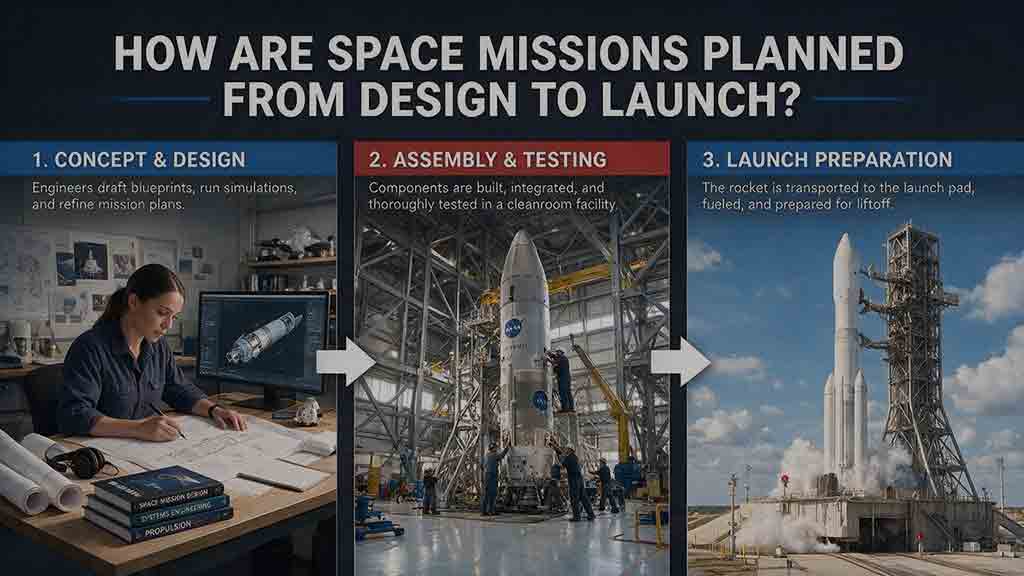
Space missions are planned by transforming a scientific, commercial, or exploration goal into a complete system that can be designed, built, tested, launched, operated, and responsibly concluded. This guide follows the full planning lifecycle, from defining measurable objectives and comparing mission concepts to writing requirements, selecting an architecture, managing resource budgets, and controlling interfaces. It explains how payloads, spacecraft platforms, trajectories, launch services, software, ground systems, regulations, and operations must be developed together. Readers will also learn how design reviews, fabrication, environmental testing, end-to-end verification, operator training, licensing, launch integration, and readiness assessments support mission development. Original planning frameworks, worked mass, power, and data calculations, troubleshooting guidance, and a practical checklist show how teams identify weak assumptions and resolve designs that do not close. The central lesson is that mission readiness depends on the entire technical and operational system—not merely on completing the spacecraft.
What Happens During a Rocket Launch Countdown?
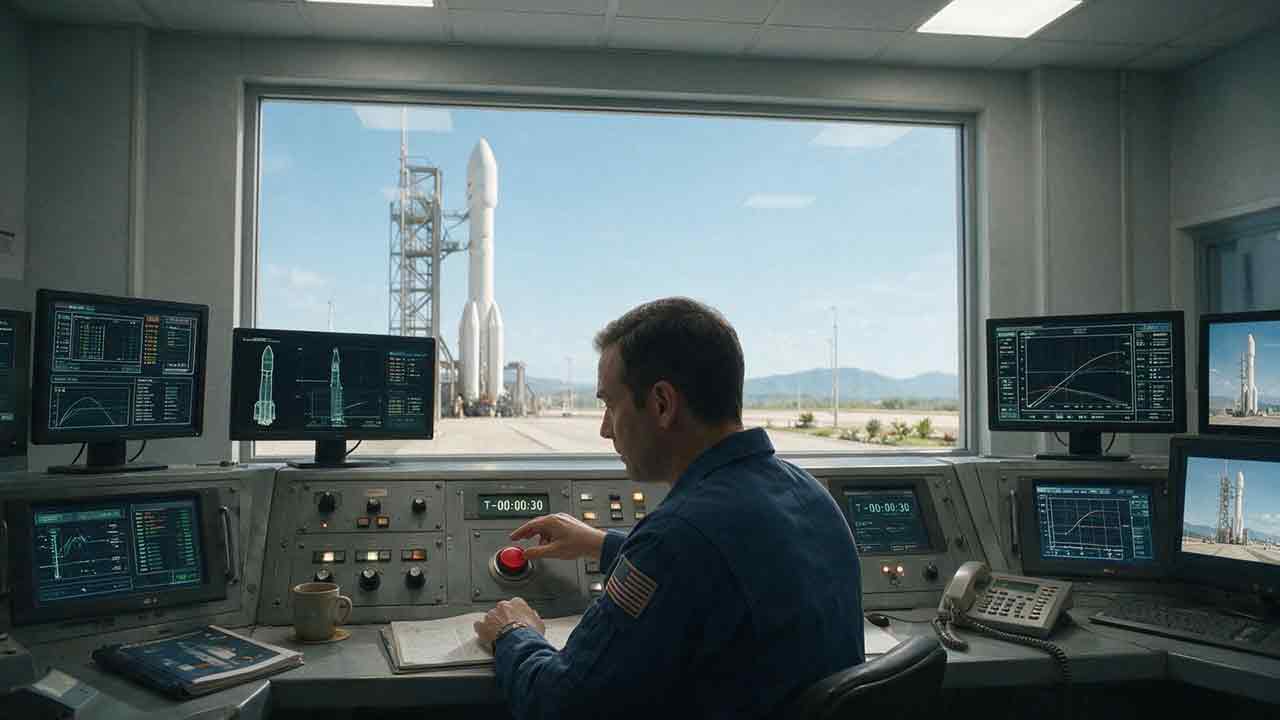
A rocket launch countdown is far more than a clock running toward zero. It is a carefully coordinated process that brings the launch vehicle, spacecraft, ground equipment, flight teams, weather conditions, and safety range into an approved configuration for liftoff. This article explains the major countdown phases, including launch-pad preparation, propellant loading, avionics and navigation checks, weather monitoring, range clearance, go/no-go polls, and terminal count. It also clarifies commonly misunderstood terms such as T-minus, L-minus, planned hold, recycle, scrub, and launch window. An original Four-C Countdown Framework—Clock, Configuration, Constraint, and Commitment—helps readers understand why teams may continue, pause, return to an earlier step, or cancel a launch attempt. Practical timelines, comparison tables, a launch-window calculation, and a viewer’s checklist make the article useful for students, educators, first-time launch viewers, and spaceflight enthusiasts.
How Do Spacecraft Dock in Orbit?
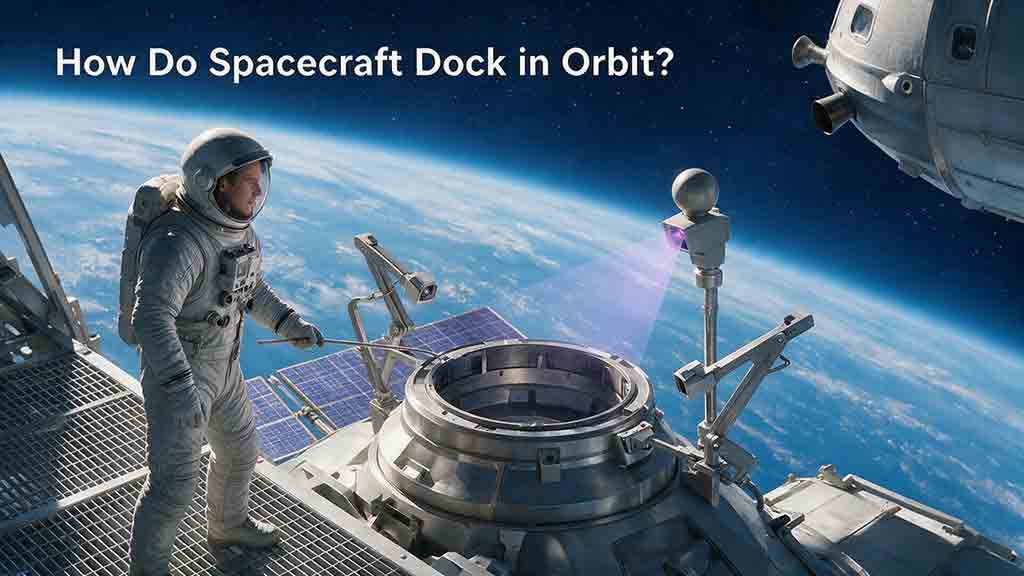
Spacecraft docking is a carefully controlled process that begins long before two vehicles make physical contact. The approaching spacecraft must first establish compatible orbital geometry, adjust its timing through phasing maneuvers, and reduce differences in position, velocity, and orientation. This guide explains the complete sequence from far-field rendezvous and relative navigation to hold points, final approach, soft capture, and hard capture. It also compares docking with robotic berthing, examines the sensors and control systems used during an approach, and shows how mission teams respond when navigation data, closing rates, or alignment fall outside permitted limits. A simplified orbital calculation demonstrates why a spacecraft in a slightly lower orbit can gradually catch its target. Readers will also find an original five-match framework, a practical docking-safety model, real mission examples, and a checklist for evaluating docking plans. The article clearly distinguishes educational principles from vehicle-specific flight procedures and engineering requirements.